
Running ads for a Shopify dropshipping store can be exciting and frustrating at the same time. You launch a campaign, watch the clicks roll in, and then wait for sales that do not always come as expected.
The truth is that ads are not the problem most of the time. What usually goes wrong is strategy. Profitable dropshipping ads are built on understanding people, not just platforms. When you know who you are targeting, how they think, and what they need to see before buying, ads stop feeling like a gamble and start becoming predictable.
This guide breaks down how to approach Shopify dropshipping marketing in a practical, realistic way. Whether you are running social media ads like Facebook ads, TikTok ads, or Google ads, these principles apply across the board. It’s not low cost, but it is effective way to get traffic to your Shopify store if you do it right.
Why Dropshipping Ads Fail for So Many Stores
Before getting into what works, it helps to understand why so many ads fail in the first place.
Many store owners jump straight into ads without clearly defining their audience. Others copy creatives they saw working for someone else without understanding why they worked. Some focus too much on traffic and not enough on what happens after the click.
Ads amplify what is already there. If your messaging is unclear or your store feels untrustworthy, ads simply send more people to experience those problems.
10 Amazingly Effective Strategies for Shopify Ads
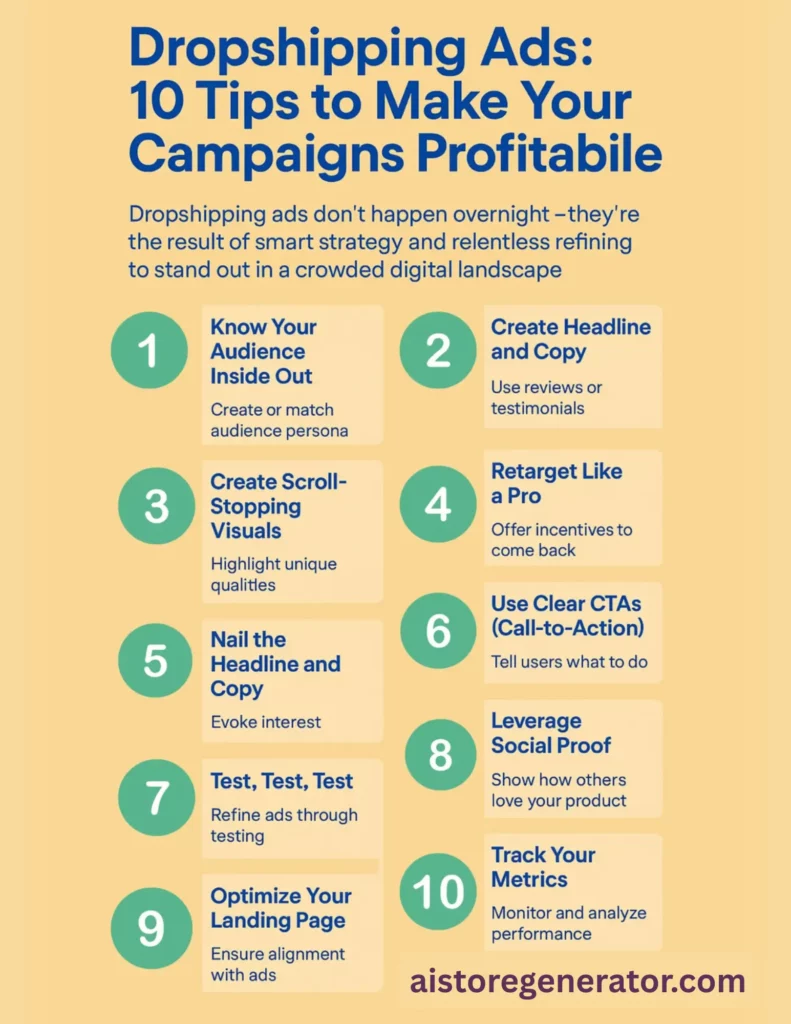
1. Know Your Audience Inside Out
Every successful ad starts with a clear understanding of who it is meant for. Selling to everyone rarely works, especially in dropshipping where competition is high.
Ask yourself simple questions. Who is most likely to buy this product? What problem are they trying to solve? What frustrates them about current solutions?
Use tools like Facebook Audience Insights and Google Analytics to look at age, location, interests, and online behavior. Over time, create buyer personas that describe your ideal customer in detail.
When you know your audience well, writing ad copy and choosing visuals becomes much easier. Your ads stop sounding generic and start feeling relevant.
2. Choose the Right Advertising Platforms
Not every platform works for every product, and forcing a product onto the wrong platform usually leads to wasted budget.
Facebook and Instagram work well for products that benefit from strong visuals and emotional appeal. They are also excellent for retargeting and building brand awareness. TikTok is ideal for products that look good in motion and appeal to trend-driven or younger audiences. Google Ads work best when people are actively searching for a solution, especially for problem-solving products. Pinterest can be powerful for home, beauty, fashion, and lifestyle niches.
Instead of trying to be everywhere, focus on the platforms where your audience already spends time. Master one or two before expanding.
3. Create Scroll-Stopping Visuals
Your creative is the first filter. If it does not grab attention, the rest of the ad does not matter.
People scroll fast, especially on social platforms. Your visuals need to stand out immediately. This does not mean they have to be expensive or overly polished. In fact, authentic content often performs better.
Short videos showing the product in use, before-and-after shots, or user-generated content usually outperform static images. Show the product solving a problem or fitting naturally into daily life.
The goal is to stop the scroll and earn the next few seconds of attention.
4. Write Headlines and Copy That Connect
Once you have attention, your copy needs to keep it.
Focus on benefits instead of features. People care less about what a product is made of and more about what it does for them. Address common frustrations or desires directly. Make the reader feel like you understand their situation.
Avoid overloading your copy. Clear, simple language works best. A strong opening line, followed by a few focused points, is often more effective than long explanations.
Urgency and scarcity can help, but only when used honestly. Overusing them can damage trust.
5. Use Social Proof to Reduce Doubt
Trust is one of the biggest barriers in dropshipping. Customers are often buying from a brand they have never heard of, which naturally creates hesitation.
Social proof helps bridge that gap. Reviews, testimonials, and user-generated content show that real people have already made the purchase and were happy with it.
Including customer photos, short quotes, or sales numbers in ads adds credibility. On landing pages, reviews reassure visitors that they are not taking a risk alone.
Even a small amount of honest social proof can significantly improve performance.
6. Retarget Interested Visitors the Right Way
Most people do not buy on their first visit, especially for products they have never seen before.
Retargeting allows you to stay in front of people who already showed interest by visiting your site or viewing products. These audiences are warmer and often cheaper to convert.
Effective retargeting ads focus on reassurance rather than selling harder. Remind visitors of the product, address common objections, and offer a small incentive when appropriate.
Done right, retargeting often delivers some of the highest returns in dropshipping ads.
7. Test Before You Scale
The most profitable ads are rarely the first ones launched. They are discovered through testing.
Test different creatives, audiences, and messaging to see what resonates. Compare video versus image ads. Test different hooks in the first few seconds. Try broad targeting alongside more specific interests.
Keep testing budgets small at first. Once you identify what works, increase spend gradually. This approach protects your budget and leads to more consistent results.
8. Use Clear and Direct Calls to Action
A surprising number of ads fail simply because they do not clearly tell people what to do.
Calls to action should be direct and easy to understand. Phrases like Shop Now, Claim Your Discount, or Order Today remove uncertainty and guide users toward the next step.
Your CTA should match the stage of the funnel. For cold traffic, focus on discovery. For retargeting, encourage action.
Clarity almost always beats creativity here.
9. Track the Metrics That Actually Matter
Clicks and impressions look good, but they do not tell the full story.
Focus on metrics that reflect real performance. Click-through rate shows how engaging your ad is. Cost per click tells you how efficiently you are spending. Conversion rate shows how well your site turns visitors into customers. ROAS shows overall profitability.
Use Facebook Ads Manager and Google Analytics to monitor performance and spot trends. Data removes guesswork and helps you make smarter decisions.
10. Optimize Your Landing Page to Match Your Ads
Even the best ad will fail if the landing page does not meet expectations.
Your landing page should feel like a natural continuation of the ad. If your ad promises a discount, show it clearly. If it focuses on a specific benefit, reinforce that benefit on the page.
Keep the design clean and focused. Highlight benefits clearly, include trust signals like reviews and secure payment icons, and make the checkout process simple. Mobile optimization is critical, as most dropshipping traffic comes from mobile devices.
Your goal is to remove doubt and make buying feel safe and easy.
Final Thoughts on Shopify Dropshipping Ads
Running profitable Shopify dropshipping ads is not about shortcuts or copying trends. It is about understanding your audience, communicating clearly, and constantly improving based on real feedback.
Ads are not just about selling products. They are about showing the right people that your product solves a real problem for them. When you combine strong creatives, thoughtful targeting, and ongoing optimization, ads become a powerful growth tool instead of a source of stress. Pair it with content marketing and conversion optimization to make the most of your marketing efforts.
Take a structured approach, test patiently, and scale what works. Over time, dropshipping ads become less about risk and more about predictable growth.