
You keep seeing the same claim on YouTube and Reddit: dropshipping is saturated, everyone is doing it, you missed the boat. Then you check the numbers and see people still starting stores every day. Something does not add up.
The truth sits somewhere in the middle. Parts of dropshipping are genuinely crowded. Other parts are wide open. The difference is not luck. It comes down to whether you know how to look at a niche and read the signals honestly before you spend a dollar.
The short answer
No, dropshipping is not saturated in 2026. The industry is projected to pass $500 billion in revenue by 2027 and continues to grow at roughly 22 to 24 percent per year.
What people mean when they say “saturated” is usually one of two things: a specific product category is crowded with identical stores, or paid ads for a specific keyword have become expensive. Both can be true without the whole model being broken.
If you are still asking whether dropshipping makes sense as a business, read is dropshipping profitable first. The margin math answers that question directly.
What “saturated” actually means
A saturated market has more sellers than the demand can support. Prices get squeezed to zero margin. New entrants cannot break in because established players own every corner.
Dropshipping does not match that description. Here is what is actually happening:
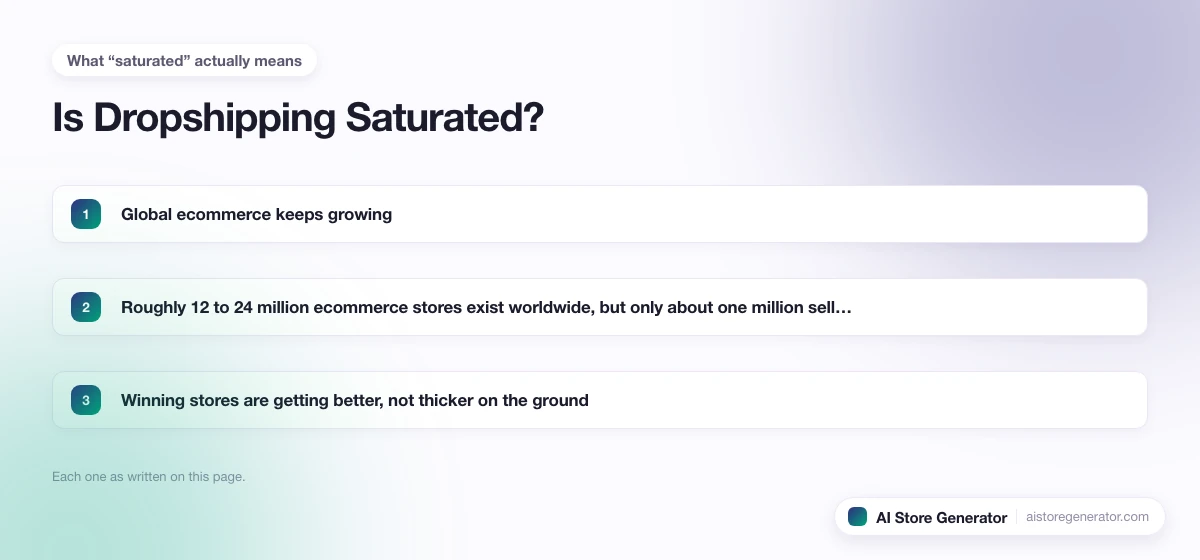
- Global ecommerce keeps growing. New customers come online every year, especially outside the US.
- Roughly 12 to 24 million ecommerce stores exist worldwide, but only about one million sell more than $1,000 per year. The market is full of dormant stores, not dominant ones.
- Winning stores are getting better, not thicker on the ground. The bar for a store that actually earns money has risen.
The confusion happens because the old dropshipping model is dead. Copying a viral TikTok product into a generic 5-page Shopify store and running Facebook ads at a 2x return does not work anymore. That version really is saturated. The version where you build a real store around a real audience is not.
The 5-question saturation test
Before you commit to any niche, run it through these five questions. If you answer yes to three or more, the slice is too crowded and you should adjust the angle or pick something else.
- Are the top 20 Google results all identical Shopify stores with the same product photos? If yes, the organic search side is crowded with copycats.
- Is the average Google Ads cost per click above $4 for your main keyword? That signals the paid side is already expensive.
- Are there more than 2,000 active Shopify stores selling the same product? You can check this with tools like MyIP.ms or the Shopify Theme Detector.
- Is the product an impulse buy under $30? Low-ticket items get commoditized fastest because everyone can afford to try them.
- Is the category already dominated by Amazon Basics or a major DTC brand? If yes, buyers default to those instead of searching.
A niche that gets four or five yeses is a warning. Two yeses is normal competition. Zero yeses probably means demand is too weak, which is a different problem.
For a full walkthrough of what makes a niche work, read the dropshipping niches guide and the breakdown of profitable dropshipping niches.
Paid saturation and organic saturation are different games
This is the split almost every “is dropshipping saturated” article misses.
Paid ad saturation looks like this: Facebook and TikTok CPMs are up, Google Ads CPC is above $3 for your keyword, and everyone is bidding on the same audiences. Your break-even math gets thinner every quarter. In this game, whoever has the biggest budget and best creatives wins. If you are trying to build a business by running ads on trending AliExpress products, yes, you are entering a saturated market.
Organic search saturation looks completely different. It measures how many quality pages Google has to choose from for a given query. Most niches still have wide open organic gaps. Most existing stores have three or four pages of content and no real SEO. A store with 30 well-written product and collection pages targeting real search intent can rank on Google in six to twelve months and pull in free traffic from that point forward.
You do not have to play the paid game to succeed. Most stores that succeed at scale eventually build organic traffic as their moat. If you want the mechanics, read how to get traffic to a Shopify dropshipping store.
Where AI Store Generator sits in this picture
Ten years ago, launching a Shopify store took weeks. Design, product research, product page copy, collection structure, and technical SEO all fell on the operator. Most people gave up before opening. The few who finished had unique-enough stores to stand out.
Today the barrier to opening a store is close to zero. That is why the low end feels saturated: anyone can launch a copycat in a weekend. What still takes effort, and what still separates winners from noise, is the quality of the store itself.
AI Store Generator was built for this problem. It generates a full Shopify store with 30 or more product pages, SEO-structured collections, and ready-to-rank informational pages in under five minutes. The difference from a manual store is not speed. It is that the store ships with the kind of on-page structure that Google rewards, so you enter the market with an organic search asset instead of an empty template.
That does not remove competition. It removes the setup work that used to eat your first month, so you can focus on picking a niche, testing products, and running the business.
Niches that are saturated vs niches that still work
A rough map. Not the last word, but a useful starting point.
Crowded and hard to break into:
- Generic phone accessories under $20
- LED lamps and rings marketed on TikTok in 2019 to 2022
- Cheap fitness gadgets sold on Facebook ads
- Copycat AliExpress fashion at $8 to $15 price points
- Generic pet products with no brand angle
Still open and often underserved:
- High-ticket home products in the $200 to $2,000 range (furniture, saunas, cabinets)
- Category-specific pet niches (senior dogs, working dogs, service animal gear)
- Hobby verticals with real communities (fly fishing, home coffee, model railroading)
- Aging-in-place products for the growing 65-plus market
- Professional gear for niche trades (barbers, tattoo artists, mobile detailers)
- Emerging category products where demand exists but branded competition has not caught up
If a niche feels wide open with no existing sellers, be careful. That usually means demand does not exist. The best niches have a few competitors doing well, which proves the market, and no dominant player, which leaves room.
For a list of shapes to avoid entirely, see dropshipping niches you should avoid.
How to compete when a niche looks crowded
Even in a crowded slice, most stores are doing the same three things badly. If you do those three things well, you separate from the pack.
- Product page depth. Most competitors have four sentences and three photos. Write real product descriptions that answer buying questions, add sizing details, include use cases, and post real photos or short videos. A 600-word product page outperforms a 60-word product page on both conversions and Google rankings.
- A tight audience angle. Instead of “dog products,” try “products for senior small-breed dogs.” Instead of “kitchen tools,” try “one-handed kitchen tools for people with arthritis.” A narrow audience defends against saturation because generic stores cannot serve them credibly.
- A real brand voice. Pick a stance. Write like a person. Answer emails within a day. Show your face on the about page. This costs nothing and it is what almost no saturated competitor is doing.
You do not need every advantage. One clear edge, applied consistently, beats a store that copies every trend it sees.
Common false signals people mistake for saturation
Most beginners who say “the market is saturated” are actually looking at one of these:
- First 30 days with no sales. Most stores need three to six months of iteration before they find product-market fit. Zero sales in month one is normal, not proof of saturation.
- Ads not converting on day one. New ad accounts need learning phase data. A cold audience rarely converts on the first impression. This is ad mechanics, not market conditions.
- Similar products already for sale. Competition proves demand. A market with zero competitors is usually a market with zero customers.
- YouTube saying “dropshipping is dead.” Every year a new wave of content creators posts this because it drives clicks. Look at their proof, not their headline.
- One influencer store dominating a category. One store is not saturation. That is a single competitor, and their weakness is usually customer service or SEO.
Learning to tell the difference between saturation and normal early-stage friction is one of the most useful skills you can build.
What to do next
If a niche you like passes the 5-question test with two or fewer yeses, the market is not saturated. What is saturated is the pool of half-built stores. Build a better one.
The fastest way to test whether an idea has legs is to get a real store online, load it with real product pages, and see what Google and shoppers do with it. That is exactly what start a dropshipping business on Shopify walks through step by step.
Frequently asked questions
Is dropshipping saturated in 2026? Not as a business model. Some product categories and paid ad keywords are crowded. Most niches still have plenty of organic search opportunity, especially outside low-ticket impulse products.
Is it too late to start dropshipping? No. The market is growing at roughly 22 to 24 percent per year. What has changed is that generic stores selling copycat AliExpress products no longer work. Stores with real product pages, a specific audience, and organic search traffic still succeed.
Which dropshipping niches are the most saturated? Generic phone accessories, cheap fitness gadgets, LED lights and rings, and copycat AliExpress fashion. These share three traits: low ticket, viral history, and no real brand differentiation possible.
Are there any dropshipping niches that are not saturated? Yes. High-ticket home goods, hobby verticals with real communities, aging-in-place products, professional gear for narrow trades, and category-specific pet niches all still have room. The niches guide has more.
How do I know if a specific niche is saturated before I start? Run the 5-question test above. Check for identical Shopify stores in the top Google results, Google Ads CPC above $4, more than 2,000 competing Shopify stores, dominance by Amazon or a major DTC brand, and a price point under $30. Three or more yeses is a warning.
Can I still make money dropshipping in a saturated niche? Sometimes. If you can offer clearly better product pages, faster shipping, a tighter audience angle, or a distinctive brand voice, yes. If you plan to compete on price with copycat products, no.