
Dropshipping sounds simple from the outside. You sell a product, someone else ships it, and you keep the profit. That is the basic idea, but the stores that actually work usually have more going on behind the scenes.
If you are thinking about starting a Shopify dropshipping store, this page is the starting point. It explains what dropshipping is, how the model works, what beginners usually get wrong, and where AI Store Generator fits into the process.
What Is Dropshipping?
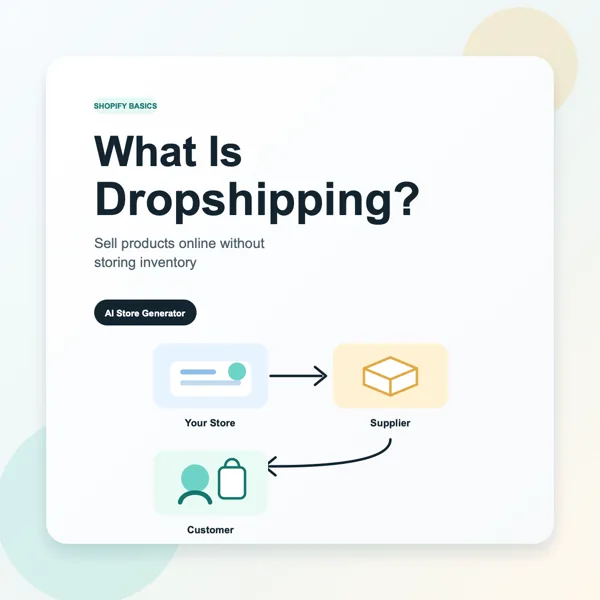
Dropshipping is an ecommerce model where you sell products online without keeping those products in stock yourself.
Instead of buying inventory upfront, storing boxes, packing orders, and shipping products from your own space, you work with suppliers. When a customer buys from your store, the order goes to the supplier. The supplier ships the product directly to the customer.
Your job is to build the store, choose the products, price them properly, bring in traffic, and give customers a reason to trust you.
That last part matters. Dropshipping is not just a shortcut around inventory. It is still a real ecommerce business. The store needs clear product pages, good branding, helpful content, strong policies, reliable suppliers, and a plan for getting visitors. For a more detailed breakdown of the model and what beginners typically get wrong, read What Is Dropshipping?
How Does Dropshipping Work?
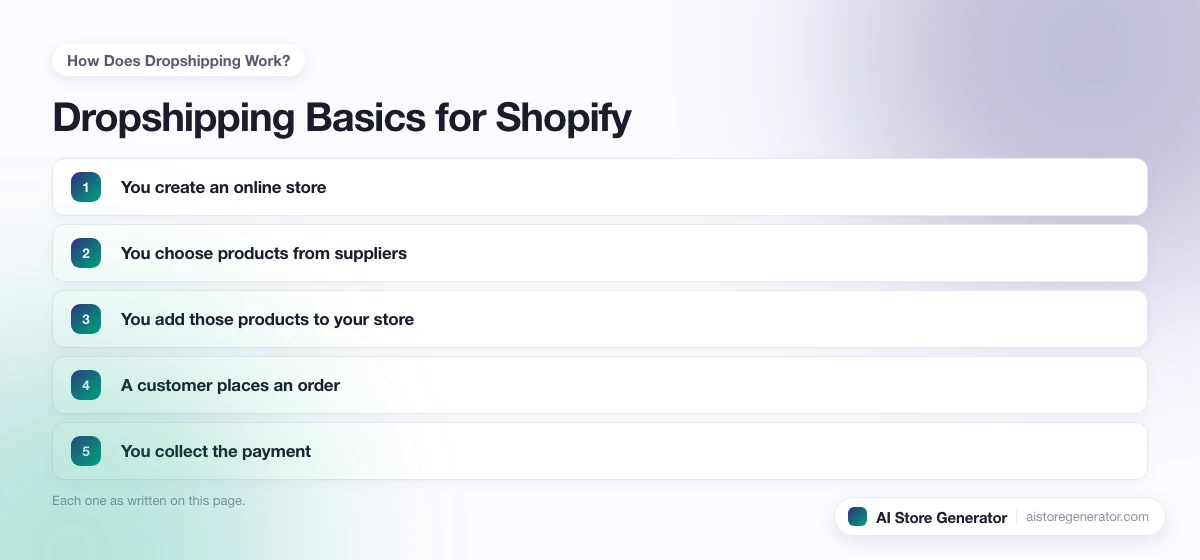
The basic dropshipping process looks like this:
- You create an online store.
- You choose products from suppliers.
- You add those products to your store.
- A customer places an order.
- You collect the payment.
- The supplier receives the order details.
- The supplier ships the product to the customer.
- You keep the difference between your retail price and your total costs.
On Shopify, this usually happens through apps and supplier integrations. Some store owners use large supplier marketplaces. Others work with niche suppliers, private agents, print-on-demand companies, or local fulfillment partners.
The model is flexible, but the goal is always the same: sell products without buying inventory before you know what people want.
Why Beginners Like Dropshipping
Dropshipping is popular with beginners because it lowers the first big barrier: inventory.
Traditional ecommerce usually means you need to buy products before you can sell them. That can mean hundreds or thousands of dollars spent before you know if customers want the product.
Dropshipping lets you test ideas faster. You can build a store, list products, and start learning what people respond to before committing to a warehouse full of stock.
That makes it attractive if you:
- Want to start a Shopify store without holding inventory
- Have a small budget
- Want to test a niche before going deeper
- Prefer working online instead of handling fulfillment
- Want to learn ecommerce without building every part manually
But low inventory risk does not mean no risk. You still need time, focus, and a store that does not look like it was thrown together in one afternoon.
What Beginners Usually Get Wrong
Most beginner dropshipping stores fail because the owner focuses only on products.
Products matter, of course. A weak product is hard to sell. But a strong product on a weak store is still a problem.
Common beginner mistakes include:
- Choosing random products with no clear niche
- Copying supplier descriptions instead of writing useful product copy
- Using a generic Shopify theme with thin pages
- Ignoring SEO until months later
- Running ads before the store looks trustworthy
- Pricing products without checking margins
- Forgetting shipping times, return policies, and customer questions
- Building a store with no blog, no internal links, and no real content structure
This is where the old dropshipping advice starts to fall apart. It is not enough to import products and hope ads save the store. Paid traffic can help, but it gets expensive fast when the site itself is not ready.
Why Shopify Is a Good Fit for Dropshipping
Shopify works well for dropshipping because it gives beginners the core ecommerce setup in one place.
You can manage products, collections, orders, payments, shipping settings, apps, discount codes, and store design from one dashboard. That makes Shopify easier than trying to build everything from scratch.
Shopify also supports dropshipping apps, print-on-demand apps, product review tools, email tools, and analytics tools. That gives store owners room to start small and improve over time.
The challenge is that Shopify does not automatically build a strong dropshipping store for you. A blank Shopify account still needs:
- A clear niche
- Products people want
- Product pages written for buyers and search engines
- Collection pages that target real category searches
- A homepage that explains the store quickly
- Trust signals and policies
- Mobile-friendly design
- Internal links
- Content that can bring organic traffic
That setup work is where many beginners get stuck.
Where AI Store Generator Fits
AI Store Generator was built for the part of dropshipping that slows people down before they ever launch.
Instead of starting with a blank Shopify store, you describe the kind of store you want. The tool builds a Shopify dropshipping store with products, pages, collections, and SEO structure already in place.
That matters because dropshipping stores need more than a nice homepage. They need a structure Google can understand and buyers can trust.
AI Store Generator helps with:
- Choosing a store direction
- Building product pages
- Creating ready-to-sell pages
- Setting up an SEO-first page structure
- Giving the store a clean Shopify design
- Reducing the setup time from days or weeks to minutes
You still own the business decisions. You still review the store, adjust anything you want, connect your Shopify account, and work on traffic. The difference is that you are not starting from zero.
Dropshipping Basics Every Beginner Should Know
Before you create a store, understand these core ideas.
Your Supplier Affects Your Brand
Customers buy from your store, not from your supplier. If shipping is slow, packaging is poor, or the product does not match the description, the customer blames you.
Choose suppliers carefully. Check shipping times, product quality, refund rules, communication, and whether the products match what your store promises.
Margins Matter More Than Revenue
A $50 sale does not mean you made $50.
You need to subtract the supplier cost, shipping, payment fees, Shopify costs, app costs, discounts, returns, and any ad spend. What is left is the real margin.
Beginners often price too low because they are afraid of scaring customers away. That can create a store that makes sales but does not make money.
Product Pages Need Real Copy
Supplier descriptions are usually not enough. Many are thin, awkward, or written for sellers instead of customers.
A good product page explains who the product is for, what problem it solves, why it is worth buying, how it works, and what the customer should expect.
That is also one reason SEO matters. Product pages should use the words people actually search for, not only the generic product name from a supplier feed.
Collections Are SEO Opportunities
Collections are not just navigation pages. They can target category-level searches.
For example, a pet niche store might need collection pages around dog owner gifts, cat accessories, puppy training products, or pet travel gear.
These pages help shoppers find the right products and help Google understand what the store is about.
Content Builds Trust
Many dropshipping stores feel thin because they only have products. No guides. No answers. No useful help.
Content changes that. Blog pages, buying guides, FAQs, comparison pages, and niche education can bring in search traffic and make the store feel more real.
This is why AI Store Generator focuses on SEO-first store structure instead of only design.
Is Dropshipping Easy?
Dropshipping is easy to start compared with traditional retail. It is not easy to win at without doing the basics properly.
The simple part is that you do not need to hold inventory. The harder part is building a store people trust, choosing products with real demand, pricing them correctly, and getting traffic without wasting money.
The best way to think about dropshipping is this:
- Easy to launch
- Harder to make profitable
- Much easier when the store starts with the right structure
That is the gap AI Store Generator is built to close.
The Dropshipping Readiness Check
Most beginner guides explain what dropshipping is. They do not tell you whether your store idea is ready to become a real Shopify store.
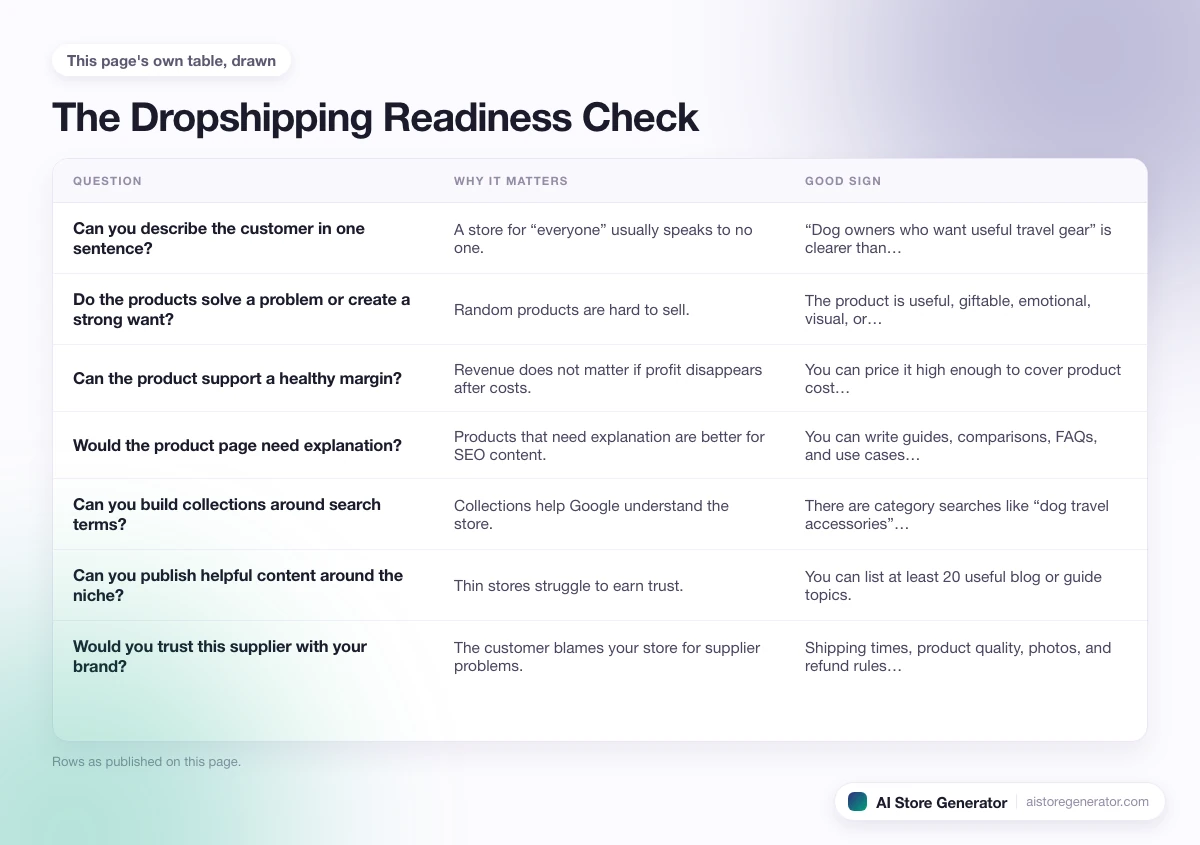
Before you launch, run your idea through this quick check:
| Question | Why it matters | Good sign |
|---|---|---|
| Can you describe the customer in one sentence? | A store for “everyone” usually speaks to no one. | “Dog owners who want useful travel gear” is clearer than “pet products.” |
| Do the products solve a problem or create a strong want? | Random products are hard to sell. | The product is useful, giftable, emotional, visual, or solves a repeat problem. |
| Can the product support a healthy margin? | Revenue does not matter if profit disappears after costs. | You can price it high enough to cover product cost, shipping, fees, returns, and marketing. |
| Would the product page need explanation? | Products that need explanation are better for SEO content. | You can write guides, comparisons, FAQs, and use cases around it. |
| Can you build collections around search terms? | Collections help Google understand the store. | There are category searches like “dog travel accessories” or “gifts for new dog owners.” |
| Can you publish helpful content around the niche? | Thin stores struggle to earn trust. | You can list at least 20 useful blog or guide topics. |
| Would you trust this supplier with your brand? | The customer blames your store for supplier problems. | Shipping times, product quality, photos, and refund rules are acceptable. |
If you cannot answer these yet, the idea is not dead. It just needs more work before you spend money driving traffic.
AI Store Generator helps once you have a direction. It gives you the store structure, product pages, collections, and SEO-ready foundation so you can review something real instead of trying to build every piece from scratch.
What Should You Learn Next?
If dropshipping still feels abstract, the what is dropshipping walkthrough covers the model in plain language, and how does dropshipping work shows the order-by-order mechanics. The two questions every beginner asks next are answered in is dropshipping profitable and is dropshipping legal. And if you keep hearing that the model is crowded, is dropshipping saturated covers what parts really are and what parts are not. If the concern on your mind is scams and legal exposure, is dropshipping safe walks through the five kinds of risk to check before you commit. For anyone confused about whether dropshipping is a separate business path from ecommerce, ecommerce vs dropshipping reframes the question and walks through the specific tradeoffs.
If you are weighing a specific product idea, what can you dropship breaks down which product categories work, which items are restricted, and how to tell the difference. If the word itself is what is tripping you up, what does dropship mean pulls apart the three places you will run into it and what each one is telling you. What counts as a dropship store is still getting its own dedicated walkthrough.
For now, if you already know you want to build a Shopify dropshipping store, start with the main AI Dropshipping Store Builder page. If you want the store launch process explained in more detail, read Start a Dropshipping Business on Shopify.
Build the Store Before You Overthink It
It is easy to spend weeks reading about dropshipping and still have no store.
Learning matters, but at some point you need something real to review. A store structure. Product pages. Collections. A homepage. A direction.
AI Store Generator gives you that starting point in minutes. You can see the store, adjust it, connect Shopify, and start working on traffic instead of getting stuck at the setup stage.
If you are ready to move from research to action, build your Shopify dropshipping store with AI Store Generator today.
FAQ
What is dropshipping in simple terms?
Dropshipping is a way to sell products online without keeping inventory yourself. A customer buys from your store, then your supplier ships the product directly to that customer.
How does dropshipping work on Shopify?
On Shopify, you create a store, add products from suppliers, and accept customer orders. When an order comes in, the supplier handles fulfillment while you manage the store, pricing, customer experience, and marketing.
Is dropshipping good for beginners?
Dropshipping can be good for beginners because it lowers inventory risk. It still requires a trustworthy store, careful product choices, realistic pricing, and a plan for traffic.
Do I need inventory to start dropshipping?
No. The main point of dropshipping is that you do not buy inventory upfront. Your supplier stores and ships the product after a customer orders from your store.
Can AI build a dropshipping store for me?
Yes. AI Store Generator can build a Shopify dropshipping store with products, pages, collections, and SEO structure already set up. You still review the store and run the business, but you do not have to start from a blank Shopify account.