
A good dropshipping supplier is the difference between a Shopify store that runs smoothly and one that turns into a slow grind of late shipping, refund emails, and damaged stock. Suppliers handle the parts of your business the customer judges you on. Picking the wrong one is the most expensive mistake a beginner can make.
This page explains who dropshipping suppliers are, the main types you can work with, what to actually check before signing up, the questions worth asking before your first order, and how to set up your store so the supplier choice is easier to live with later.
Short Answer
Dropshipping suppliers are the companies that store the products and ship them to your customers when an order comes in. You sell on Shopify; they fulfill in the background. The four main types are marketplace suppliers (AliExpress, DSers, CJDropshipping), dedicated supplier networks (Spocket, Modalyst, Doba), private agents in China or local fulfillment partners, and brand-direct suppliers you contact yourself. Each type trades off price, shipping speed, product range, and how much support you get.
What a Dropshipping Supplier Actually Does
A supplier sits behind your Shopify store doing the physical work you would otherwise do yourself. When a customer buys a product, the order details flow to the supplier. The supplier picks the product from their warehouse, packs it, and ships it directly to the customer. The customer never sees the supplier’s name or address.
Your job is the storefront, the marketing, the pricing, and the customer relationship. Their job is the inventory, packing, and shipping. The handoff is silent, which is also why a bad supplier hurts so much: a slow shipment or a damaged box becomes a complaint on your store, not theirs.
The Main Types of Dropshipping Suppliers
Most beginner stores use one of four supplier categories. Each has its place.
- Marketplace suppliers. The most common starting point. Apps like DSers, CJDropshipping, and Zendrop pull products from huge marketplaces (mostly AliExpress) and sync them to your Shopify store. Cheap, enormous catalog, easy to install, but shipping times are usually slower and quality varies wildly between sellers.
- Dedicated supplier networks. Apps like Spocket, Modalyst, and Doba curate suppliers and surface ones based in the US, EU, or other regions with faster shipping. Smaller catalogs, higher product cost, faster delivery, more consistent quality.
- Private agents and local fulfillment partners. Once a store has steady orders, many owners switch to a private agent in China who sources, ships, and handles quality control directly. Agents quote per product, can negotiate factory pricing, and often store inventory on your behalf. Higher trust required, much better margins.
- Brand-direct suppliers. Reach out to brands or manufacturers and ask if they offer dropshipping or wholesale. Many do not advertise it. This is slower to set up but creates a real supply relationship and lets you sell branded products properly.
There is also print-on-demand, which is a sub-type of dropshipping where a supplier prints a custom design on a blank product and ships it. The fulfillment model is the same.
What to Check Before Choosing a Supplier
Most beginners pick a supplier based on which app is easiest to install. The better filter is what the customer will actually experience.
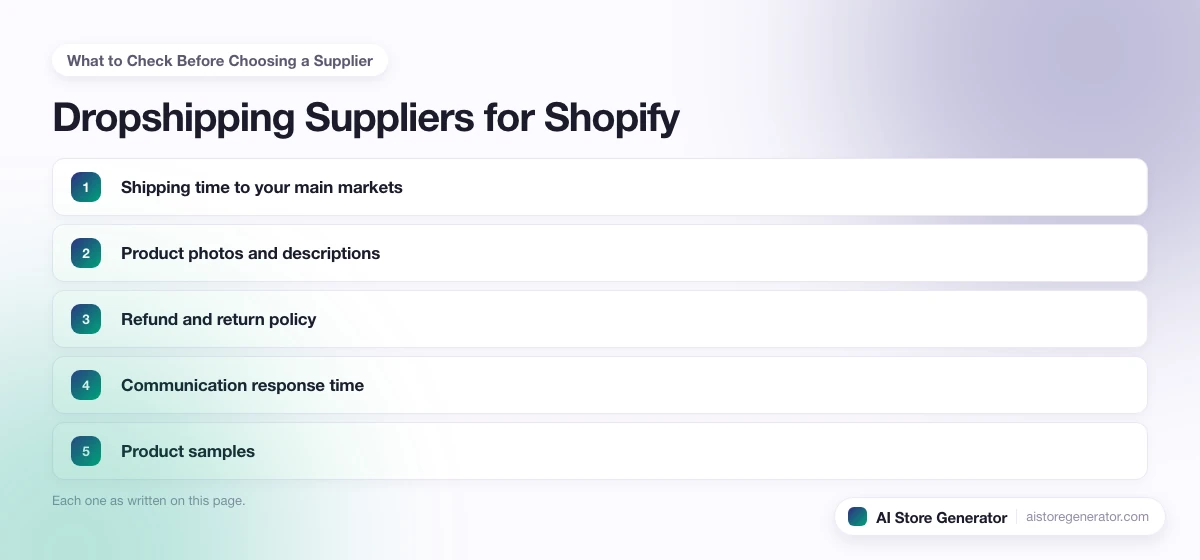
Before committing to any supplier, check:
- Shipping time to your main markets. Estimates of seven to thirty days are common with overseas suppliers. Anything quoted as “20-60 days” is a problem for paid traffic.
- Product photos and descriptions. If they look poor on the supplier feed, they will look poor on your store. Plan to rewrite copy and re-shoot or restyle photos.
- Refund and return policy. Who pays for returns? Where do returned products go? Some suppliers do not accept returns at all.
- Communication response time. Send a question before you place an order. If the reply takes a week, the same will happen when a customer needs help.
- Product samples. Order at least one sample. You will spot quality issues, packaging problems, and shipping speed in a single test order that would otherwise hit a paying customer.
- Stock reliability. Can you check live stock levels through the app or the supplier’s site? Out-of-stock orders mid-launch are brutal.
- Branding options. Some suppliers will add a small thank-you card, custom packaging, or your logo on the package. Those small touches build a brand that does not look generic.
- Payment terms and currency. Confirm what payment methods, currencies, and processing fees apply.
Treat this as a checklist, not a rough guide. Stores that skip it are guessing.
Where AI Store Generator Fits
Picking a supplier and importing 200 products into a blank Shopify store is the moment most beginners stall. The store has products but it does not look like a store. No collections, no copy, no proper structure.
AI Store Generator builds the storefront for you with products, product pages, collections, and an SEO-first structure already in place. You decide on the niche and the supplier model. The tool handles the setup work that would otherwise take weeks, so the supplier you pick lands on a real-looking store from day one instead of a blank Shopify account.
The supplier still matters. The store still matters. AI Store Generator removes the part where the store does not exist yet.
Common Supplier Mistakes Beginners Make
The supplier-related mistakes that wreck new dropshipping stores are predictable. Knowing them upfront is the cheapest fix you will ever make.
- Skipping a sample order. Trusting product photos and supplier ratings instead of touching the product yourself.
- Choosing one supplier for everything. Mixed shipping speeds confuse customers. Try to keep a category in one supplier whenever you can.
- Ignoring the supplier’s policies on branded products. Selling counterfeit or trademark-violating items is the fastest way to get a Shopify store shut down.
- Picking the cheapest supplier for a flagship product. A flagship product needs the most reliable supplier you can find, even at a higher cost.
- Failing to plan for refunds and chargebacks. Customers will return products. Knowing in advance who pays and where returns ship to prevents panic later.
- Overloading the store with imported products. A focused 20-50 SKU store usually outperforms a 500-SKU store full of supplier feed dumps.
- Not telling the supplier your store is dropshipping. Some marketplaces require a flag for dropshipping orders so the supplier omits invoices or branding from the package.
A Quick Supplier Comparison
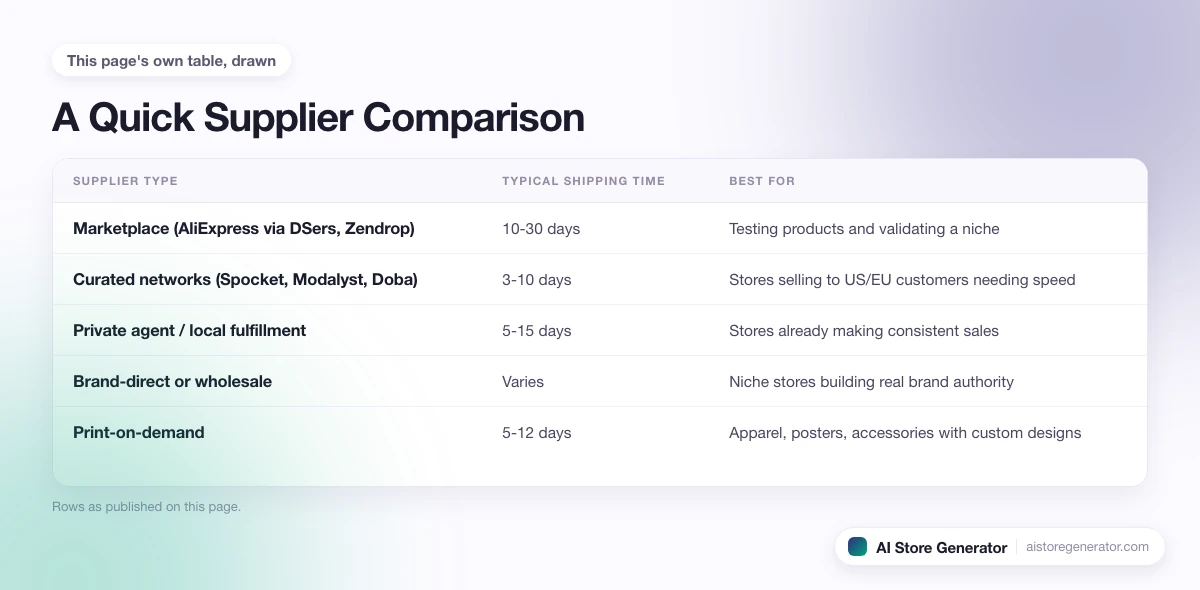
This is a simplified view to help frame the choice. Real suppliers vary inside each row.
| Supplier type | Typical shipping time | Product cost | Setup speed | Best for |
|---|---|---|---|---|
| Marketplace (AliExpress via DSers, Zendrop) | 10-30 days | Lowest | Fastest | Testing products and validating a niche |
| Curated networks (Spocket, Modalyst, Doba) | 3-10 days | Medium-high | Fast | Stores selling to US/EU customers needing speed |
| Private agent / local fulfillment | 5-15 days | Medium | Slowest | Stores already making consistent sales |
| Brand-direct or wholesale | Varies | Varies | Slowest | Niche stores building real brand authority |
| Print-on-demand | 5-12 days | Medium | Fast | Apparel, posters, accessories with custom designs |
Use marketplace suppliers to learn the market. Switch to faster or higher-quality suppliers once you know which products are working.
Questions Worth Asking Every New Supplier
Before you publish a product to your store, send the supplier these questions and use their replies as part of the decision. Suppliers that ignore questions or take a week to reply will do the same when a customer issue arrives.
- What is the average shipping time to my main customer countries?
- Which carrier do you use? Is tracking provided?
- What happens if a product arrives damaged or missing?
- Do you offer custom packaging, inserts, or no-supplier-branding shipping?
- What is the live stock situation for the items I want to sell?
- Do you accept returns and where do they ship to?
- Do you charge a per-order fee, monthly fee, or only product cost plus shipping?
- Are there any restrictions on which products I can sell with you (branded, restricted, regulated)?
Ask these in writing. Save the replies. They become the basis of your store’s shipping and returns policies.
Setting Up Suppliers Inside Shopify
After choosing a supplier, the Shopify side of the work usually involves four moves:
- Install the supplier’s Shopify app or connect via an order-syncing service.
- Import a small set of products. Resist importing the full catalog.
- Rewrite product titles and descriptions in your own voice. Supplier-feed copy will not convert paid traffic.
- Update your shipping policy, returns policy, and FAQ to match what the supplier actually does.
If the storefront, collections, and product pages are already in place, this step takes minutes per product. If you are still trying to build the store from scratch, supplier setup happens on top of half-finished pages and feels much harder than it should.
For the broader beginner picture before drilling into suppliers, the Dropshipping Basics for Shopify guide explains the whole model. If you are ready to launch, the Start a Dropshipping Business on Shopify guide walks through the launch process. For theme choice once your supplier is sorted, see the Best Shopify Theme for Dropshipping guide.
The deeper how-to-find guide walks the actual search-and-vet workflow: where to find candidates, how to spot a middleman pretending to be a factory, the scam checks that take 10 minutes, and an outreach template that gets a reply. How to find dropshipping suppliers covers the whole process step by step. The AliExpress-specific walkthrough is in dropshipping with AliExpress, which covers the DSers workflow, the real margin math after every fee, seller vetting beyond a rating percentage, dispute handling when an order goes wrong, and the cases where AliExpress is the wrong supplier choice. The how to use Alibaba for dropshipping walkthrough covers the three operating models the platform supports, the trading-company-versus-factory tests, MOQ negotiation, Trade Assurance, and the landed-cost math that decides whether sourcing direct from Chinese factories actually beats AliExpress on margin. A walkthrough on finding dropshipping suppliers in the USA goes deeper into spotting real US suppliers, vetting them with the 24-hour test, and handling the sales tax side. Guides on Amazon dropshipping and China-based supplier sourcing are still on the way.
Build the Store First, Then Pick the Supplier
Most beginners spend weeks comparing suppliers before they have a store to put the products on. That is backwards. Without a real store, a supplier is just a list of products with no context.
Use AI Store Generator to build the store, products, and pages. Pick a supplier model that matches your timeline and budget. Then test, learn, and switch supplier types as the store grows. Once orders start landing, Shopify dropshipping operations covers the day-to-day work, and Shopify dropshipping strategy covers the longer-term growth questions.
FAQ
What are dropshipping suppliers?
Dropshipping suppliers are the companies that hold the inventory and ship products directly to your customers. You sell on Shopify, the supplier ships from their warehouse, and the customer never sees the supplier’s name on the package.
How do I find dropshipping suppliers for my Shopify store?
Most beginners start with marketplace apps like DSers, Zendrop, or CJDropshipping that connect to AliExpress. Faster shipping usually requires curated supplier apps like Spocket or Modalyst, a private agent in China, or a direct relationship with a brand or manufacturer.
Are AliExpress suppliers safe for dropshipping?
AliExpress suppliers are widely used, but quality varies a lot between sellers. Always order a sample, check supplier ratings and order history, and avoid sellers with vague shipping estimates or no responsive communication.
Where can I find dropshipping suppliers in the USA?
US-based suppliers usually live inside curated networks like Spocket, Modalyst, and SaleHoo, or are found by contacting US wholesalers, brands, and manufacturers directly. The full guide on finding USA dropshipping suppliers covers the difference between real US warehouses and relabeled Chinese 3PLs, plus the vetting checklist. US suppliers cost more per product but ship in three to seven days, which is a major advantage when running paid ads.
Do I need to pay dropshipping suppliers upfront?
Most dropshipping suppliers are paid per order, not upfront. The customer pays you, and you pay the supplier the product cost plus shipping when the order is placed. Some supplier apps and networks have a small monthly fee on top.
How do I contact a dropship supplier?
Email or use the supplier’s contact form. Introduce yourself, explain that you run a Shopify store, list the products you are interested in, and ask the practical questions: shipping times, return policy, fees, and whether they support dropshipping orders. Keep it short and professional. For copy-paste email templates and phone scripts by supplier type, see how to contact dropship suppliers.
Can I dropship branded products on Shopify?
Reselling branded products without permission is risky and often illegal. Many suppliers offer generic equivalents that are fine to sell. To sell branded products legitimately, you usually need a wholesale or distribution agreement directly with the brand.
What is the best dropshipping supplier for beginners?
For beginners, a marketplace app like DSers is the fastest way to start. It is free to install, syncs orders automatically, and gives you access to a huge product range. Switch to faster or higher-quality suppliers once you know which products customers actually want.
How does AI Store Generator help with dropshipping suppliers?
AI Store Generator builds the Shopify storefront, products, product pages, and collections for you. The supplier still handles fulfillment, but instead of importing products into a blank store, you import them into a finished one. That removes the setup work that usually slows beginners down.