
Most dropshipping advice is written for absolute beginners. After the first ten or hundred orders, the questions change. Should the store stay generic or go branded? Is the margin ceiling really $10,000 a month, or higher? When does it make sense to switch from a marketplace supplier to a private agent? When does a course actually help, and when is it just expensive theory?
This page covers the strategic side of running a Shopify dropshipping store. It is not a launch walkthrough. It is the next set of decisions once the store is real and the basics are working.
Short Answer
A real dropshipping strategy comes down to four decisions: how branded the store should be, where margin will come from in the long run, which supplier model supports that margin at higher volumes, and what the store should look like in two years. Most stores that stall make these decisions by accident. The ones that grow make them on purpose.
When Strategy Actually Starts Mattering
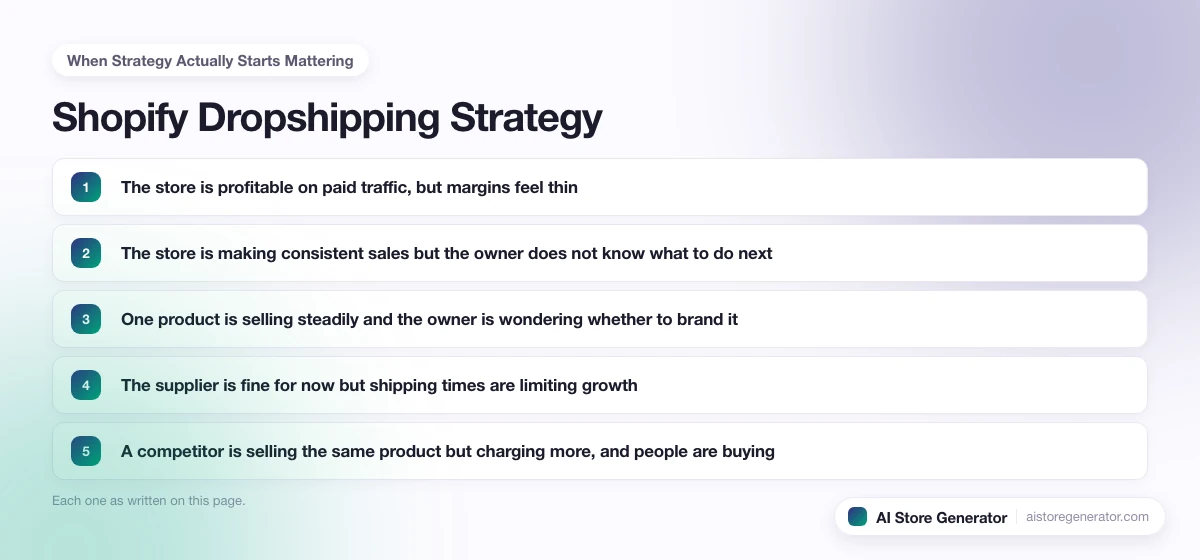
Strategy questions do not usefully apply on day one. On day one, the answer is to build a real store, pick a niche, choose a supplier, and start sending traffic. Strategy starts mattering somewhere around the moment one of these is true:
- The store is profitable on paid traffic, but margins feel thin.
- The store is making consistent sales but the owner does not know what to do next.
- One product is selling steadily and the owner is wondering whether to brand it.
- The supplier is fine for now but shipping times are limiting growth.
- A competitor is selling the same product but charging more, and people are buying.
At any of those points, the cheap-and-fast approach that worked for launch starts to hold the store back.
Generic vs Branded Dropshipping
The biggest strategic decision is whether the store stays generic or becomes a brand.
Generic dropshipping is the standard beginner model. Sell trending products from a marketplace supplier under a clean store, focus on ads, accept that the products are also sold by hundreds of others, and try to win on store experience and pricing. Cheap to run, easy to switch products, hard to defend.
Branded dropshipping treats the store as a real brand even if the supplier ships generic products. Custom packaging, custom branded inserts, a focused niche, original product copy, real photos, and a story that connects the products. Slower to build, harder to start, much harder for competitors to copy.
The middle ground is white label dropshipping, where the same supplier product gets shipped with your store’s branding on the packaging or the product itself. Most overseas suppliers will quote this once order volume is steady.
Most stores that scale past beginner revenue have moved from generic to white label or branded by month six.
How to Build a Branded Dropshipping Store
Branding does not require huge upfront money. It requires consistent decisions.
- Pick a customer, not a product. A store for “dog owners who travel” can hold dozens of related products. A store for “anti-bark collars” cannot.
- Pick a name and look that fit the customer. Plain text logos and a clean color palette are fine. Custom illustration is not required at the start.
- Write product copy as the brand, not as the supplier. The supplier feed describes the product. Your copy explains who it is for and why they would care.
- Use real photos where possible. Order samples, take simple lifestyle photos, and replace the supplier images. Even basic phone photos beat generic supplier shots.
- Add a story page. A short “about” with a real reason the store exists. Not corporate copy, just a clear voice.
- Match the post-purchase experience. Branded tracking emails, a thank-you note in the packaging if the supplier supports it, a follow-up email asking how the product worked.
- Build content around the customer. Guides, comparisons, and answers that the customer searches for. This is where organic traffic compounds over years.
None of these are expensive. They are just deliberate.
Realistic Income Targets for Shopify Dropshipping
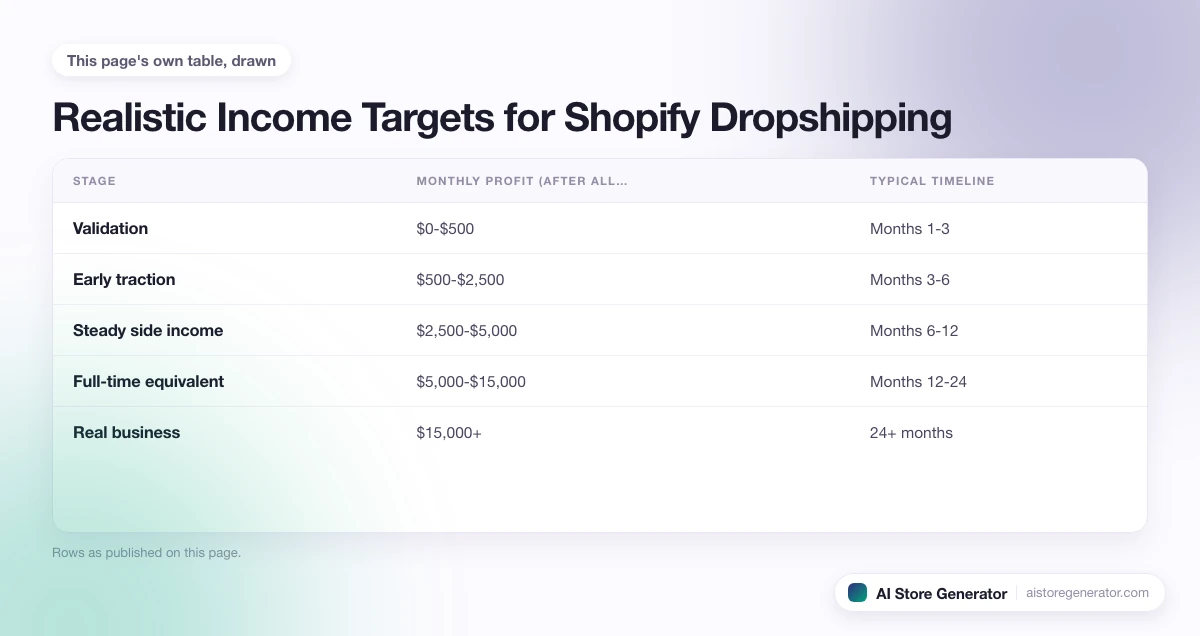
Income claims in the dropshipping space are mostly nonsense. The realistic numbers are still good, just less dramatic.
| Stage | Monthly profit (after all costs) | Typical timeline | What it usually takes |
|---|---|---|---|
| Validation | $0-$500 | Months 1-3 | A working store, basic ads or content, first sales |
| Early traction | $500-$2,500 | Months 3-6 | A repeatable winning product, controlled ad spend |
| Steady side income | $2,500-$5,000 | Months 6-12 | A small product line, organic traffic starting to compound |
| Full-time equivalent | $5,000-$15,000 | Months 12-24 | Branded store, healthy margins, multiple traffic channels |
| Real business | $15,000+ | 24+ months | Brand, audience, repeat customers, sometimes a small team |
The number that matters is profit after all costs, not revenue. A store doing $50,000 in monthly revenue with 5% margin makes less than a store doing $10,000 in monthly revenue with 30% margin.
Sourcing Strategy as You Scale
Sourcing usually goes through three phases.
- Marketplace apps. Easy, cheap, slow shipping. Right for validation. Wrong for scale.
- Curated supplier networks. US/EU warehouses, faster shipping, smaller catalogs. Right for the transition from generic to white label.
- Private agent or brand-direct. Custom packaging, factory pricing, quality control. Right once orders are steady and the store is committed to one or two product lines.
Switching too early wastes the bargaining power that volume creates. Switching too late means staying stuck with slow shipping and tight margins long after the store could afford to fix that. If most of your customers are American, one fix is sourcing from dropshipping suppliers in the USA that cut delivery to a few days.
The signal to upgrade sourcing is usually a steady week of 20+ orders for a single product. That is enough volume to ask a supplier for custom packaging or a small reserved inventory arrangement.
Reverse Dropshipping and Other Niche Models
A few less-talked-about models that occasionally fit a specific store:
- Reverse dropshipping: sourcing high-quality products from a country with strong manufacturing reputation (often US, EU, Japan, Korea) and selling into markets where those products are seen as premium imports. Lower volume, higher margin, brand-driven.
- Local-only dropshipping: pick suppliers based in the same country as the target customer to guarantee fast shipping. Smaller catalog, much better customer experience.
- High-ticket dropshipping: sell items $300+ where one sale per day funds the store. Higher trust requirement, much lower ad cost per dollar of revenue.
- Subscription / refill dropshipping: sell a consumable product (skincare refill, pet treats, supplement) with a subscription on top. Very different unit economics, much harder to build but much more valuable when it works.
None of these are required. They are options to consider once a store has data and the owner can see which direction has room to grow.
Where AI Store Generator Fits in a Real Strategy
Strategy works on top of structure. A branded store, a high-ticket positioning, or a content-driven traffic plan all assume the store has product pages that read well, collection pages that target real searches, and a homepage that earns trust in five seconds. Without that structural layer, strategy becomes hopeful marketing.
AI Store Generator builds that structural layer in minutes. Product pages, collections, ready-to-sell pages, and an SEO-first layout are in place from day one. The strategic decisions above (branding, sourcing, income targets) all start from a real store instead of from a blank Shopify account.
This is the difference between strategy that compounds and strategy that lives in a notebook.
Common Strategic Mistakes
Stores that stall around month six tend to make the same kinds of strategy mistakes:
- Staying generic past the point where branding would have paid for itself.
- Chasing trending products instead of building a niche customers come back to.
- Pricing for volume when the unit economics need pricing for margin.
- Switching sourcing too late, then losing customers to faster competitors.
- Treating an information course as a substitute for actually building.
- Ignoring organic traffic because it takes longer than ads.
- Adding products faster than the store can support them.
None of these are dramatic failures. They are quiet drag, and over six months they add up to a store that should be growing but is not.
A Two-Year View
Most successful Shopify dropshipping stores look like this two years in:
- One clear customer profile and a niche the owner can describe in a sentence.
- 20-100 products, not 500.
- White label or branded packaging on the top sellers.
- One or two reliable suppliers, not ten.
- Real margins of 25 to 45 percent on the core catalog.
- A mix of paid and organic traffic so the store does not collapse if one channel changes.
- An email list that produces a meaningful share of revenue.
This is the shape to aim for. Not every decision needs to head there immediately, but every decision should at least not move the store away from it.
For the broader beginner picture, the Dropshipping Basics for Shopify guide explains the model itself. If the store is not live yet, the Start a Dropshipping Business on Shopify guide walks through the launch process. For choosing the right supplier, which determines most of the strategic outcomes above, read Dropshipping Suppliers for Shopify. And once the store is live, Shopify Dropshipping Operations covers the day-to-day work that strategy builds on top of.
When you are ready to stop planning and see a real store, AI Store Generator builds the Shopify dropshipping foundation in minutes so the strategic decisions above have somewhere real to start.
FAQ
What is a good Shopify dropshipping strategy for beginners?
The simplest strategy that works: pick one clear customer, choose a niche you can describe in a sentence, build a clean store with real product pages, start with one traffic channel, and review margins weekly. Move from generic to branded as soon as one product is selling steadily.
What is branded dropshipping?
Branded dropshipping treats the store as a real brand instead of a generic catalog. The supplier may still be a third party, but the packaging, copy, photos, and post-purchase experience all carry your store’s identity. It is harder to start than generic dropshipping and much harder for competitors to copy.
What is white label dropshipping?
White label dropshipping is the middle ground between generic and branded. The supplier ships the same standard product but with your store’s name and packaging applied. Most overseas suppliers will quote this once order volume is steady, and it is usually the first real branding step a growing store takes.
What is reverse dropshipping?
Reverse dropshipping sources products from a country with strong manufacturing reputation (often US, EU, Japan, Korea) and sells into markets where those products are seen as premium imports. Lower volume than mass-market dropshipping, higher margins, and the model depends on the brand association rather than the cheapest possible product.
How much money can you actually make with Shopify dropshipping?
Realistic profit (after all costs) tends to land around $500-$2,500 monthly by month six, $2,500-$5,000 by month twelve for stores that build properly, and $5,000-$15,000+ by month two if the store goes branded and adds organic traffic. Anything quoted as “$10,000 in 30 days” is almost always cherry-picked or revenue (not profit).
Is Shopify dropshipping still worth it?
Shopify dropshipping is still worth it for store owners willing to treat it as a real business. The generic-store-running-aliexpress-ads version is mostly saturated. The branded-store-with-real-products version still produces strong businesses, especially when paired with a clear niche and an SEO-friendly store structure.
Do I need a Shopify dropshipping course?
Usually no. The vast majority of useful information is free across guides, supplier docs, and Shopify’s own help center. Courses can save time if they teach a specific skill (advanced ad optimization, a particular sourcing relationship) but most general “how to start dropshipping” courses are repackaging public information.
When should I switch from a marketplace supplier to a private agent?
When one product is selling 20+ orders a week steadily, the volume justifies asking a private agent for custom packaging, faster shipping, or factory-direct pricing. Switching earlier wastes the bargaining power volume creates. Switching later means staying stuck with the same constraints (slow shipping, no branding, tight margins) longer than necessary.
How does AI Store Generator help with dropshipping strategy?
AI Store Generator builds the structural layer that strategic decisions sit on top of: product pages, collections, ready-to-sell pages, and an SEO-first layout. The strategic choices around branding, sourcing, and growth start from a real store instead of a blank Shopify account, which makes them practical instead of theoretical.