
A heads-up before this page goes any further: every legal, tax, and registration rule mentioned below varies by country, state, and personal situation. This page covers the structure of the decisions and the questions to ask, not specific legal advice. For anything binding, check the actual rules where you live or talk to a local accountant or lawyer.
With that out of the way: most beginner dropshipping store owners stall on these questions for weeks before launching, then push them off for months after. This page covers what actually needs doing in the first three months, what can wait until the store is earning, and what the common mistakes look like.
Short Answer
In most countries, you can open a Shopify store and start dropshipping without any business registration on day one. A registered business, formal accounting, sales tax registration, and possibly an LLC or local equivalent usually become important once the store is making consistent revenue, not before launch. The right time to formalize is when the cost of doing it correctly is less than the cost of not doing it. For most people that is somewhere around the first $1,000-$2,000 in monthly profit.
Is Dropshipping Legal?
Dropshipping itself is legal in most countries. It is a fulfillment model, not a separate type of business, and the laws that apply are the same laws that apply to any online store. What can be illegal is what you sell, how you describe it, or how you handle customer money.
The usual rules to follow:
- Do not dropship counterfeit or trademarked products without permission.
- Do not make health, financial, or safety claims you cannot back up.
- Do not use copyrighted images, videos, or descriptions from other brands.
- Follow consumer-protection rules where your customers live, including refund windows and clear shipping disclosure.
- Comply with privacy rules where your customers live (the EU’s GDPR, California’s CCPA, and similar).
- Do not dropship restricted items (firearms, certain supplements, certain electronics) into countries that ban them.
Most store-level legal trouble comes from product choice, not from the model itself.
Do You Need to Register a Dropshipping Business?
In most countries, no, not on day one. You can usually accept Shopify orders as a sole trader or individual using a personal bank account and pay tax on profits through your personal tax return.
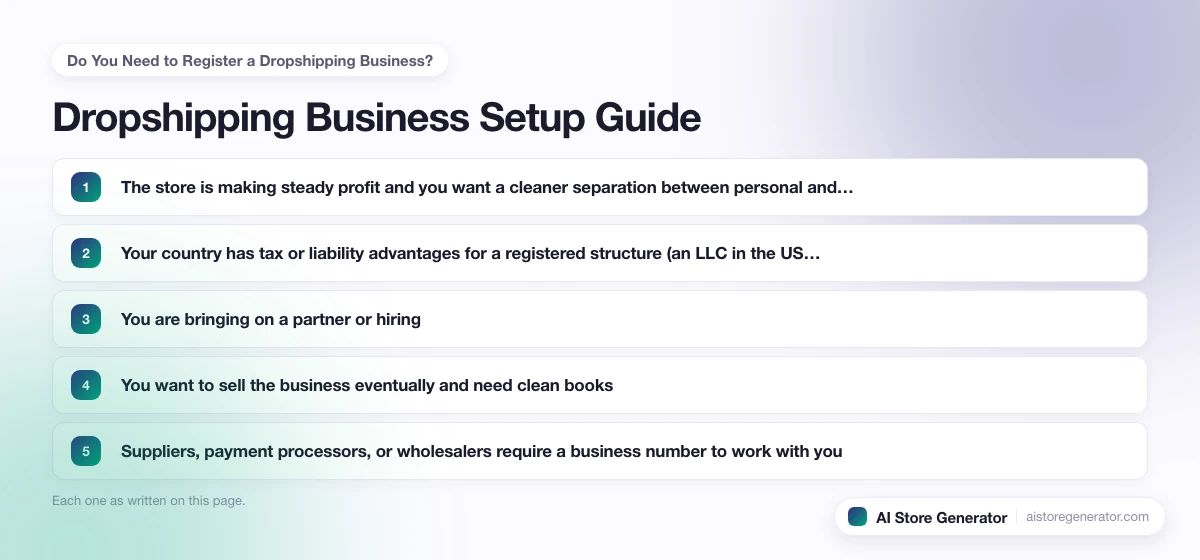
Registering a formal business usually becomes useful when one of these is true:
- The store is making steady profit and you want a cleaner separation between personal and business money.
- Your country has tax or liability advantages for a registered structure (an LLC in the US, a Ltd in the UK, a Pty in Australia, etc.).
- You are bringing on a partner or hiring.
- You want to sell the business eventually and need clean books.
- Suppliers, payment processors, or wholesalers require a business number to work with you.
The right time varies. For many store owners it lands somewhere in the first few months after consistent profit appears. Talk to a local accountant if you are unsure.
Do You Need an LLC for Dropshipping?
An LLC (or your country’s equivalent, such as Ltd in the UK, GmbH in Germany, or Pty Ltd in Australia) is a separate legal structure that sits between you and the business. It usually offers some personal-liability protection and, in some places, tax flexibility.
For dropshipping specifically:
- An LLC is not required to open a Shopify store in most countries.
- An LLC does not, by itself, change how much tax you owe in most cases.
- An LLC does provide a layer of liability protection if a customer ever sues over a product issue. For a small store this risk is low, but it is not zero.
- Many overseas store owners use a US LLC to access US payment processors and US-only services. This is a separate decision with its own costs and ongoing filing requirements.
If you are running a small store as a side project, you can usually delay this. If the store is your main income or you are selling higher-risk products, set it up earlier rather than later.
Sales Tax, VAT, and GST
Sales tax (US), VAT (Europe and UK), GST (Australia, Canada, India, New Zealand, others) all work differently, but the structure is similar: when you sell to a customer in a region that requires it, you may need to collect tax from them and pass it to the local tax authority.
The general pattern looks like this:
- Below a certain sales threshold in a given region, registration is usually not required.
- Above the threshold, you usually need to register, collect, and remit.
- Shopify can calculate and collect these taxes automatically once configured.
- Your supplier’s tax treatment is separate from yours. You usually owe sales tax on what your customer paid, not what you paid the supplier.
Thresholds, rates, and rules change frequently. The right move is to set Shopify up correctly from the start (it is much easier than fixing it retroactively) and ask a local accountant about your specific country’s rules before you scale.
Do You Pay Income Tax on Dropshipping Profits?
Yes, in nearly every country. Dropshipping profits are taxable as ordinary business income. The exact treatment depends on whether you operate as an individual, a sole trader, or through a registered business structure.
A clean approach from the start:
- Keep dropshipping income separate in a dedicated bank account, even if you are not registered.
- Save 25-35 percent of profit (not revenue) as a tax reserve until you know your real tax rate.
- Track expenses properly from order one: Shopify fees, app fees, supplier costs, ad spend, samples, software, education. These reduce taxable profit.
- File income from the store on your personal or business tax return depending on your structure.
- If you are unsure of the rules in your country, an hour with a local accountant is usually the cheapest way to get clarity.
Treating tax as an afterthought is the most common reason beginner stores hit a wall in year two. The fix is treating it as part of the operating cost from the start.
Business Bank Account, Payment Processors, and Cash Flow
Even without formal registration, separating store money from personal money saves real headaches:
- Open a dedicated bank account for the store. Even a basic checking account works.
- Use that account for all Shopify payouts, supplier payments, ad spend, and app subscriptions.
- Run any owner draws or transfers as separate, clearly labeled transactions.
This single change makes bookkeeping, tax filing, and any future formal registration dramatically easier.
For payment processors, Shopify Payments is available in many countries and is usually the easiest starting point. Where it is not available, options include PayPal, Stripe (where allowed), 2Checkout, and various country-specific processors. Some processors require a registered business or business bank account before approval, so research what is available where you live before you commit to a launch date.
Where AI Store Generator Fits
AI Store Generator builds the storefront so you can focus on the parts of the business that actually need human judgment, including the legal, tax, and structural decisions above. The setup work that used to take weeks (product pages, collections, policies, SEO structure) happens in minutes, which frees the store owner’s first few months for the decisions that matter and cannot be automated.
The tool does not file taxes, register your business, or give legal advice. It builds the Shopify foundation so the legal and tax side has a real store to attach to.
A Realistic Setup Order for a New Store
Most stores do not need to do everything on day one. A reasonable order:
- Pre-launch: open the Shopify store, pick a niche, choose a supplier, build the store. No formal business setup required in most places.
- At launch: open a separate bank account for the store. Start tracking every expense.
- First sales through ~$500/month: start saving 25-35 percent of profit as a tax reserve. Keep selling as a sole trader or individual.
- Once steady at $1,000-$2,000/month profit: book a one-hour call with a local accountant. Decide whether to register as a business, form an LLC or equivalent, and how to handle sales tax in your selling regions.
- Beyond $5,000/month profit: revisit structure annually. Consider a more formal entity, separate accounting software, and a quarterly tax-payment schedule if your country uses one.
- If selling internationally: review sales tax, VAT, and GST registration thresholds for the regions where most of your customers live.
This order keeps costs low at the start and adds structure exactly when it pays for itself.
Common Legal and Tax Mistakes
The patterns that quietly hurt stores in year two:
- Mixing personal and store money from day one.
- Treating tax as something to figure out at the end of the year, which is too late to plan.
- Registering an LLC or company too early “to look professional” and paying for filings and accounting before any revenue exists.
- Selling counterfeit, trademarked, or branded products from marketplace suppliers and assuming nobody will notice.
- Skipping a privacy policy, terms, and refund policy because Shopify autogenerates the basics. Shopify’s defaults are a starting point, not a finished policy.
- Ignoring sales tax until a customer complains, an audit triggers, or a region sends a registration notice.
- Trying to take legal advice from forum threads instead of a local accountant.
None of these are dramatic on day one. Each one quietly compounds.
When to Talk to an Accountant or Lawyer
You do not need a lawyer to start a dropshipping store. You probably do not need one for the first six months unless something specific comes up. The moments worth booking a one-hour consultation:
- Once monthly profit is steady and you are deciding whether to register.
- Before forming an LLC or equivalent in any country.
- Before selling into a region with strict tax or consumer-protection rules.
- If a supplier or product raises trademark, safety, or import concerns.
- If a customer threatens action, a payment processor freezes funds, or a marketplace platform sends a takedown notice.
- Before selling the business.
A one-hour call at the right moment costs less than a year of guessing.
For the broader beginner picture, the Dropshipping Basics for Shopify guide explains the model itself. If the store is not live yet, the Start a Dropshipping Business on Shopify walkthrough covers the launch process. For supplier choice, which interacts with product-safety and import issues, read Dropshipping Suppliers for Shopify. For day-to-day work after the legal side is sorted, Shopify Dropshipping Operations covers pricing, fulfillment, and customer support. And for the longer-term decisions, Shopify Dropshipping Strategy covers branded versus generic, sourcing upgrades, and realistic income targets.
When you are ready to stop planning and see a real store, AI Store Generator builds the Shopify foundation in minutes so the legal and tax decisions above have a real business to attach to.
FAQ
Is dropshipping legal?
Yes, in most countries. Dropshipping is a fulfillment model, not a separate type of business, so the same online-selling laws apply. Trouble usually comes from what you sell (counterfeit, trademarked, restricted items) or how you describe it, not from the model itself.
Do I need to register a business to start dropshipping?
In most countries you can start as a sole trader or individual without any formal registration. Registering becomes useful once the store is making consistent profit, when you want personal-liability protection, or when payment processors and suppliers require a business number. Check your country’s specific rules.
Do I need an LLC for dropshipping?
An LLC (or your country’s equivalent) is not required to open a Shopify store. It provides liability protection and sometimes tax flexibility, and many store owners set one up once revenue is steady or if they sell higher-risk products. Talk to a local accountant before forming one. There are ongoing filing and reporting costs to consider.
Do you pay tax on dropshipping income?
Yes, dropshipping profits are taxable as business income in nearly every country. The structure depends on whether you operate as an individual, sole trader, or registered business. A common starting habit is to save 25-35 percent of profit as a tax reserve and track expenses properly from order one.
Do I need to charge sales tax, VAT, or GST?
Usually only once you cross the registration threshold in a given region. Shopify can calculate and collect these taxes automatically once configured. Thresholds, rates, and rules vary significantly by country and state, so confirm requirements for the regions where most of your customers live.
Do I need GST for dropshipping?
In countries that use GST (Australia, Canada, India, New Zealand, others), GST registration is usually required only after you cross the local sales threshold. Below the threshold, registration is often optional and may not be worth the extra reporting. Local rules and thresholds change, so confirm before deciding.
What is the easiest country to set up a dropshipping business in?
There is no single easiest. Countries with simple sole-trader registration, common online payment processors, and clear tax thresholds tend to be the smoothest. The US, UK, Canada, Australia, Singapore, and parts of the EU are common starting points for English-speaking owners. Each has tradeoffs in tax, banking, and processor availability.
How do I get a 2Checkout account approved for dropshipping?
Most payment processors, including 2Checkout, want to see a real store with finished product pages, clear policies (shipping, returns, privacy, terms), a working contact method, and a business or personal identity that matches the application. Applying with a half-built store is the most common reason for rejection. Build the store properly first, then apply.
Can I sell my dropshipping business later?
Yes, dropshipping stores are sellable assets, and a number of marketplaces specialize in them. The price depends mostly on clean books, repeatable traffic, and provable profit. The earlier you keep proper financial records, the easier the eventual sale will be.
Does AI Store Generator handle legal and tax setup?
No. AI Store Generator builds the Shopify storefront, products, pages, and SEO structure. The legal, tax, registration, and accounting side is the store owner’s responsibility and depends on your specific country and situation. Treat it as separate work, usually best handled by a local accountant once the store is earning.