
The honest answer is yes, dropshipping is still profitable in 2026, but not in the way most beginner videos promise. The stores that make real money are not the ones running ads on random trending products. They are the ones treating the store as a real ecommerce business: focused niche, real product pages, healthy margins after every cost, and consistent traffic. This page covers what actually decides whether a Shopify dropshipping store makes money or quietly loses it.
If you want a clear-eyed look at the profit math before you commit time and money, this page is for you. It covers what really determines profit, what realistic income looks like at different stages, and the most common reasons stores that look like they should be making money are not.
Short Answer
Dropshipping is profitable when retail price minus every real cost (supplier, shipping, payment fees, app fees, returns, ad spend) leaves a meaningful margin. For most successful Shopify dropshipping stores, that margin is 25 to 40 percent of revenue after twelve months of work. Stores that fail almost always fail on the math, not on the model. Treat margins as a daily decision, not a yearly calculation, and the model works.
What Actually Decides Profitability
The profit on any dropshipping order comes down to one equation:
Retail price − (supplier cost + supplier shipping + payment processing fees + app and platform fees + estimated returns + ad spend per order) = real profit per order
Then multiply by orders, subtract fixed monthly costs (Shopify plan, domain, apps, software), and you have the store’s actual profit.
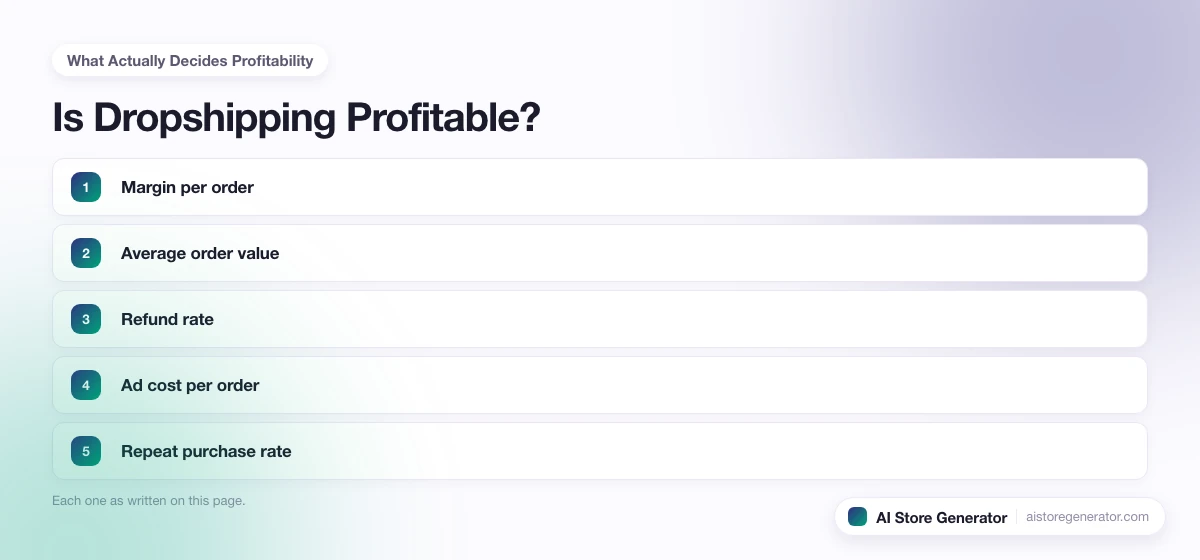
The numbers that move profit the most:
- Margin per order. Higher-margin products absorb mistakes; thin-margin products do not.
- Average order value. A $60 average order is roughly twice as profitable as a $30 average order, even if margin percentage is the same.
- Refund rate. Every refund eats the original order’s profit plus the cost of acquiring that customer.
- Ad cost per order. The number most beginners under-track. Even small inefficiencies become large losses at volume.
- Repeat purchase rate. Customers who come back twice cost almost nothing the second time. They are pure margin.
- Fulfillment speed. Fast shipping means fewer “where is my order” emails and lower refund rates.
- Supplier reliability. A bad supplier week wipes out a good store week.
Each of these can be measured. Stores that measure them have a profit problem they can fix. Stores that do not measure them have a profit problem they cannot see.
Realistic Profit Targets
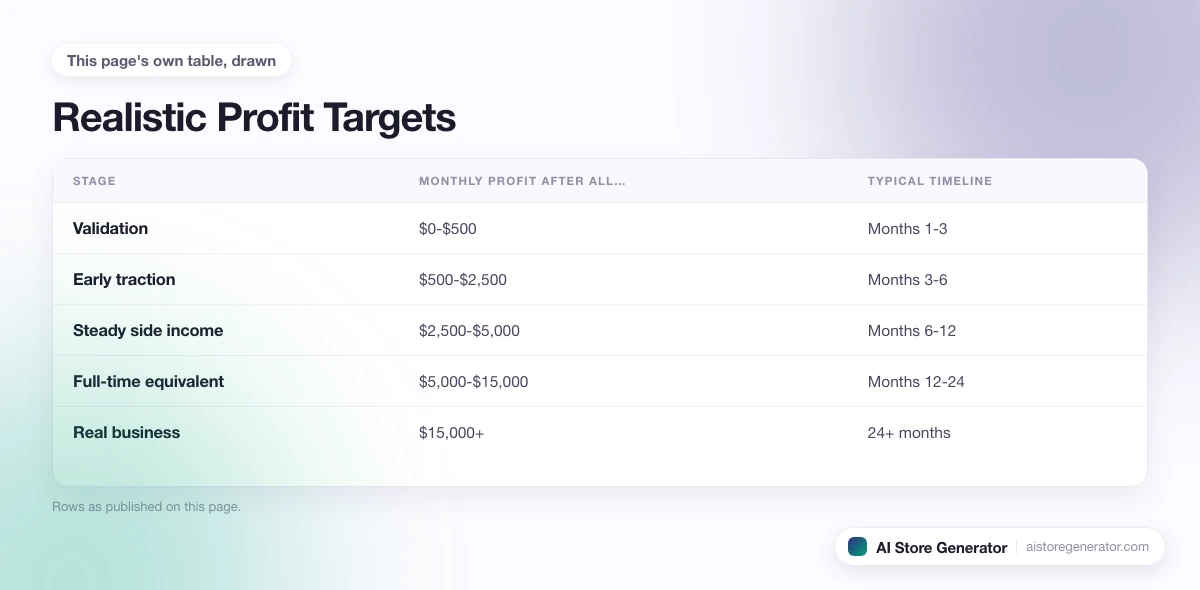
The income claims in the dropshipping space are mostly nonsense. The honest version looks like this:
| Stage | Monthly profit after all costs | Typical timeline | What it usually takes |
|---|---|---|---|
| Validation | $0-$500 | Months 1-3 | A real working store, basic ads or organic content, first sales |
| Early traction | $500-$2,500 | Months 3-6 | A repeatable winning product, controlled ad spend, growing audience |
| Steady side income | $2,500-$5,000 | Months 6-12 | A small product line, organic traffic starting to compound |
| Full-time equivalent | $5,000-$15,000 | Months 12-24 | Branded store, healthy margins, multiple traffic channels |
| Real business | $15,000+ | 24+ months | Brand, audience, repeat customers, sometimes a small team |
These numbers are profit, not revenue. A store doing $50,000 in monthly revenue at 5 percent margin makes less than a store doing $10,000 at 30 percent margin.
Why Some Stores Make Money and Others Do Not
Two stores can sell the same product, use the same supplier, and spend the same amount on ads. One makes money and one loses it. The difference is almost always in one of these areas:
- Niche focus. A store with a clear customer profile attracts repeat buyers. A generic store attracts one-off buyers who cost more than they pay.
- Product pages. A page that explains who the product is for and why it matters converts at 3-5 percent. A page that copies the supplier feed converts at 0.5 percent. Same traffic, ten times the difference.
- Pricing discipline. Stores that price for volume often have no margin to absorb anything. Stores that price for margin can survive bad weeks.
- Refund handling. Quick, generous refunds on low-value items cost less than the support time of arguing.
- Traffic source. Paid traffic is fast but expensive and depends on margin. Organic and content traffic is slower but compounds and is much more forgiving on margin.
- Supplier relationship. A reliable supplier with reasonable shipping times produces fewer refunds, better reviews, and better repeat rates than a cheaper supplier with 30-day shipping.
None of these are dramatic individually. Together they decide whether a store quietly grows or quietly stalls.
The Real Costs Beginners Underestimate
When most beginners calculate margin, they subtract supplier cost from retail price and assume the rest is profit. The real list of costs is longer:
- Shopify plan ($29-$39/month)
- Domain name (~$15/year)
- Supplier app subscription ($0-$50/month)
- Email tool, review tool, basic analytics ($0-$100/month combined)
- Payment processing fees (2-3 percent plus a flat fee per transaction)
- Chargebacks and disputes (occasional, but expensive when they happen)
- Refunds (the original product cost is lost; sometimes shipping too)
- Customer support time
- Ad spend (variable but often the biggest expense)
- Sample orders (small but real)
- Taxes on profit at year end
A store that ignores these costs can look profitable on monthly revenue and still lose money over the year.
Where AI Store Generator Fits
A surprisingly large share of profitability comes from the store itself, not the products. Conversion rate, average order value, and refund rate all depend on whether the storefront looks trustworthy, whether product pages convert, and whether collections help shoppers find what they want.
AI Store Generator builds the storefront with real product pages, collections, ready-to-sell pages, and SEO structure in place from day one. That foundation does not make a store profitable on its own, but it removes the most common reason stores never reach profitability: a thin storefront that wastes whatever traffic it gets.
When Dropshipping Stops Being Profitable
The model genuinely fails in a few specific situations:
- The product has a saturated market and every seller is racing to the bottom on price.
- The supplier’s shipping times are too slow to support paid traffic.
- The store relies on a single ad platform and that platform’s costs rise faster than retail prices can absorb.
- The store has no repeat-purchase mechanism and pays full customer-acquisition cost on every order forever.
- Refund rates are above 10 percent and the store is absorbing them without fixing the underlying product or page issue.
If you find a store in any of these positions, the fix is usually structural (different niche, different supplier, different traffic source, different product page) rather than tactical (raise the budget, change the ad creative).
Profit Math for a Typical Order
A worked example to make the math concrete:
- Customer pays: $49.99
- Supplier cost: $12.00
- Supplier shipping: $4.50
- Payment fee (2.9% + $0.30): $1.75
- Apps and platform allocated per order: $0.50
- Ad cost per order (paid traffic): $14.00
- Estimated refund reserve: $1.50
Profit per order: $49.99 − $34.25 = $15.74, or about 31% margin.
This is a healthy number. A store running 5 orders a day at this margin makes ~$2,400/month profit. At 20 orders a day, ~$9,500/month. These are realistic targets at the early-traction and side-income stages above.
Now consider the same product priced at $34.99 instead:
- Customer pays: $34.99
- All other costs unchanged: $34.25
Profit per order: $0.74, or about 2% margin.
Same product, same supplier, same ad spend. The first version is a business. The second is a hobby that loses money on any returned order. Pricing is the single biggest profit lever in dropshipping.
For a side-by-side comparison of dropship margins against running the same product with your own inventory, ecommerce vs dropshipping works through both models on the same SKU.
How to Make Sure Your Store Is Actually Profitable
Six habits that separate profitable stores from stores that look profitable:
- Calculate margin per product before launching. If the math is tight, raise prices or change products before you spend on ads.
- Track ad spend per order, not per click. A $5 cost per click means nothing without knowing the conversion rate behind it.
- Watch refund rate weekly. A spike on one product means a product problem, not a sales problem.
- Separate revenue from profit in your head and your spreadsheets. Revenue is a vanity number. Profit is the only one that matters.
- Save 25-35 percent of profit (not revenue) for taxes from order one. Discovering the tax bill at year end is the most common reason “profitable” stores end up flat.
- Review the full P&L monthly. Even a basic monthly check catches most issues while they are still small.
For the broader picture of the model, see the Dropshipping Basics for Shopify guide. For the order flow itself, the How Does Dropshipping Work? walkthrough explains exactly what happens on each sale. Once profit is steady, the Shopify Dropshipping Strategy guide covers how to grow it (branded versus generic, sourcing upgrades, realistic income targets). And the operational side that quietly affects profitability is covered in Shopify Dropshipping Operations.
When you are ready to see a real store, AI Store Generator builds the Shopify foundation in minutes so you can spend your time on margin, traffic, and product decisions instead of store setup.
FAQ
Is dropshipping still profitable in 2026?
Yes, but the easy-money version sold by guru videos is mostly gone. Profitable stores in 2026 win through niche focus, real product pages, healthy margins, and consistent traffic. The generic-store-running-random-trending-products approach mostly does not work anymore.
How much profit do dropshipping stores actually make?
Most successful stores land between $500-$2,500 monthly profit by month six, $2,500-$5,000 by month twelve, and $5,000-$15,000 by month two if branded properly. Anything quoted as “$10,000 in 30 days” is almost always cherry-picked or talking about revenue rather than profit.
What is a good profit margin for dropshipping?
A reasonable target is 25-40 percent net margin after all costs (supplier, shipping, payment fees, apps, returns, ad spend). Anything tighter struggles to absorb bad weeks. Margins below 15 percent usually mean the store is one ad-cost increase away from losing money.
Why are dropshipping margins so thin?
Most beginners price products by adding a fixed markup to the supplier cost without subtracting all the other costs. Real profit appears only after payment fees, apps, refunds, and ad spend are subtracted. Tight margins usually come from underpricing, not from the model itself.
Is dropshipping profitable without ads?
Yes, but it takes longer to ramp. Stores that build profitability through SEO, content marketing, email, and organic social can run much thinner ad budgets (or none) and keep more of every dollar. The tradeoff is months of upfront work before traffic compounds.
How long does it take for a dropshipping store to become profitable?
Most realistic stores see first sales within weeks but real profit somewhere between months three and six. Steady, scalable profit usually shows up between months six and twelve. Stores that skip the foundation work take longer or never get there.
Is Shopify dropshipping profitable for beginners?
It can be, but with realistic expectations. Beginners that treat the store as a real business (clear niche, real product pages, careful pricing) usually reach early traction within months. Beginners chasing trending products with ads on a thin store usually burn budget without learning anything useful.
What is the most profitable dropshipping niche?
There is no single most profitable niche. The patterns that produce healthy margins are: clear customer profile, products that solve a real problem or create strong want, room to price above supplier cost without scaring buyers, and content topics where organic traffic can compound. Pet, home, hobby, and specialty-apparel niches consistently produce real businesses. If thin margins are the problem, high-ticket dropshipping niches raise the price point so each sale carries more profit.
Does AI Store Generator make dropshipping more profitable?
It does not change the per-order math directly, but it removes a common drag on profitability: a thin storefront that wastes traffic. AI Store Generator builds the product pages, collections, and SEO structure that lift conversion rate and average order value, which both feed directly into profit.