
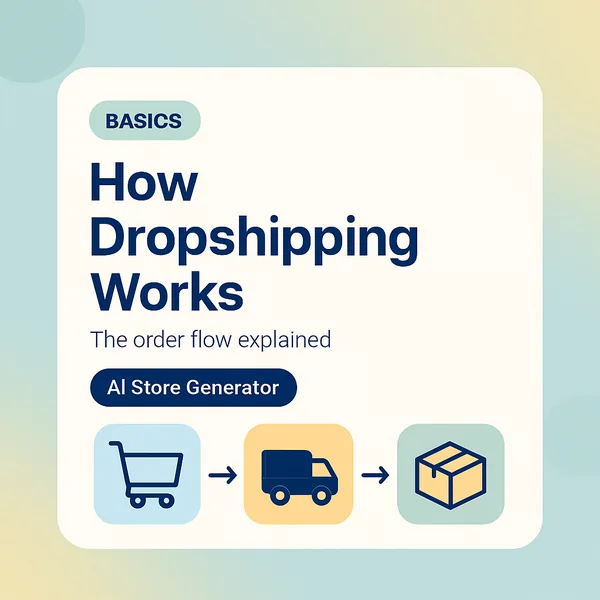
The mechanics of dropshipping are simpler than most explanations make them sound. A customer buys from your store. You forward the order to a supplier. The supplier ships it to the customer. You keep the difference. That is the whole model. Everything else is operational detail around making that flow reliable and profitable.
This page walks through the order flow step by step, explains where you fit, where the supplier fits, and what the customer actually sees. By the end you should be able to picture exactly what happens between “customer clicks Buy” and “package arrives at their door.” For the underlying definition of the model and what beginners typically get wrong about it, read What Is Dropshipping?.
Short Answer
When a customer buys a product on your Shopify store, Shopify takes the payment and notifies your supplier. The supplier picks, packs, and ships the product directly to the customer. You handle the storefront, the marketing, the pricing, and the customer relationship. The supplier handles the physical part. You never touch the product, and the customer never knows the supplier exists.
The Order Flow, Step by Step
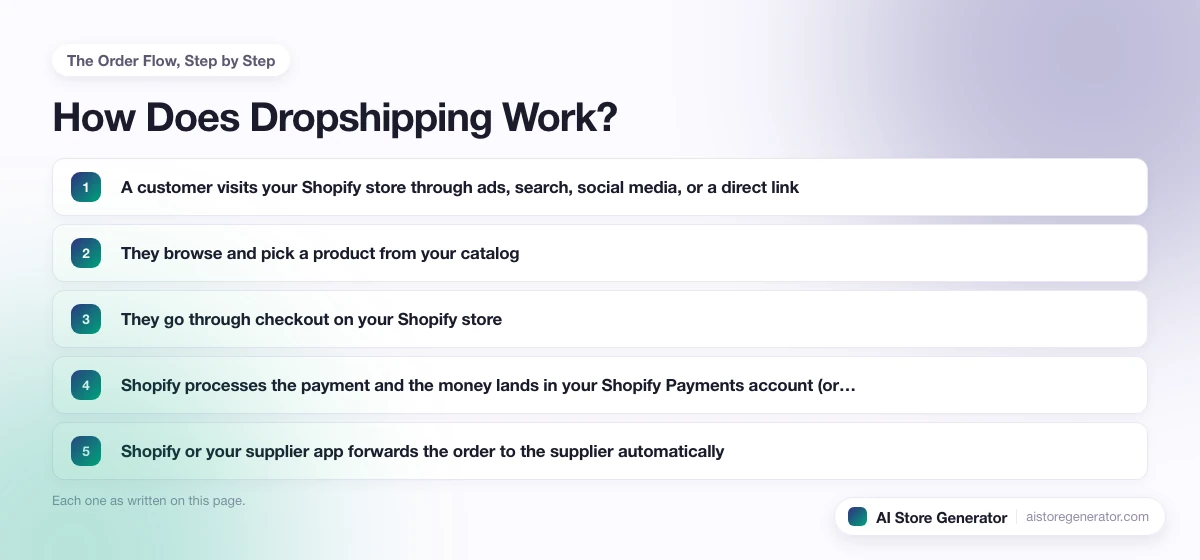
A real dropshipping order goes through this sequence:
- A customer visits your Shopify store through ads, search, social media, or a direct link.
- They browse and pick a product from your catalog. The product is listed at your retail price, not the supplier’s wholesale price.
- They go through checkout on your Shopify store. They enter shipping details, choose a shipping option if available, and pay with their card, PayPal, or another option you support.
- Shopify processes the payment and the money lands in your Shopify Payments account (or whichever processor you have set up). The customer sees a confirmation page and gets a confirmation email from your store.
- Shopify or your supplier app forwards the order to the supplier automatically. This is usually instant if you have the integration set up.
- The supplier receives the order details with the customer’s shipping address and the product they bought. They pick the product from their warehouse, pack it, and prepare it for shipment.
- The supplier ships the product through their preferred courier. They generate a tracking number.
- The tracking number flows back to your Shopify store via the same integration. Your store sends a shipping notification email to the customer with the tracking link.
- The customer receives the product in the shipping window you advertised on the product page.
- You keep the difference between what the customer paid and what the supplier charged you (plus shipping, fees, returns, ads, and other costs).
The whole flow takes minutes from order to supplier and days to weeks from supplier to customer, depending on shipping distance.
Who Does What
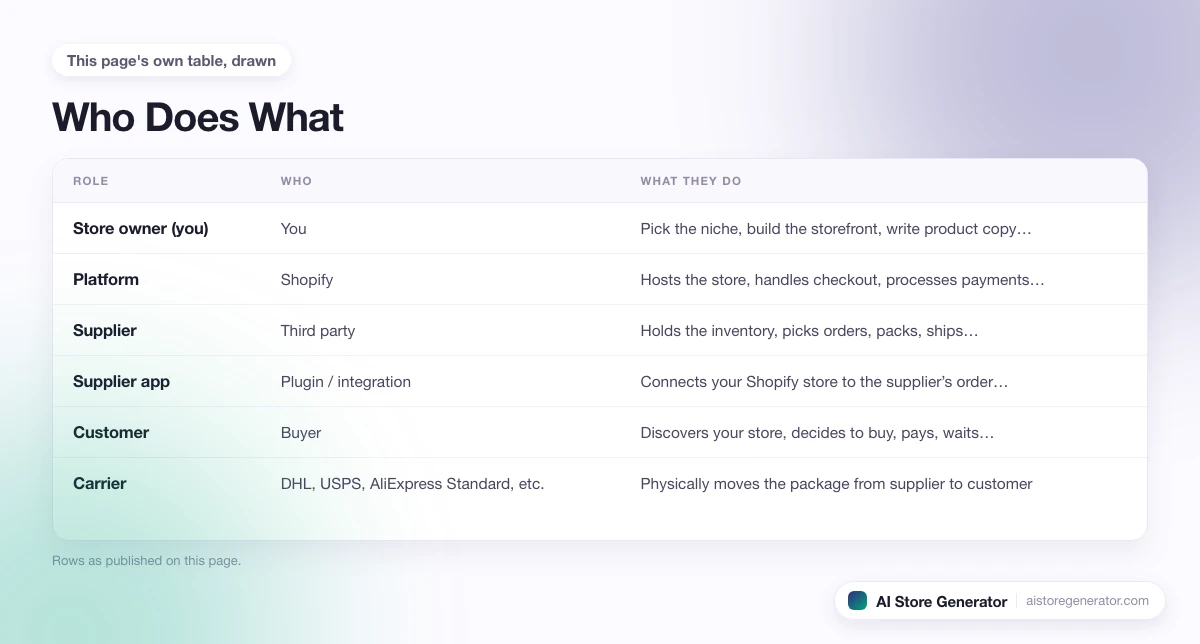
This is where most confusion comes from. The roles look like this:
| Role | Who | What they do |
|---|---|---|
| Store owner (you) | You | Pick the niche, build the storefront, write product copy, set prices, run marketing, handle customer support, manage returns |
| Platform | Shopify | Hosts the store, handles checkout, processes payments, tracks orders, syncs with apps |
| Supplier | Third party | Holds the inventory, picks orders, packs, ships, generates tracking |
| Supplier app | Plugin / integration | Connects your Shopify store to the supplier’s order system so forwarding is automatic |
| Customer | Buyer | Discovers your store, decides to buy, pays, waits, receives, reviews |
| Carrier | DHL, USPS, AliExpress Standard, etc. | Physically moves the package from supplier to customer |
You are the brand the customer sees. The supplier stays invisible. The customer’s experience, good or bad, reflects on your store, not on the supplier they never knew was involved.
Where the Money Moves
Following the money is the clearest way to see why pricing matters so much in dropshipping.
- Customer pays your retail price to your Shopify store.
- Shopify deducts a payment-processing fee (usually 2-3 percent plus a flat fee per transaction).
- The remaining balance lands in your account.
- You pay the supplier their wholesale price plus their shipping cost.
- You also pay for any app subscriptions, ad spend attributed to that order, and a portion of your monthly fixed costs.
- Whatever is left is your margin.
A common beginner mistake is treating revenue (what the customer paid) as profit. The honest math is retail minus (supplier cost + supplier shipping + payment fees + app/platform fees + estimated returns + ad spend) equals real profit.
Where Shopify Fits
Shopify is the platform layer. It is responsible for hosting your store, processing payments, calculating taxes, handling the checkout flow, tracking orders, and connecting to all the other tools through its app marketplace. Shopify does not handle inventory, does not negotiate with suppliers, does not write your product pages, and does not bring traffic to your store.
The reason Shopify dominates dropshipping is that the platform side is genuinely easy. You can set up a store, accept payments, and start receiving orders in a single afternoon. What is harder, and what Shopify does not solve, is everything else: which products, which suppliers, which traffic channel, and how to make the math work.
For more on the launch process specifically, see the start a dropshipping business on Shopify guide.
How Suppliers Actually Fit In
Suppliers come in several different shapes:
- Marketplace suppliers (AliExpress sellers, often accessed through DSers or similar apps). Huge catalog, low prices, slow shipping. The starting point for most beginners.
- Curated supplier networks (Spocket, Modalyst, Doba). Smaller catalogs, faster shipping from US, EU, or other regional warehouses, higher product costs.
- Private agents (often based in China). Single-person or small-team intermediaries who handle sourcing, quality control, packaging, and shipping for stores doing steady volume.
- Brand-direct suppliers (manufacturers or brands offering dropship terms). Slower to set up, much better margins, often the path to a real branded business.
The choice of supplier shapes shipping time, product quality, packaging, return options, and margin. For most beginners, marketplace suppliers are the right start. For details on choosing, see the dropshipping suppliers guide.
Where AI Store Generator Fits
The order flow above only works if the storefront is in good enough shape to actually convert visitors into buyers. Product pages that explain the product. Collection pages organized around real searches. Policies that match what the supplier actually does. Trust signals that turn cold traffic into orders.
AI Store Generator builds that foundation in minutes. Instead of staring at a blank Shopify admin trying to figure out what a good product page looks like, you start with a real store and decide what to keep, change, or expand. The order-flow mechanics described above remain the same. You just get to focus on the parts that actually drive sales.
What Customers Actually See
A useful sanity check is to imagine the customer’s view of the same flow:
- They land on your store from an ad or search result.
- They see a clean homepage, real-looking product pages, clear prices, and visible policies.
- They add a product to cart, pay through a standard checkout, get a clean confirmation page.
- A few minutes later they get a confirmation email from your store.
- A day or two later they get a shipping notification with a tracking number.
- After the advertised shipping window, the package arrives. Branding (if any) matches the store.
- They use the product, decide whether they liked it, and either become a repeat buyer, leave a review, or never think about your store again.
Anywhere this flow looks unprofessional, surprising, or broken, the customer disengages. Most “dropshipping is hard” stories trace back to a flow that did not look smooth from the customer’s side.
Common Misunderstandings
A few things people often get wrong about how dropshipping works:
- The supplier is not invisible to your customer service inbox. Shipping questions, refund requests, and tracking issues all land on you. You forward the supplier-related parts to the supplier; you still own the customer.
- You are responsible for the product even if you never touched it. Legal liability, refund policy, and customer trust all attach to your store, not to the supplier behind it.
- The “automatic” part is partial. Order forwarding can be automatic. Pricing, product copy, customer support, returns decisions, ad management, and product quality all still require you.
- The supplier is not your partner. You are one of hundreds or thousands of stores selling the same products. The supplier’s priorities are their own. Treat the relationship accordingly, and have a backup for any top-selling product.
- Margins are smaller than they look. A $50 sale does not mean $50 of profit. After supplier cost, shipping, payment fees, returns, and ad spend, the real margin is often 20-40 percent of revenue, sometimes less.
For the broader picture of what dropshipping is, see the Dropshipping Basics for Shopify guide. If you are getting close to launching a store, the Start a Dropshipping Business on Shopify walkthrough covers the launch process. And once orders are flowing, Shopify Dropshipping Operations covers the day-to-day work that makes the order flow above repeatable.
When you are ready to see a real store instead of just reading about one, AI Store Generator builds the Shopify foundation in minutes so the order flow above has somewhere good to start.
FAQ
How does dropshipping work in simple terms?
A customer buys a product from your Shopify store. You forward the order to a supplier. The supplier ships the product directly to the customer. You keep the difference between what the customer paid and what the supplier charged. You never hold inventory and never touch the product.
How does dropshipping work on Shopify specifically?
Shopify provides the storefront, checkout, payment processing, and order management. When an order comes in, a supplier app forwards the order details to your supplier automatically. The supplier ships, generates a tracking number, and the tracking flows back to Shopify, which sends the customer a shipping email.
Who pays for shipping in dropshipping?
The customer pays for shipping at checkout (or it is bundled into the product price as “free shipping”). The supplier then charges you their shipping cost when they fulfill the order. The difference, if any, sits with you. Most stores price products to absorb at least part of the shipping cost.
Do I have to pay the supplier upfront?
No. The supplier charges you only after a customer places an order on your store. That is the core reason dropshipping is low-risk compared to traditional retail: you are never paying for inventory you have not sold.
How long does dropshipping take from order to delivery?
It depends entirely on the supplier and the carrier. Marketplace suppliers (AliExpress and similar) usually quote 10-30 days. Curated networks with regional warehouses often deliver in 3-7 days. Private agents and brand-direct setups can sometimes match standard ecommerce shipping speeds. Set customer expectations on the product page based on the supplier you actually use.
Who handles returns in a dropshipping store?
You do. You decide the refund policy, communicate with the customer, and decide whether to refund or have the product returned. Many overseas suppliers do not accept physical returns, so the store often absorbs returns as a cost rather than physically returning the item.
Can I see what the supplier is shipping?
Usually not before they ship it. The best practice is to order samples of your top products yourself before you sell them, so you know exactly what the customer will receive. This single step prevents most quality-related refund issues.
Does Shopify handle dropshipping automatically?
Shopify handles the storefront, checkout, payments, and order management. It does not, by itself, connect to suppliers or forward orders. You add a supplier app (DSers, Spocket, Zendrop, CJDropshipping, and others) to make the order-forwarding step automatic.
How does AI Store Generator fit into the order flow?
AI Store Generator builds the Shopify storefront (product pages, collections, ready-to-sell pages, policies, and SEO structure) so the order flow above has a good store to run on. It does not change how dropshipping works; it just removes the multi-week setup phase that usually sits between deciding to start and actually being ready to take orders.