
If you are weighing “ecommerce” against “dropshipping” as two separate business paths, the framing is already off. Ecommerce is the category. Dropshipping is one way to fulfill orders inside that category. Your Shopify store is ecommerce whether the boxes ship from a supplier in Guangzhou, a 3PL warehouse in Kentucky, or the spare bedroom of the person who owns the store. The choice you actually have to make is smaller than it looks: for the products you plan to sell, should orders be packed by a supplier who holds the stock, or by you (or a 3PL) using stock you paid for upfront? That single call changes your startup cash, your profit per order, your delivery windows, your customer service load, and how fast you can scale. This guide covers what actually changes, what stays the same, and how to pick without over-committing.
The short answer
Dropshipping is a fulfillment model. Ecommerce is the whole store. So the real question is not “which one,” it is “for which products, and for how long.”
Both models live inside the same Shopify store. Both need product pages, a collection structure, checkout, mobile speed, trust signals, and SEO. Both compete on ads, email, and retention. What changes is who holds the stock, who packs the box, and how much cash sits tied up in inventory before a sale happens. If you want a plain-English refresher, what dropshipping is and how it works step by step will save you time before making a model call.
The rest of this guide gets specific: the cost split, the margin math, a switching threshold you can calculate for your own store, and a hybrid setup that runs both models side by side. A tool like AI Store Generator builds the underlying Shopify store either way, so the model choice becomes just a fulfillment decision instead of a “learn to build a store first” project.
What actually changes between the two models
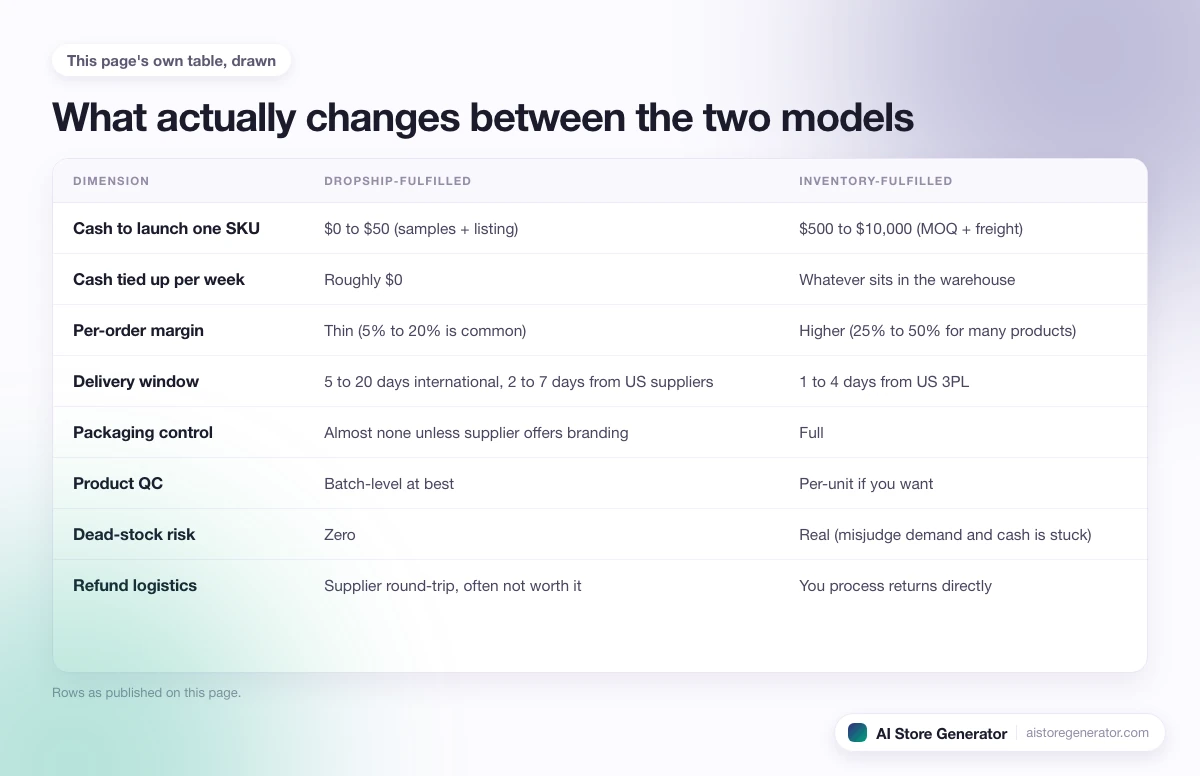
Most comparisons list the same eight things and stop. Here is what really matters when you are picking:
| Dimension | Dropship-fulfilled | Inventory-fulfilled |
|---|---|---|
| Cash to launch one SKU | $0 to $50 (samples + listing) | $500 to $10,000 (MOQ + freight) |
| Cash tied up per week | Roughly $0 | Whatever sits in the warehouse |
| Per-order margin | Thin (5% to 20% is common) | Higher (25% to 50% for many products) |
| Delivery window | 5 to 20 days international, 2 to 7 days from US suppliers | 1 to 4 days from US 3PL |
| Packaging control | Almost none unless supplier offers branding | Full |
| Product QC | Batch-level at best | Per-unit if you want |
| Dead-stock risk | Zero | Real (misjudge demand and cash is stuck) |
| Refund logistics | Supplier round-trip, often not worth it | You process returns directly |
| Supplier price shock | You absorb it or lose the SKU | Only affects future reorders |
| Scaling ceiling | Supplier capacity + shipping time | Your cash + warehouse space |
Notice the pattern: dropshipping trades margin and control for cash safety and speed. Owned inventory trades cash safety for margin and control. Neither one is “better.” They are two answers to the same question, and the right answer depends on what you are selling and how much you can afford to have stuck in a box.
The true cost of running each model
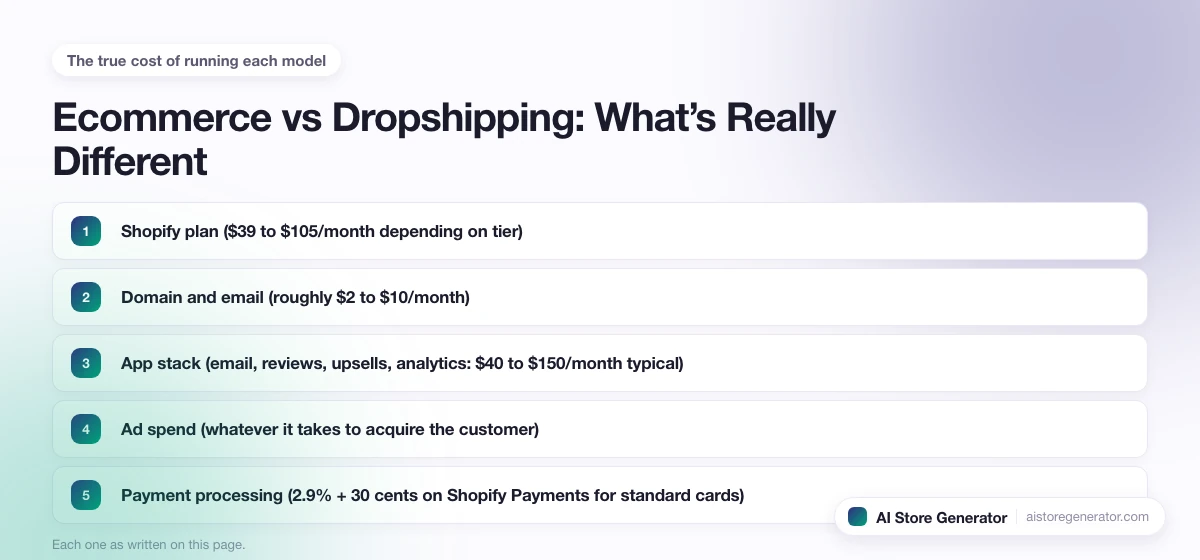
The comparison most articles skip is what monthly overhead looks like once the store is live. Costs that are identical in both models:
- Shopify plan ($39 to $105/month depending on tier)
- Domain and email (roughly $2 to $10/month)
- App stack (email, reviews, upsells, analytics: $40 to $150/month typical)
- Ad spend (whatever it takes to acquire the customer)
- Payment processing (2.9% + 30 cents on Shopify Payments for standard cards)
- Customer support tooling
Costs that only appear on the dropship side:
- Supplier account minimums (usually $0)
- Sample orders when vetting products ($20 to $100 per SKU tested)
- Automation apps like DSers, Zendrop, or Spocket ($0 to $50/month)
Costs that only appear on the owned-inventory side:
- MOQ purchase and freight (per-SKU)
- 3PL pick-and-pack ($2 to $4 per order typical) or your own labor and space
- Storage fees ($0.30 to $1 per cubic foot per month at most 3PLs)
- Return handling (~$5 to $10 per return processed)
- Inventory insurance for larger stockholdings
For a store selling 200 orders a month, the operational overhead is often within a few hundred dollars either way. The real cost difference is the working capital sitting in inventory before it becomes sales.
Margin math with a worked example
This is the part that trips people up. “Gross margin” and “profit” are not the same, and the gap gets wider on the dropship side because supplier prices are already loaded with the middleman’s own margin.
Take a portable neck fan selling at $34.99.
Dropship path:
- Product from supplier: $16.00
- Supplier shipping: $4.00
- Payment processing: $1.32
- Ad cost per order (at a $12 CAC): $12.00
- Contribution margin: $1.67 per order (4.8%)
Owned path, same product, 500-unit MOQ at $8/unit plus $700 freight (landed cost $9.40/unit):
- Product landed cost: $9.40
- 3PL pick-and-pack: $2.80
- USPS Ground Advantage: $4.20
- Payment processing: $1.32
- Ad cost per order: $12.00
- Contribution margin: $5.27 per order (15%)
Same product. Same ad spend. Same customer. Roughly 3x more profit on the owned side. But owned also required $5,400 upfront ($9.40 × 500 + $700 freight) sitting in a warehouse before the first sale. Dropship required zero.
That is the actual trade. Not “which model is better,” but “how much cash do you have, and how sure are you the product will sell?”
Which model wins for your product type
Product type does most of the work here. A useful shortcut:
- Trend and impulse products (fidget gadgets, seasonal novelties, viral TikTok items): dropship wins. Test fast, cut the losers, do not get stuck with pallets of dead stock when the trend passes.
- Apparel, beauty, premium home: owned wins. Packaging, branding, fit consistency, and delivery speed drive repeat rates that dropship suppliers cannot match.
- Heavy or oversized items (furniture, appliances, mattresses): US-based dropship or 3PL owned. International dropship on heavy items destroys unit economics through freight.
- Restricted goods (supplements, medical devices, licensed characters, food): owned or a specialist supplier who handles compliance. Regular dropship suppliers rarely check the paperwork you actually need.
- Digital and print-on-demand: a different model entirely, worth reading about separately.
- Consumables you want repeat orders on (candles, coffee, skincare): owned. Repeat customers judge you on the unboxing, not the price.
If the answer for your product falls between two rows, start dropship, prove the sales, then bulk the winner. That leads into the next section.
The switching threshold: when moving to owned inventory pays back
Every store owner running dropship eventually asks the same question: “At what point does it pay to buy in bulk?” There is a formula for it.
payback_months = MOQ_cost / (extra_margin_per_unit × monthly_units_sold)Using the neck fan example above:
- MOQ cost: $5,400
- Extra margin per unit if owned: $5.27 – $1.67 = $3.60
- Monthly units sold: 200
payback_months = $5,400 / ($3.60 × 200) = 7.5 months
That is longer than a lot of first-year store owners realize. The rule of thumb worth applying: switch a SKU to owned inventory only when you have sold it at the current rate for at least 60 days AND payback comes in under six months. If either check fails, keep it on dropship. This protects you from bulk-buying a product that had a good week and then stalled.
There is one meaningful exception: if the SKU is central to your brand identity and unboxing quality matters to repeat rate, the payback math may not capture the full value. In that case, owned wins even at a longer payback, because you are buying brand consistency, not just margin.
The hybrid model: running both on one Shopify store
You do not have to pick just one. The setup that most established stores end up with runs both models inside the same Shopify store, one product at a time.
Practical setup on Shopify:
- Tag each product with either
fulfill:dropshiporfulfill:ownedat the product level. - For owned products, track inventory in Shopify (or through a 3PL app that syncs stock levels).
- For dropship products, either use a fulfillment app like DSers or Zendrop, or route orders manually to the supplier through their portal.
- Set up two shipping profiles: one that uses the 3PL’s rates for owned products, one that uses a flat estimate for dropship. Shopify’s checkout automatically applies whichever rule matches the cart’s tags.
- Point your customer service macros at the right instructions: owned returns come back to the 3PL, dropship returns usually get a partial refund without asking for the product back (the return shipping cost more than the item’s wholesale value).
The upside of this setup is testing new SKUs on dropship without touching the fulfillment flow for your winners. The downside is a slightly more complex operations day, so most people who run hybrid keep the SKU count small and specialize the dropship side to trend testing only.
If you go this direction, finding reliable dropshipping suppliers becomes the constraint. A flaky supplier will break the trust signals you built with your owned products.
Shared risks nobody warns you about
The comparison articles usually frame all the risk on one side or the other. In practice, several risks land on the store owner no matter which model you pick.
- Chargebacks come out of your bank account. The bank does not care that the supplier packed the wrong item. You process the refund, you eat the chargeback fee, and your dispute rate is what payment processors watch.
- Sales tax is on you. In the US, economic nexus rules mean once you cross a state’s threshold (usually $100k in sales or 200 transactions), you owe tax there. Fulfillment model does not change this. Business setup and tax basics cover the paperwork side.
- Supplier price hikes on the dropship side. A supplier raising the wholesale price by $2 on a $34.99 item can flip a profitable SKU to a losing one overnight. Owned inventory locks in the cost per unit for the batch you already bought.
- Dead stock on the owned side. Order 500 of the wrong SKU and $5,000 sits in a warehouse for a year. Not just lost profit, lost cash you could have spent testing other products.
- Ad platform changes hit both. Meta breaking attribution, Google raising CPCs, TikTok Shop policy shifts. Fulfillment model does not insulate you.
- Legal exposure. Whether dropshipping is legal has a longer answer than most people expect, and most of it applies to owned inventory too. Trademarked products, misleading claims, warranty obligations, they all live with the seller of record.
Neither model saves you from these. The store owner is the seller of record either way, and that means chargebacks, tax filings, and customer trust land on your desk.
Where AI Store Generator fits
Whichever model you pick, the store itself is the same problem. A properly built Shopify store needs product pages with real specs and buying-decision content, collection pages that both users and Google can parse, category and breadcrumb structure, SEO markup, mobile page speed under two seconds, and trust signals that make cold traffic convert. That is a multi-week project if you build it by hand, and most first-time store owners never finish the SEO side.
AI Store Generator builds that infrastructure in under five minutes: a full Shopify store with products, SEO-optimized product pages, collection pages, and ready-to-sell pages so the store looks and behaves like something a real customer would buy from. You still choose the fulfillment model, run the ads, and handle customer service. But the “how do I even build a Shopify store that ranks” step, which is the part that eats new store owners, is done for you.
That matters here because most people who agonize over “ecommerce vs dropshipping” are really asking “which one is easier to get off the ground.” The honest answer is that both are the same amount of work on the store side. The model choice only changes what happens after a customer clicks buy.
How to actually decide
If you are trying to pick without reading five more articles, use this order:
- Look at your cash. Under $500 to launch and no runway to eat losses, start dropship. Between $2,000 and $10,000 with a clear product idea, consider starting hybrid or going straight to owned for one hero SKU.
- Look at your product type. Match it to the framework two sections up. If the answer is “owned wins for this category,” but you cannot afford the MOQ, dropship the same product first to validate demand.
- Look at your timeline. Testing 20 products in the next two months? Dropship. Building a brand you want to run for five years? Owned or hybrid, with dropship reserved for trend tests.
- Look at your fulfillment expectations. If your customers expect 2-day delivery and your competitors offer it, dropship from Asia will lose. US-based dropship or owned 3PL becomes required.
- Check the profitability math for the specific product. The macro answer of “which is more profitable” is useless. The unit economics for the SKU you plan to sell are what matter.
If any of the terminology in this guide is unfamiliar, dropshipping basics for Shopify covers the fundamentals before you commit.
Most stores end up running some version of hybrid within their first year. Starting fully on one side and switching later is normal and expected. The point is to launch and start collecting real sales data instead of picking the “correct” model in the abstract.
If the store-build side is what is blocking you, that part is now the fastest step in the entire process. Build your Shopify store with AI Store Generator and pick the fulfillment model once you have real customers to serve.
FAQ
Is dropshipping the same as ecommerce? No, but they are not opposites either. Ecommerce is any store that sells online. Dropshipping is one way to fulfill the orders those stores take. Every dropshipping store is an ecommerce store. Not every ecommerce store dropships.
Can I do both dropshipping and traditional ecommerce on one Shopify store? Yes. This is the hybrid model most established stores end up running. Tag products by fulfillment type, use different apps or workflows to route orders, and set shipping profiles that match each product’s real delivery timeline. Nothing in Shopify’s setup prevents it.
Which is more profitable, dropshipping or ecommerce? Wrong question, because dropshipping is inside ecommerce. The right question is dropship-fulfilled vs owned-inventory-fulfilled orders. Owned typically has higher margin per order (15% to 40% common) than dropship (5% to 20% common), but owned ties up cash and creates dead-stock risk. Per-order margin comparisons ignore the cash a store had to spend to earn it.
Is dropshipping still worth it in 2026? For product testing, cash-light launches, and trend-driven items, yes. For long-term brand building on core SKUs, owned inventory usually wins. Search intent, ad platforms, and consumer expectations have all shifted since the 2018 era of pure aliexpress dropship stores. The playbook that works now is dropship-to-validate, then bulk the winners. Is dropshipping saturated covers this in more detail.
Do I need a business license for either model? Requirements are the same. The seller of record is you (or your LLC), and the fulfillment model does not change what a state or country asks for. Sales tax registration, business licenses, and EIN filings all apply regardless. The business-setup guide linked above walks through the actual paperwork.
Which is easier for beginners? Dropshipping is easier to launch (less cash, less risk of dead stock) but harder to run profitably long-term (thin margins, less control). Owned inventory is harder to launch (more cash, more setup) but easier to run profitably once you have the right SKUs. Most first-time store owners start dropship for the launch simplicity, then bulk winners as the store matures.
How much money do I need to start either one? Dropshipping can start under $200 (Shopify trial, a domain, a few sample orders, and a small ad budget). Owned inventory usually needs at least $1,500 to $5,000 to buy an MOQ, cover Shopify and apps, and run the ads to sell it. See how much money you need to start dropshipping for a full breakdown by budget tier.
What about Amazon FBA, is that dropshipping or ecommerce? FBA is closer to owned inventory: you buy stock in bulk and send it to Amazon’s warehouses, and they fulfill orders. It is a fulfillment path inside ecommerce, similar to running a 3PL through Shopify, just on Amazon’s platform instead of your own store.