
A reminder before this page goes anywhere: rules, taxes, payment processors, and platform availability for dropshipping change constantly and vary by country, state, and personal situation. This page covers the framework of country-level decisions: what to research, what tends to matter most, and which patterns show up in most markets. It is not a country-by-country legal guide. For anything binding in your country, talk to a local accountant or lawyer.
With that out of the way: many beginner dropshipping owners get stuck on country questions before they even open Shopify. “Can I dropship from my country? Do I need to register here or somewhere else? What about payments?” Most of these questions have practical answers that depend less on the country itself and more on a small set of universal factors.
Short Answer
You can run a Shopify dropshipping store from most countries in the world. The four things that actually decide whether the setup works in a given country are: whether Shopify and major payment processors operate there, whether reasonable shipping is available to your target customers, whether your country has clear (or at least workable) tax rules for online sellers, and whether your suppliers will ship to your market. Country choice matters less than where you sell to.
What Actually Changes by Country
Most beginners overthink country-specific differences. The real list of what varies is shorter than it sounds:
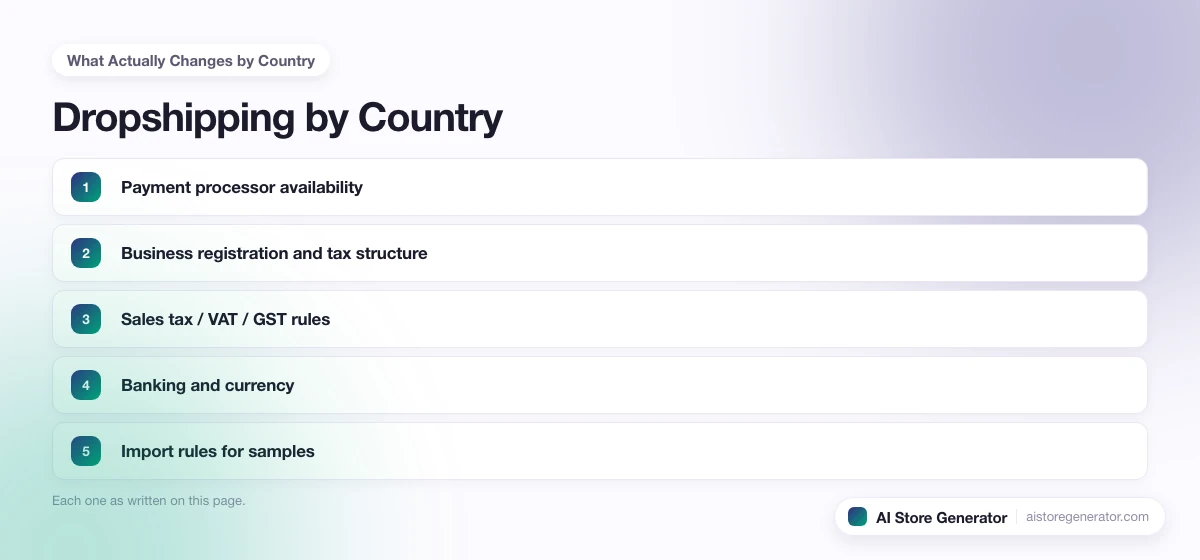
- Payment processor availability. Shopify Payments, Stripe, PayPal, and 2Checkout all have different country coverage. This is usually the biggest single constraint.
- Business registration and tax structure. Whether you can sell as an individual, what counts as a sole trader, when and how to register a formal business, and what tax rates apply.
- Sales tax / VAT / GST rules. Whether you must collect tax from customers, registration thresholds, and how to remit.
- Banking and currency. Whether you can open a business bank account, what currencies your bank supports, and how foreign-currency payouts get treated.
- Import rules for samples. Tariffs, duty, and customs forms for the small inbound shipments most dropshippers eventually order.
- Consumer-protection law. Refund windows, mandatory disclosures, and product-safety rules that apply when selling to customers in that country.
- Where your customers live. Often more important than where you live. Taxes and consumer law usually follow the customer’s country, not yours.
Everything else (product selection, supplier choice, ads, store structure) works largely the same way globally.
Where to Sell from vs Where to Sell to
This is the question most beginners conflate. There are two separate decisions:
- Where you set up the business: your residence, banking, registration, income tax.
- Where you sell to: your customer base, their consumer law, their sales tax / VAT / GST.
You can run a store registered in one country that sells primarily to customers in another. Many overseas dropshippers register a US LLC to access US-only payment processors and sell to US customers, even though they personally live elsewhere. This works but adds ongoing filing requirements and accounting complexity. It is usually worth it once revenue justifies the cost, not before.
Common Starting Countries for English-Speaking Dropshippers
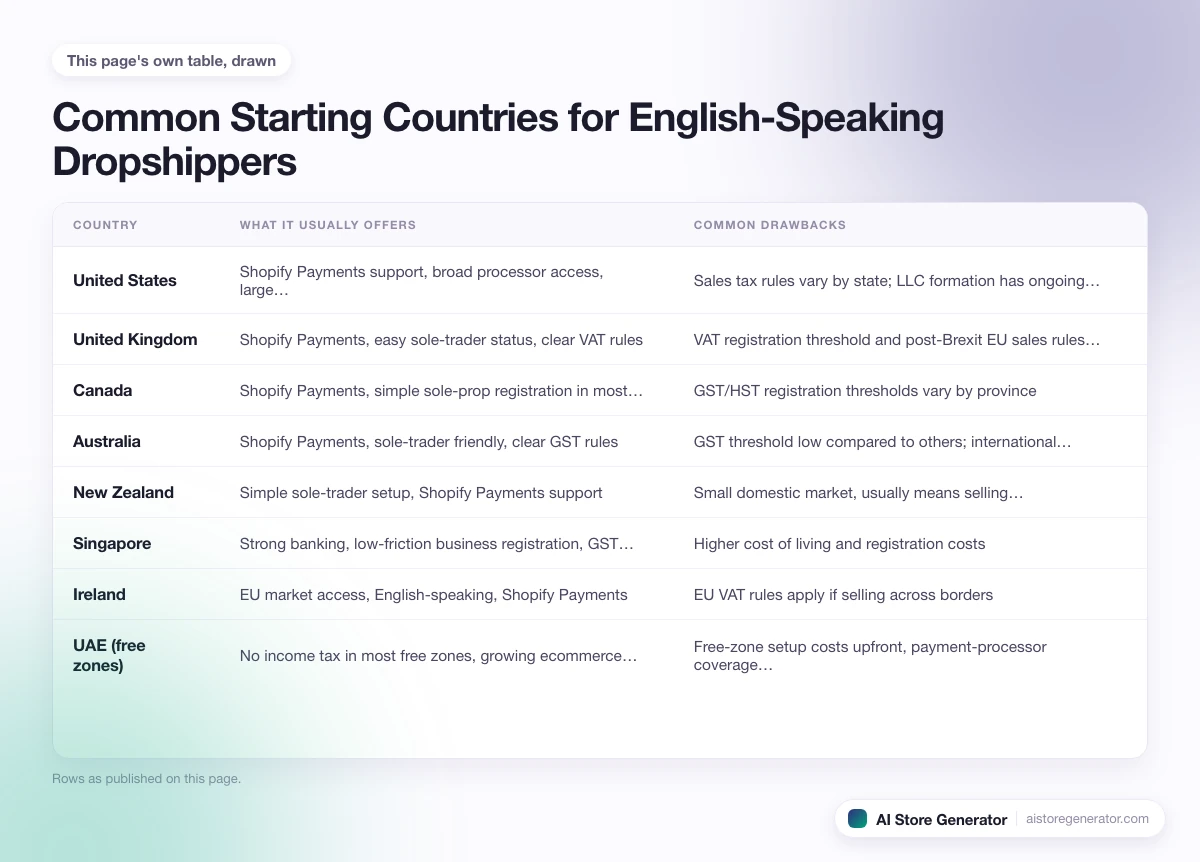
These are commonly used starting points. Each comes with tradeoffs. None of the descriptions below are a substitute for confirming current rules with a local accountant.
| Country | What it usually offers | Common drawbacks |
|---|---|---|
| United States | Shopify Payments support, broad processor access, large domestic market | Sales tax rules vary by state; LLC formation has ongoing filing costs |
| United Kingdom | Shopify Payments, easy sole-trader status, clear VAT rules | VAT registration threshold and post-Brexit EU sales rules add complexity |
| Canada | Shopify Payments, simple sole-prop registration in most provinces | GST/HST registration thresholds vary by province |
| Australia | Shopify Payments, sole-trader friendly, clear GST rules | GST threshold low compared to others; international shipping costs higher |
| New Zealand | Simple sole-trader setup, Shopify Payments support | Small domestic market, usually means selling internationally |
| Singapore | Strong banking, low-friction business registration, GST clarity | Higher cost of living and registration costs |
| Ireland | EU market access, English-speaking, Shopify Payments | EU VAT rules apply if selling across borders |
| UAE (free zones) | No income tax in most free zones, growing ecommerce infrastructure | Free-zone setup costs upfront, payment-processor coverage still developing |
| India | Large domestic market, strong supplier relationships, growing payment infrastructure | GST registration and compliance overhead, processor approval can be slower |
| Nigeria | Large growing market, increasing payment-processor support | International payment-processor access historically limited; check current options |
This is not an exhaustive list, and the situation in any one country can change in a single year. Use it as a starting point, not a final answer.
Selling Internationally vs Selling Locally
The other country-level decision is how much of your customer base will be local vs international:
- Local-only stores are simpler. One currency, one tax system, one set of consumer-protection rules, no international shipping complexity, faster delivery, and easier customer support.
- International stores open up a much larger market, but every additional country adds tax registration thresholds, currency conversion, slower shipping, and more refund logistics.
Many stores grow well by starting local for the first six to twelve months, then opening up specific high-fit countries once the foundation is steady. Going global on day one is usually a distraction.
Payment Processors by Region
Payment processing is the single biggest country-level constraint for dropshippers. A quick framework:
- Shopify Payments is the simplest option where available. Coverage is broad but not universal. Check the current list for your country before committing to Shopify Payments as your only processor.
- PayPal is available in many more countries but has stricter fraud holds and longer dispute windows. Usually fine as a secondary option, risky as the only option.
- Stripe is available in many countries but not all. Coverage expands over time.
- 2Checkout, Razorpay, Paystack, Flutterwave and other regional processors cover specific countries where the big players are limited. Each has its own approval requirements and fee structure.
- Direct-to-bank options (manual transfer, local payment networks) work in some markets but rarely scale for a store relying on ad-driven impulse purchases.
The right move is usually to confirm processor availability for your country before launching, not after. A store with a finished design but no working payment processor is an expensive lesson.
Common Country-Level Mistakes
The patterns that show up across many countries:
- Picking a country to register in based on tax stories online instead of confirming with a local accountant.
- Forming a US LLC as an overseas owner without realizing the ongoing US filing, state-tax, and accounting requirements.
- Launching a store before confirming Shopify Payments or PayPal is available in the country.
- Ignoring local consumer-protection rules and assuming “international” rules apply.
- Treating GST/VAT/sales tax as something to handle “once we’re bigger.” Most countries have registration thresholds that catch growing stores faster than expected.
- Trying to sell into the US, EU, and UK simultaneously on day one and burning out on tax registration paperwork.
- Choosing a country for tax optimization without considering banking, payment processors, and supplier relationships in that country.
The simpler approach: start where you live, learn the basics with the rules you understand best, then expand once the store is making consistent profit.
Where AI Store Generator Fits
AI Store Generator builds the storefront in minutes regardless of which country you operate from. Product pages, collections, ready-to-sell pages, and SEO structure are all in place from day one. The country-specific decisions (registration, taxes, payment processors, local consumer law) are still on you, and usually best handled by a local accountant once the store is real.
The tool removes the part of the setup that is the same in every country (building a good Shopify store) so you can spend your first few weeks on the parts that vary (where to register, how to handle taxes, which processor to set up first).
A Practical Country Setup Checklist
A short routine before launching from any country:
- Confirm Shopify is available in your country and supports your currency. Most countries are covered. A few are not.
- Confirm at least one payment processor works for both your country and your target customer countries.
- Identify your country’s threshold for required business registration and your country’s threshold for sales tax / VAT / GST registration. Note both.
- Open a dedicated bank account for the store even before registration is required.
- Decide where most of your customers will be. This usually decides which consumer-protection rules and tax rules apply to your sales, regardless of where you live.
- Check supplier shipping coverage to your main target markets. A supplier that ships fast to the US may not ship at all to your country, or vice versa.
- Book a one-hour call with a local accountant before crossing into formal business registration or hiring a tax advisor. Country rules change frequently, and one hour of professional time is far cheaper than guessing.
This checklist works in most countries. The exact answers behind each step are where things change.
For the broader beginner picture, the Dropshipping Basics for Shopify guide explains the model itself. If you are getting close to launch, the Start a Dropshipping Business on Shopify walkthrough covers the launch process. The Dropshipping Business Setup Guide goes deeper into LLCs, taxes, and registration. And for supplier choice, which interacts heavily with country availability, read Dropshipping Suppliers for Shopify.
When you are ready to stop researching and see a real store, AI Store Generator builds the Shopify foundation in minutes so the country-specific decisions above have a real business to attach to.
FAQ
Can you dropship from any country?
In most countries with internet access, yes. The practical constraints are payment-processor availability, banking access, and supplier shipping coverage to your target markets. A small number of countries have heavier restrictions on online business, foreign payment processors, or international shipping, but the majority of the world can run a Shopify dropshipping store.
Where is the best country to set up a dropshipping business?
There is no single best country. The strongest options usually combine wide payment-processor support, clear tax rules, easy business registration, and stable banking. The US, UK, Canada, Australia, Singapore, Ireland, and parts of the EU are common starting points. The right answer is usually wherever you actually live, unless your country lacks payment-processor access.
Can I run a Shopify dropshipping store from a country where Shopify Payments is not available?
Yes, by using alternative processors like PayPal, Stripe, 2Checkout, or regional processors specific to your country. Some store owners also register a business in a country that does support Shopify Payments. Both approaches work; both add complexity. Check current processor availability in your country before committing.
Do I need to register a business in my country to start dropshipping?
In most countries you can start as a sole trader or individual without formal registration, then register once revenue is steady. Some countries require business registration earlier; some require it only for specific types of activity. Check your country’s specific rules with a local advisor.
Should I form a US LLC if I live outside the US?
Some overseas dropshippers do this to access US payment processors and sell to US customers, but a US LLC adds ongoing filings, state-tax considerations, US-side accounting, and bank-account requirements. It is usually worth it once revenue clearly justifies the cost, not as a starting move. Confirm the implications with both a US-licensed accountant and one in your home country before forming one.
Is dropshipping legal in my country?
Dropshipping is legal in most countries because it is a fulfillment model, not a separate business type. What can be illegal is what you sell (counterfeit, trademarked, restricted items), how you describe it, or how you handle customer money. Confirm both the e-commerce rules and any product-specific restrictions where you live before launching.
Do I pay sales tax based on where I live or where my customer lives?
Usually the customer’s country. Most sales tax, VAT, and GST regimes are based on the buyer’s location, not the seller’s. Thresholds for when you must register and collect vary widely. Shopify can calculate and collect taxes automatically once configured, but you are responsible for registering in the regions where required.
How does AI Store Generator work for stores in different countries?
The same way regardless of country. The tool builds the Shopify storefront, products, collections, and SEO structure independently of where you operate from. The country-specific work (registration, taxes, payment processors, local consumer-protection rules) is handled separately by the store owner, usually with help from a local accountant once the store is earning.