
Most beginners pick a supplier the same way they pick a Wi-Fi network in a café: whichever one shows up first and looks usable. That works for Wi-Fi. It does not work for the company that will ship every order your customers ever receive. A bad supplier wrecks shipping times, damages products in transit, ignores refund requests, and quietly makes your Shopify store look like a scam, even when nothing about your branding or marketing has changed. The fix is to treat supplier sourcing like a search-and-vet process, not a one-click app install. This page walks the actual workflow: where to find candidates, how to test them, how to spot a middleman pretending to be a factory, and how to write the first outreach message so a real supplier replies.
The Short Answer
There are five workable routes to a dropshipping supplier: marketplace apps (DSers, CJDropshipping, Zendrop), curated supplier networks (Spocket, Modalyst, Doba, SaleHoo), B2B directories (Worldwide Brands, Wholesale Central, Alibaba), going direct to brands and manufacturers, and reverse-engineering the suppliers that competing stores already use. Most beginners stop at route one. The faster shipping, better margins, and stronger brand stories live in routes three through five. Whichever route you pick, the vetting is the same: order a sample, confirm the supplier is the actual seller and not a reseller of a reseller, ask the questions that surface the truth, and only then connect them to your store.
The full picture of which supplier types exist and the trade-offs between them is covered in the dropshipping suppliers overview. This page focuses only on the finding part.
Five Ways to Actually Find a Dropshipping Supplier
Each route has its place. The decision is which combination fits your niche, budget, and shipping promise.
- Marketplace apps. The Shopify app store has a long list of supplier apps that pull from AliExpress and other marketplaces and sync products to your store. Apps like DSers, CJDropshipping, and Zendrop install in minutes and give you access to millions of SKUs. Cheapest and fastest start, but shipping is slow and quality is uneven across sellers. The full AliExpress-on-Shopify workflow, from DSers setup to dispute handling and the real margin math, lives in dropshipping with AliExpress.
- Curated supplier networks. Spocket, Modalyst, Doba, and SaleHoo pre-vet suppliers and let you filter by warehouse location. Smaller catalogs, higher per-unit cost, faster delivery, fewer surprises. Worth the monthly fee once you know which products actually convert.
- B2B directories. Worldwide Brands, Wholesale Central, ThomasNet, and (for India) IndiaMART list wholesalers and manufacturers, many of whom will dropship if you ask. The directory itself is the easy part. The follow-up email is where most people give up.
- Direct to the brand or manufacturer. Find a brand you want to carry, scroll to the footer, and click “Wholesale” or “Become a Reseller”. Many small brands quietly accept dropshipping accounts even when their site does not advertise it. You get authentic products, real relationships, and a story to put on your product pages. Going direct also keeps the legal and business setup side cleaner, since you have a written supplier agreement instead of a marketplace listing.
- Reverse-engineer a competitor’s supplier. Order one product from a competitor that runs the same model you want. When the package arrives, the return address, the packing slip, and the carrier label tell you exactly who they use. Search the address. The supplier’s name is usually one Google query away.
The Vetting Workflow
Once you have two or three candidate suppliers, run each through the same test. Skipping the test is how stores end up with a supplier they regret three months later.
- Order a sample to your home address. Pay the same price a customer would. Photograph the package the moment it arrives, before opening. Check unboxing condition, packaging quality, and any supplier branding that should not be on a dropshipped order.
- Time the shipment. Note the order date, the dispatch date, and the delivery date. Compare the actual transit time to whatever the supplier promised. Suppliers who quote “7 to 15 days” and deliver in 26 will do the same to your customers.
- Inspect the product against the listing. Photos, dimensions, materials, and finish. A small mismatch on the supplier feed becomes a refund email after every other sale.
- Send a test support request. Email the supplier about a fictional damaged item. See how long they take to reply, what evidence they ask for, and whether they offer a refund or a reship. That reply is exactly what your customer will get when a real package arrives broken.
- Place a test order through your store. Even if the store is in draft, walk a full order through the supplier’s app or API. Most supplier integrations break in small ways that only show up under a real order, not a test button.
- Read the small print. Per-order fees, currency conversion, restocking fees, banned countries, and minimum payouts. The supplier app will not bring these up. The terms page usually will.
If a supplier passes all six tests, they go on the shortlist. If they fail two or more, move on. There are always more suppliers.
Factory or Middleman? How to Tell the Difference
Many “suppliers” listed on directories and Shopify apps are middlemen reselling someone else’s products. That is not always bad, but you should know which one you are working with.
Signs you are dealing with a middleman:
- Their catalog covers wildly unrelated categories (electronics, jewelry, baby clothes, garden tools) from a single warehouse.
- The product photos are stock images you can find on AliExpress with a reverse image search.
- The pricing leaves room for a 30 to 50 percent markup before resale. Factories rarely give that much room.
- The “factory tour” video is generic and could be any warehouse in any country.
Why it matters: every middle layer adds delay, error, and cost. For a starter store, a middleman is fine and often easier to work with. For a store that is scaling, removing layers improves shipping speed and margin at the same time. Many private agents in China specialize in cutting you straight to the factory once you have proof of consistent orders.
The Scam-Spotting Playbook
Most supplier scams are not exotic. They are the same three setups dressed in different fonts.
- The fake factory. A polished site, photos lifted from real factories, prices 70 percent under market, no business registration, payment only by wire transfer. Skip.
- The directory that is just a subscription. Some “supplier directories” sell you access to lists you could find for free. Look for independent reviews on Trustpilot and ask in dropshipping communities before paying.
- The supplier who only accepts crypto or Western Union for first orders. Legitimate suppliers accept normal B2B payment methods: bank transfer, PayPal for small orders, Alibaba Trade Assurance for verified vendors, or credit card through their app.
Verification moves that take 10 minutes:
- Run the supplier’s business name through their country’s company registry (Companies House in the UK, OpenCorporates internationally, the State Administration for Market Regulation in China).
- Reverse image search the “factory” photos. Stolen images turn up immediately.
- Search the supplier’s email address and phone number in quotes. Scam suppliers reuse contact details across multiple sites.
- For Alibaba sellers, check the Trade Assurance badge, transaction history, and response time on the seller profile.
Do these checks before sending any money. Once a wire is gone, it is gone.
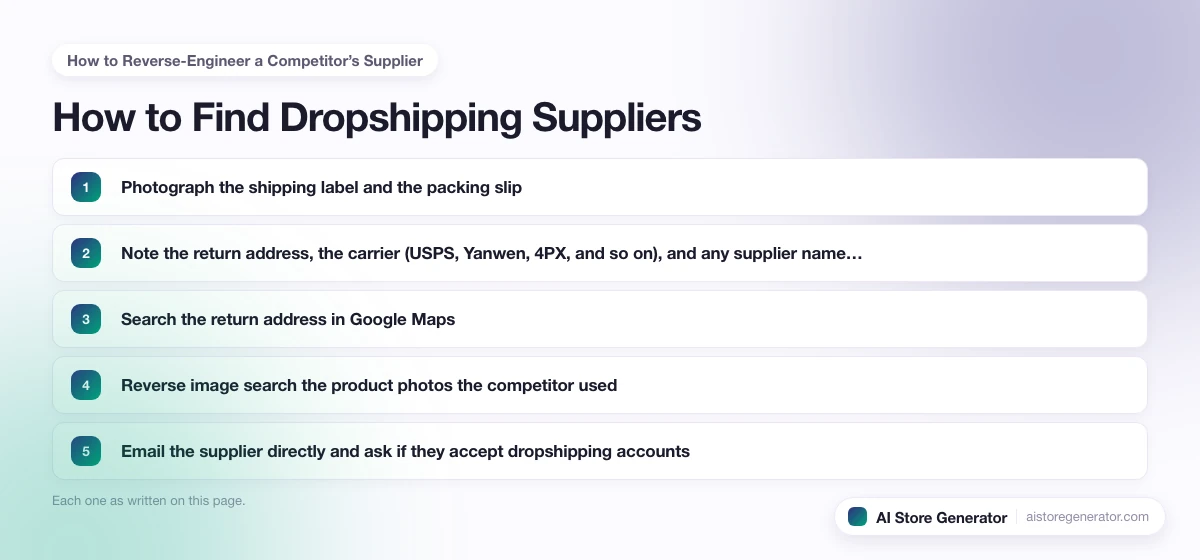
How to Reverse-Engineer a Competitor’s Supplier
Find one Shopify store in your niche that is clearly running dropshipping. Order their lowest-price product. When the package arrives, do this:
- Photograph the shipping label and the packing slip.
- Note the return address, the carrier (USPS, Yanwen, 4PX, and so on), and any supplier name printed on the slip.
- Search the return address in Google Maps. If a fulfillment center comes up, that is your supplier.
- Reverse image search the product photos the competitor used. Identical photos on AliExpress, DSers, or a Spocket listing usually identify the source.
- Email the supplier directly and ask if they accept dropshipping accounts.
Experienced sellers find suppliers their competition wishes were a secret. Nothing about it is dishonest. You bought a product, and the package told you where it came from.
Outreach: What to Say in Your First Message
Most beginners email a supplier with “Do you do dropshipping?” and never hear back. Treat it like a sales message. You are asking a stranger to set up an account for you.
A template that works:
Hi [name],
I run a Shopify store in the [niche] space selling to customers in [country or region]. I came across your [product line] and would like to add 3 to 5 SKUs to my store on a dropshipping basis.
Could you tell me: – Typical shipping time to [country]. – Whether you support dropshipping orders with no supplier branding on the package. – Per-unit cost and shipping fees for the SKUs listed below. – Payment terms and how to set up an account.
The SKUs I am interested in are: [list].
Happy to share my store URL and registration details if useful.
Thanks, [your name]
Send it from a business email, not Gmail. Include the store URL. Reply within 24 hours when they get back to you. Suppliers move on quickly if you do not. For separate templates by supplier type (marketplace seller, factory, US wholesaler, private agent), plus a phone script and a follow-up cadence, see how to contact dropship suppliers.
Where AI Store Generator Fits
Finding a supplier is the part most beginners obsess over. Building the actual Shopify store, with collections, product pages, copy, and an SEO-first structure, is the part they avoid. By the time a usable storefront exists, the supplier shortlist has gone cold.
AI Store Generator flips the order. You decide on the niche, the tool builds the store, the products, and the pages. When the supplier you picked finally replies, you are connecting them to a finished store rather than a blank Shopify trial. The supplier still ships the products. The store is no longer the bottleneck.
Common Mistakes When Finding Suppliers
- Picking on price alone. The cheapest supplier almost always ships the slowest, and shipping speed kills more stores than product cost ever does.
- Skipping the sample order. A supplier who looks great on a marketplace listing can still ship a product that ruins your refund rate.
- Importing 500 products from one feed without writing your own copy. Supplier-feed text and photos do not convert paid traffic and often get flagged by Shopify or ad platforms.
- Choosing a supplier before the store exists. You waste days comparing options for products you have nowhere to sell. Build the store first, then narrow the supplier list to the ones that actually fit.
- Trusting the supplier’s quoted shipping time without checking it. Timed sample orders settle every shipping argument before it reaches a customer.
- Picking a supplier in a region you cannot run customer support for. A 12-hour reply delay every time a customer asks where their order is becomes its own job.
- Ignoring whether the supplier allows your country to receive the products. Some suppliers quietly block destinations because of past customs or fraud issues.
A Final Checklist Before You Commit
Run a candidate supplier through this list. If they fail three or more, keep looking.
- Sample arrived within the quoted shipping time.
- Sample matches the listing photos and description.
- Supplier replied to a question within 48 hours.
- Supplier offers a clear returns or refund policy in writing.
- Supplier supports payment methods you can dispute (credit card, PayPal, Trade Assurance).
- Supplier’s business registration is verifiable in their country’s registry.
- Per-order fees, currency conversion, and shipping costs are documented.
- The supplier integrates cleanly with Shopify, or has a simple manual order flow.
- The supplier will ship without their own branding on the package.
- You can comfortably mark up the product 2 to 3 times and still match competitor pricing.
A supplier that ticks every box is rare. A supplier that ticks eight or nine is workable. Anything below that is a future problem.
FAQ
How long does it take to find a good dropshipping supplier?
With marketplace apps, you can install a supplier and order a sample the same day. Vetting a curated or direct supplier usually takes one to three weeks, including the sample order and a couple of question-and-answer rounds. Direct brand outreach can take a month, since it depends on the brand’s response time and approval process.
Do I need to buy from a supplier before they accept me?
For marketplace and curated supplier apps, no. For brand-direct accounts and many B2B directories, suppliers expect a minimum first order or proof of an active store. A small sample order is often enough to start the relationship.
Can I use multiple dropshipping suppliers at the same time?
Yes, and most growing stores do. The trade-off is mixed shipping speeds and split packages, which can confuse customers. Keep one supplier per product category whenever you can, and tell customers upfront when an order will arrive in more than one package.
What is the safest way to pay a new dropshipping supplier?
Credit card or PayPal for small orders, since both let you dispute charges if the order goes wrong. For larger orders through Alibaba, Trade Assurance protects payment if the product never arrives or does not match the listing. Avoid wire transfers and crypto for first-time suppliers.
Should I use a USA-based dropshipping supplier or an overseas one?
USA suppliers ship in three to seven days and reduce refund pressure on paid traffic stores. Overseas suppliers cost less per unit and carry a wider catalog. A common setup is overseas suppliers for testing products, USA suppliers for the proven winners. The guide to finding USA dropshipping suppliers walks through the directories, the vetting checklist, and the 24-hour test that separates real US suppliers from relabeled Chinese ones. The dropshipping by country guide covers more country-by-country detail.
How do I check if a dropshipping supplier is legitimate?
Search their business registration in the supplier’s country, reverse image search their factory photos, order a sample, and check independent reviews outside the supplier’s own site. Legitimate suppliers reply to questions within 48 hours and accept normal B2B payment methods.
What is the difference between a wholesaler and a dropshipping supplier?
A wholesaler sells bulk inventory at a discount, which you store and ship yourself. A dropshipping supplier holds the inventory and ships individual orders for you when a customer buys. Many wholesalers also offer dropshipping accounts if you ask.
Can AI Store Generator pick a supplier for me?
AI Store Generator builds the Shopify store, product pages, collections, and SEO structure for you. The supplier choice still sits with you, since it depends on your niche, budget, and target shipping speed. Once the store is built, importing your chosen supplier’s products is the last step before launch.