
A quick disclaimer before anything else: laws vary by country, state, and what you sell, and this page is general information, not legal advice. For anything binding, check the rules where you live or talk to a local lawyer. With that said, the short version is reassuring: dropshipping itself is legal in most countries. The trouble, when it happens, almost never comes from the model. It comes from what gets sold, how it gets described, and how customer money is handled.
This page explains why dropshipping is legal, the specific things that can make a store illegal, and the rules worth following from day one so the question never becomes a problem.
Short Answer
Yes, dropshipping is legal in most countries. It is a retail fulfillment method, not a separate kind of business, so the same laws that govern any online store apply to it. A dropshipping store becomes a legal problem when it sells counterfeit or restricted products, makes false claims, infringes trademarks or copyrights, or mishandles customer payments and data. Follow normal online-retail rules and the model itself is not the issue.
Why Dropshipping Is Legal
Dropshipping is just a way of fulfilling orders. Instead of stocking products yourself, you pass the order to a supplier who ships it directly to the customer. Nothing about that arrangement is inherently illegal. Retailers have sold products they do not physically hold for a very long time, both online and offline.
What matters legally is that you are running a real retail business: you take payment, you owe the customer the product they paid for, and you are responsible for the transaction. The fulfillment method behind the scenes does not change those obligations or make them illegal.
So the model is fine. The question worth asking is not “is dropshipping legal?” but “is my specific store doing anything that crosses a line?”
What Can Make a Dropshipping Store Illegal
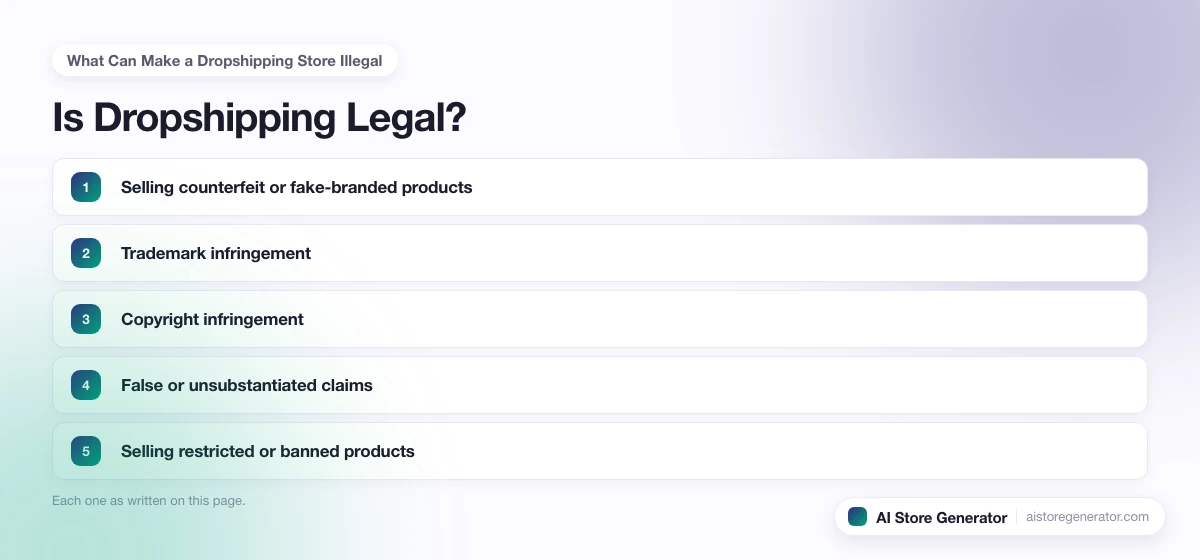
This is the part that actually matters. A store can get into legal trouble through any of these:
- Selling counterfeit or fake-branded products. Selling knockoff branded goods (fake Nike, fake AirPods, fake designer items) is illegal almost everywhere and is the fastest way to get a store shut down and sued.
- Trademark infringement. Using another brand’s name, logo, or protected design without permission, even in ads or product titles, can trigger takedowns and legal claims.
- Copyright infringement. Copying product photos, videos, or descriptions from other brands or creators without rights to them.
- False or unsubstantiated claims. Health claims, financial-return claims, or safety claims you cannot back up. This is heavily regulated in most countries, especially for supplements, cosmetics, and electronics.
- Selling restricted or banned products. Items that are illegal to sell or import in your customer’s country (certain electronics, weapons, some supplements, recalled goods).
- Mishandling customer money. Taking payment and failing to deliver, running deceptive refund practices, or hiding key terms at checkout.
- Ignoring consumer-protection law. Not honoring mandatory refund windows, hiding shipping times, or failing required disclosures where your customers live.
- Mishandling customer data. Ignoring privacy rules like the EU’s GDPR or California’s CCPA when you collect and store customer information.
Notice that none of these are about dropshipping as a model. They are about specific choices a store owner makes. Avoid them and the legality question disappears.
Product Choice Is Where Most Legal Risk Lives
The single biggest legal risk in dropshipping is the product. Marketplace suppliers carry an enormous range of items, and a meaningful share of them are counterfeit, trademark-infringing, or restricted in some markets. For a plain list of the product categories that are off-limits or risky to sell, see what you can and cannot dropship. That is one of the five kinds of risk covered in is dropshipping safe, which walks through what to check on suppliers, customer data, and platform policies too.
A few rules that prevent most product-related trouble:
- Do not sell anything carrying a brand name or logo unless you have written permission to resell it.
- Be cautious with “inspired by” or lookalike products of famous designs; some cross into trademark or design infringement.
- Avoid categories with heavy regulation unless you understand the rules: supplements, cosmetics, medical devices, baby products, electronics with wireless components, and anything that makes a health or safety claim.
- Check whether a product is restricted or banned in the countries you sell to before listing it.
- When in doubt about a specific product, ask the supplier for documentation, or simply choose a different product. There are millions of safe options.
Do You Need a Business License or Registration to Be Legal?
Being legal and being registered are two different things. In most countries you can legally start selling as an individual or sole trader without formal business registration, then register once revenue is steady. Registration affects your tax and liability situation, not whether the act of dropshipping is legal.
The mechanics of registering, forming an LLC or local equivalent, and handling tax are covered in detail in the Dropshipping Business Setup Guide. For how the rules change between countries, the Dropshipping by Country guide covers the framework. This page stays focused on the legality question itself.
Is Dropshipping Legal on Shopify?
Yes. Shopify explicitly supports dropshipping and has supplier apps built into its app marketplace. Running a dropshipping store does not violate Shopify’s terms.
What can get a store suspended by Shopify or its payment processor is the same list as above: selling counterfeit goods, making prohibited claims, high chargeback rates from undelivered orders, or selling products on Shopify’s restricted list. Shopify’s rules mirror the law here, so a store that stays on the right side of the law usually stays on the right side of Shopify too.
The Rules Worth Following From Day One
A short list that keeps a store clearly on the legal side:
- Sell only products you have the right to sell. No counterfeits, no unauthorized branded goods.
- Write your own product descriptions and use images you have rights to. Supplier feeds are a starting point, not a free pass.
- Show honest shipping times and refund terms before checkout. Surprises at delivery cause both chargebacks and legal complaints.
- Publish clear policies. Shipping, returns, privacy, and terms pages. Shopify generates basic versions; treat them as a starting point.
- Honor refunds and consumer-protection rules in the countries where your customers live.
- Handle customer data responsibly and comply with privacy rules that apply to your customer base.
- Keep records. Order history, supplier invoices, and customer communications protect you if a dispute ever arises.
Following these is not complicated. It is mostly a matter of not cutting corners on products, claims, and policies.
Where AI Store Generator Fits
A surprising amount of legal risk for beginners comes from skipped or sloppy store pages: missing policies, copied descriptions, vague shipping terms. AI Store Generator builds a complete store structure, including policy pages and original product page layouts, so the basics that keep a store compliant are in place from the start instead of being added as an afterthought.
The tool does not give legal advice or vet your product choices. Those decisions stay with you. It removes the structural gaps that often cause avoidable problems.
For the broader picture of the model, see the Dropshipping Basics for Shopify guide. To understand exactly how the order flow works, the How Does Dropshipping Work? walkthrough covers each step. For the registration, LLC, and tax side, read the Dropshipping Business Setup Guide. And for how legal and tax rules change between markets, the Dropshipping by Country guide covers the framework.
When you are ready to see a real store with proper policy pages already in place, AI Store Generator builds the Shopify foundation in minutes.
FAQ
Is dropshipping legal?
Yes, in most countries. Dropshipping is a fulfillment method, not a separate type of business, so normal online-retail laws apply. Legal trouble comes from what you sell (counterfeit, restricted, or infringing products), how you describe it (false claims), or how you handle customer money and data, not from the model itself.
Is dropshipping legal on Shopify?
Yes. Shopify supports dropshipping and offers supplier apps in its marketplace. Stores get suspended for the same things that cause legal trouble: counterfeit goods, prohibited claims, undelivered orders, or selling restricted products. Stay on the right side of the law and you stay on the right side of Shopify.
Can you get in trouble for dropshipping?
You can if you sell counterfeit or trademarked products, make claims you cannot back up, sell restricted items, or fail to deliver what customers paid for. The model itself does not get you in trouble; specific choices do. Careful product selection and honest store policies prevent almost all of it.
Is it legal to dropship branded products?
Only with permission. Selling genuine branded products you are authorized to resell can be legal. Selling counterfeit branded goods, or using a brand’s trademarks without permission, is illegal in most countries and is the most common legal mistake new dropshippers make.
Do I need a license to dropship legally?
In most countries you can legally start as an individual or sole trader without a formal business license, then register once revenue is steady. A license or registration affects your tax and liability position, not whether dropshipping itself is legal. Check your local rules, since requirements vary.
Is dropshipping legal without an LLC?
Yes. An LLC is a business structure that offers liability protection and sometimes tax benefits, but it is not required to dropship legally in most countries. Many store owners start without one and form an LLC or local equivalent once the store is earning. See the business setup guide for the full picture.
Is it legal to use AliExpress photos for dropshipping?
Often not without permission. Supplier photos may be copyrighted by the brand or manufacturer, and using them without rights can be copyright infringement. The safer path is to order samples and take your own photos, or use images you have explicit permission to use. This also makes your store look more professional.
Does AI Store Generator handle the legal side of dropshipping?
No. AI Store Generator builds the store structure, including policy pages and original product page layouts, which removes common compliance gaps. It does not give legal advice or vet product choices. The legal decisions, product selection, and any registration or tax steps remain the store owner’s responsibility, ideally with help from a local professional.