
Asking yourself, what’s the best dropshipping niche? The good news? The best dropshipping niche ideas are just under your nose. The challenge is cutting through the noise to spot real opportunities before they become oversaturated. Dropshipping isn’t saturated, but some niches aren’t the best. We can’t give you a list of products because the best niches are always changing, but we can help you find the best niches for today.
In this guide, we’re breaking down five proven strategies that successful dropshippers use to discover the best niches. These aren’t theoretical exercises, they’re practical, actionable methods you can start using today to build your shortlist.
Whether you’re starting from scratch or looking to pivot your existing store, these strategies will help you identify opportunities that in dropshipping niches with market demand, your interests, and are also profitable dropshipping niches. You might also want to know which dropshipping niches to avoid.
5 Top Strategies to Finding the Best Dropshipping Niches
Strategy 1: The Best Niches are in Front of Your Eyes
The best dropshipping niches often hide in plain sight, in your own problems, hobbies, and daily frustrations. This isn’t just feel-good advice; it’s strategic. When you sell products you understand personally, you have an unfair advantage over competitors who are just chasing dollar signs. Own a dog? Try dog niches for dropshipping. Love jewelry? Try jewelry dropshipping.
Think about it: you already know the pain points, the language your customers use, what features actually matter, and what’s missing from current solutions. That’s market research you can’t buy.
Questions to Spark Best Niche Ideas
Grab a notebook and spend 30 minutes answering these questions. Don’t filter yourself, just brainstorm. The niche gold is often in the answers you initially dismiss as ‘too specific’ or ‘too niche.’
What products do you regularly buy and wish were better?
Everyone has products they love but find frustrating. Maybe it’s gym equipment that breaks too easily, kitchen gadgets with terrible designs, or tech accessories that never quite fit right. These frustrations signal opportunities. If you’re annoyed, chances are thousands of others are too.
What hobbies or interests do you spend money on?
Passionate hobbyists are ideal customers, they’re emotionally invested and willing to pay premium prices for quality products. Whether you’re into cycling, cooking, gaming, gardening, or photography, you already understand what products people need and what gaps exist in the market.
What problems have you solved with a product purchase?
Problem-solving products are conversion machines. Think about the last time a product genuinely made your life easier. Was it a posture corrector that saved your back during work-from-home? A cable organizer that finally tamed your desk? A pet product that reduced anxiety? These moments of relief are what customers will pay for.
What communities or forums do you participate in?
Communities form around shared interests and challenges. If you’re an active member of any online community, whether it’s a subreddit, Discord server, Facebook group, or forum, you’re sitting on a gold mine of niche ideas. These communities literally tell you what they want to buy.
What do your friends or family constantly complain about?
Recurring complaints signal unmet needs. Maybe your parent friends are always venting about toddler products that don’t work. Maybe your colleagues can’t stop talking about terrible work-from-home setups. Maybe your neighbors complain about pet supplies that fall apart. Listen to these patterns, they’re market signals.
Strategy 2: Mine Social Media Communities
Social media communities are unfiltered focus groups running 24/7. Reddit, Facebook groups, Discord servers, TikTok comment sections, and niche forums are where people openly discuss what they love, hate, want, and need. This is market research in real-time for the best dropshipping niches.
The key is knowing what to look for and how to spot patterns that signal profitable opportunities.
What to Look For in Communities
Active communities with 50K+ members
Size matters, but engagement matters more. A community with 50,000 active members who post daily is worth more than a dead group with 500,000 subscribers. Look for communities where people are genuinely interacting, asking questions, sharing photos, and having conversations.
Frequent product recommendation requests
When you see posts like ‘What’s the best X for Y?’ or ‘Can anyone recommend Z?’ on repeat, that’s buying intent at scale. These people are ready to purchase, they just need direction. If you can become the go-to resource for recommendations in a community, you’ve found your niche.
Recurring complaints about existing products
Pay close attention to frustration. Comments like ‘Why does every X break after two months?’ or ‘I wish Y existed in Z style’ are opportunities in disguise. If multiple people express the same complaint, you’ve found a gap in the market that suppliers might be able to fill.
People sharing their setups or collections
When community members proudly show off their gear, setups, or collections, they’re signaling product enthusiasm. This is passion-niche gold. These people don’t just buy, they invest in building out their hobby or interest. High lifetime value, low price sensitivity.
High engagement on product-related posts
If product reviews, unboxings, or recommendation threads consistently get hundreds of comments and upvotes, that community cares about products. They’re researching before buying, which means they’re willing to pay for quality when they find it.
Where to Start Your Research
- Reddit: Start with r/all and browse popular posts, then work through specific subreddits related to hobbies, problems, or demographics. Use the search function to find product recommendations.
- Facebook Groups: Search for groups related to specific interests, life stages, or problems. Join 10-15 groups and lurk for a week, noting common themes.
- Discord: Join servers for hobbies, games, or communities you’re interested in. The casual conversation often reveals unmet needs.
- TikTok: Search hashtags related to potential niches and watch what products creators are showcasing or complaining about.
- Niche Forums: Older-school forums still thrive for specific hobbies. Find them through Google searches like ‘[hobby] forum’ or ‘[interest] community.’
Pro Move
Don’t just lurk, participate authentically. Answer questions, be helpful, and build credibility. Once you launch your store, you’ll have a warm audience that already knows and trusts you. Just don’t spam. Nobody likes spam. If you want the best niche for dropshipping, be prepared to do work.
Strategy 3: Reverse-Engineer Successful Stores
Success leaves clues if you’re looking for the best dropshipping niches. Instead of reinventing the wheel, study stores that are already winning and learn from their playbook. This isn’t about copying, it’s about understanding what works and finding your unique angle.
When you analyze successful stores, you’re essentially seeing validated niches with proven demand. Your job is to understand why they’re successful and how you can serve the same market differently or better. Don’t count out high ticket niches.
Where to Find Successful Stores
Browse Shopify’s showcase and look for the best dropshipping niches.
Shopify regularly features successful stores built on their platform. These aren’t small operations, many are doing six or seven figures. Study their product selection, branding, messaging, and how they position themselves in their niche. What problem are they solving? Who’s their target customer?
Check what products are trending on AliExpress or Oberlo
Supplier platforms show you what niches are getting traction with dropshippers. High order volumes signal demand. Look for products with hundreds or thousands of orders, but also check the reviews. If a product is trending but has terrible reviews, there’s an opportunity to source higher quality versions.
Analyze top-selling items on Amazon in various categories
Amazon’s Best Sellers lists are pure gold for dropshipping niche research. Get into specific categories and subcategories. Notice which products have thousands of reviews and high ratings, that’s validated demand. Look for product categories where Amazon’s offerings feel generic or impersonal. That’s where you can compete with better branding and customer experience.
Follow what ads you’re seeing on Facebook and Instagram
Those dropshipping ads that keep popping up in your feed? Someone is spending money to show them to you because they’re profitable. Click through, visit the stores, study their product pages and ad copy. What angle are they using? What features are they highlighting? What’s their pricing strategy? Save these ads to a swipe file for inspiration.
Use tools like SimilarWeb to see traffic sources
SimilarWeb and similar tools reveal where successful stores get their traffic. Are they crushing it with paid ads? SEO? Social media? This tells you what marketing channels work for that niche and helps you understand who you would be competing against.
What to Analyze
When you think you find the best store, dig deeper than just the products. Look at:
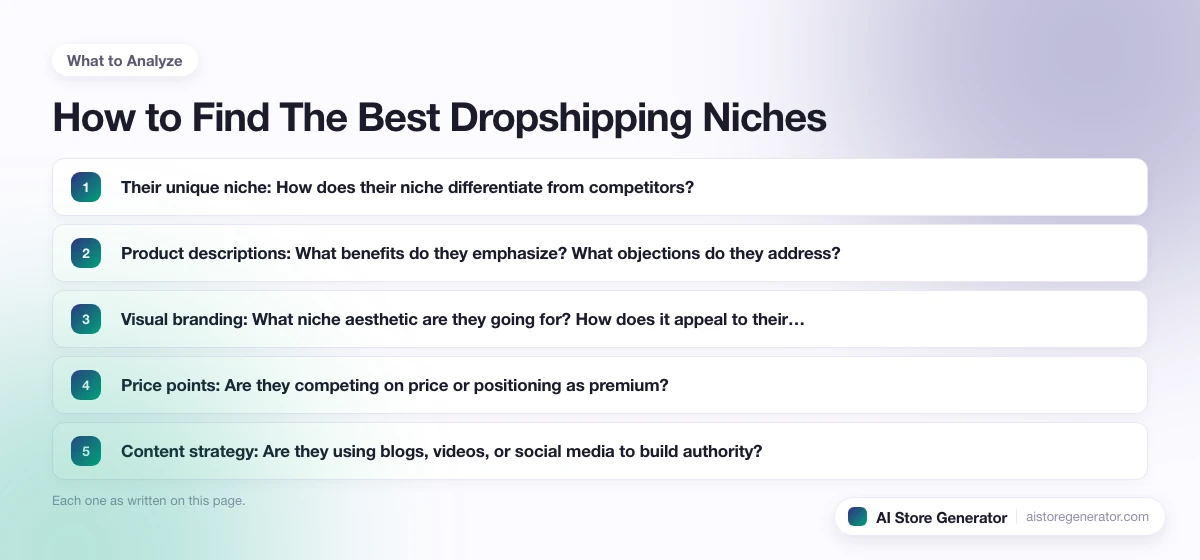
- Their unique niche: How does their niche differentiate from competitors?
- Product descriptions: What benefits do they emphasize? What objections do they address?
- Visual branding: What niche aesthetic are they going for? How does it appeal to their target market?
- Price points: Are they competing on price or positioning as premium?
- Content strategy: Are they using blogs, videos, or social media to build authority?
- Customer reviews: What do customers love? What do they wish was different?
Important Reminder
Don’t copy. Get inspired by their positioning and then find your unique niche within the bigger marketplace.
Successful stores prove that the best niches hae demand. Your job is to carve out your own space within that niche by targeting a specific sub-segment, offering better quality, creating stronger branding, or providing superior customer experience. Find the gap and fill it.
Strategy 4: Use Keyword Research Tools
Search data doesn’t lie. Every Google search, every Amazon query, every ‘near me’ lookup is a signal of what people actually want right now. Keyword research tools tap into this data to reveal opportunities hiding in plain sight.
The beauty of keyword research is that it’s objective. It’s not based on hunches or assumptions, it’s based on real search behavior from real potential customers. This makes it one of the most reliable ways to validate niche ideas before investing time and money.
Essential Tools and How to Use Them
Google Trends for spotting rising interest
Google Trends shows you whether interest in a niche is growing, stable, or declining. This is important, you want to catch waves on their way up, not on their way down. Compare multiple related keywords to see which has the most momentum. Look at regional interest to identify geographic opportunities. Check the ‘Related queries’ section for sub-niche ideas you might have missed.
Ahrefs or SEMrush for keyword volume and competition
These premium tools give you the full picture: how many people search for keywords each month, how difficult it would be to rank for them, and what your competitors are doing. Look for keywords with decent search volume (10,000-100,000 monthly searches) but manageable competition. The sweet spot is keywords where demand exists but competition hasn’t completely saturated the space yet.
Answer The Public for question-based searches
This free tool visualizes all the questions people ask about a topic. Enter a broad keyword like ‘yoga mat’ and you’ll see hundreds of actual questions people search: ‘what yoga mat is best for beginners,’ ‘how to clean yoga mat,’ ‘why yoga mat smells,’ etc. These questions reveal pain points, concerns, and needs, perfect for understanding what content to create and what products to offer.
Google autocomplete for related searches
Sometimes the simplest tools are the most powerful. Start typing a keyword into Google and watch what suggestions appear. These are real searches people make frequently. Type ‘best [your niche]’ or ‘[your niche] for’ and see what Google suggests. This can reveal sub-niches and specific use cases you hadn’t considered.
Amazon search bar for product category ideas
Amazon’s autocomplete is trained on actual shopping behavior. Start typing product-related keywords and Amazon will suggest what people are searching for when they’re ready to buy. This is buying intent at its purest. Pay attention to the specific modifiers people use, like ‘for small spaces,’ ‘for beginners,’ ‘for sensitive skin,’ etc. These modifiers often signal some of the best niches and most profitable sub-niches.
Your Keyword Research Workflow
Here’s a simple workflow to find niche ideas using keyword research:
Step 1: Start broad with Google Trends. Input 5-10 potential niche keywords and compare interest over time. Eliminate any showing declining trends.
Step 2: Take your growing or stable keywords to Ahrefs/SEMrush. Check search volumes and keyword difficulty. You want monthly searches between 10K-100K and keyword difficulty under 40 (on a 100-point scale).
Step 3: Run your top keywords through Answer The Public. Review the questions people ask and note recurring themes or pain points.
Step 4: Use Google and Amazon autocomplete to discover long-tail variations and specific sub-niches.
Step 5: Compile a list of 10-15 niche ideas with supporting data: search volumes, trends, and key customer questions.
Pro Tip
Don’t just focus on head keywords (broad terms). Look for long-tail keywords (specific phrases) that signal strong buying intent. ‘Yoga mat’ is broad. ‘Best eco-friendly yoga mat for hot yoga’ is gold, it shows someone who knows exactly what they want and is ready to buy.
Strategy 5: Explore Emerging Trends
Some of the best dropshipping niches are early birds to the scene. Getting in early on a rising trend can be incredibly lucrative. The key word here is ‘early’, too soon and there’s no market yet; too late and you’re fighting established players. Timing is everything.
Trend-based niches can generate quick wins and explosive growth, but they require vigilance and the willingness to pivot when the trend matures. Use this strategy alongside evergreen approaches for a balanced portfolio.
Where to Spot Emerging Trends
TikTok trending hashtags and viral products
TikTok is the trend engine of Gen Z and millennial culture. When a product goes viral on TikTok, demand explodes overnight. Follow trending hashtags in your areas of interest. Watch what products creators are showcasing, reviewing, or incorporating into their content. Pay attention to comment sections, people asking ‘Where can I buy this?’ is your signal.
Instagram explore page and trending reels
Instagram’s algorithm surfaces trending content based on your interests. Regularly browse your Explore page and watch for product-related content gaining traction. Reels showcasing products, aesthetic setups, or problem-solving items often signal emerging demand. Save posts that interest you and revisit them weekly to see if traction is growing.
Pinterest trending searches
Pinterest publishes trend reports and shows trending searches in real-time. Because Pinterest users plan ahead, weddings, home renovations, fashion for next season, the platform can signal trends before they hit mainstream. Check Pinterest Trends regularly and note rising search terms related to products.
Tech and lifestyle publications
Publications like TechCrunch, The Verge, Wirecutter, BuzzFeed, and lifestyle blogs often cover emerging products and trends before they go mainstream. Set up Google Alerts or RSS feeds for topics you’re interested in. When these publications start covering a niche, consumer interest usually follows.
Kickstarter and Indiegogo for new products
Crowdfunding platforms showcase innovation in real-time. Browse successfully funded projects to see what resonates with backers. Look for projects that exceeded their funding goals by 500%+ – that’s validated demand. You can’t dropship the exact products, but you can identify product categories and features that consumers are excited about, then source similar items.
Trade shows and industry reports
Industry trade shows and reports preview what’s coming to market in 6-12 months. While you might not attend in person, many publish recap articles, highlight reels, and trend reports.
The Trend Timeline Framework
Not all trends are created equal. Understanding where a trend sits in its lifecycle helps you make smarter decisions.
Early Stage (Innovators): Only a small group knows about it. Risk: No market yet. Reward: First-mover advantage if it takes off.
Growth Stage (Early Adopters): Gaining momentum but not mainstream yet. This is your sweet spot, proven demand without massive competition.
Peak Stage (Mainstream): Everyone knows about it, competition is fierce. You can still succeed with superior execution, but margins compress.
Decline Stage (Late Majority): Interest is fading. Unless you’re getting in with deep discounts or pivoting to a sub-niche, avoid.
One Caution
Jumping on fads can work for quick wins, but building a sustainable business requires evergreen demand. Choose wisely.
The best approach to finding a niche? Build your foundation on evergreen products that will sell all year-round, then layer in trending products as they emerge. This gives you stability with upside potential. Don’t bet your entire business on a trend that might be gone in six months. For the full method on choosing each product, see our guide on how to find products to dropship.
Check the Cost of the Traffic, Not Just the Demand
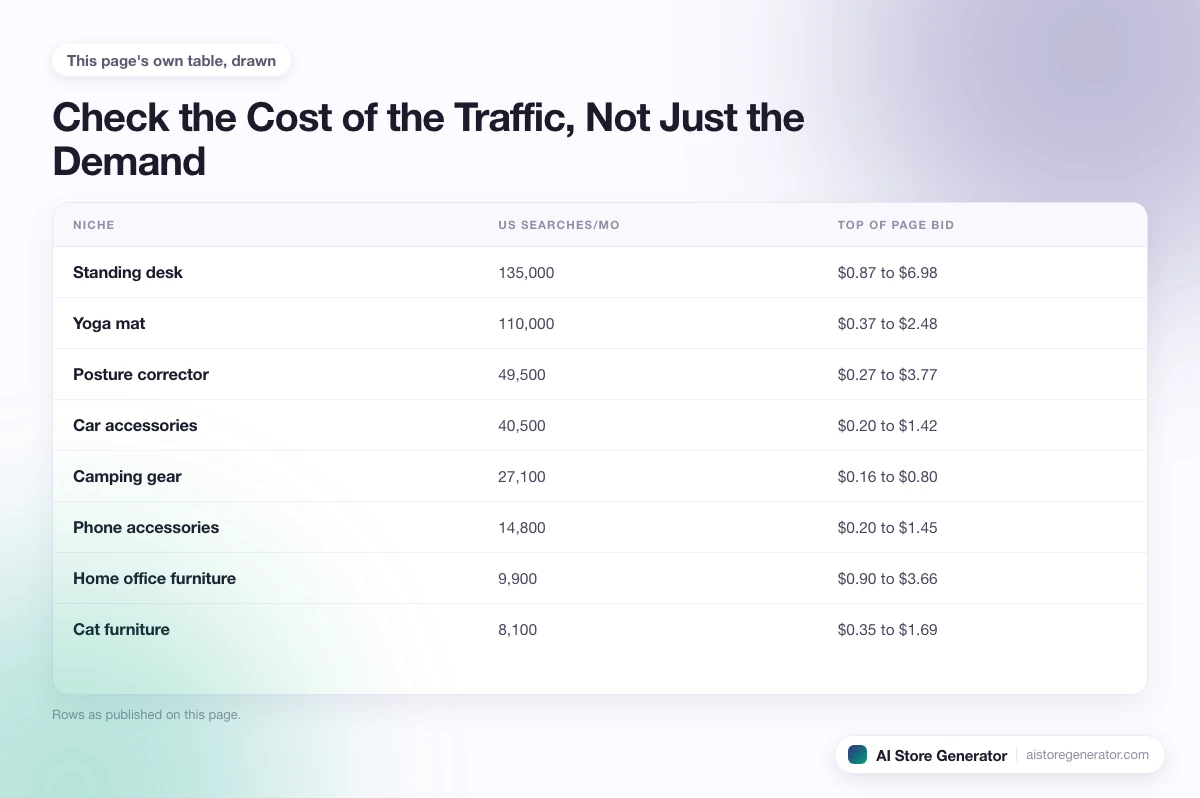
Every niche list you will read ranks ideas by search volume. Volume tells you how many people want the thing. It says nothing about what it costs to reach them, and that second number is what decides whether a store makes money. We pulled both figures for nine common dropshipping niches from Google’s own keyword data on 29 September 2026, US searches, so you can see how differently they behave.
| Niche | US searches/mo | Competition | Top of page bid |
|---|---|---|---|
| Standing desk | 135,000 | High | $0.87 to $6.98 |
| Yoga mat | 110,000 | High | $0.37 to $2.48 |
| Posture corrector | 49,500 | High | $0.27 to $3.77 |
| Car accessories | 40,500 | High | $0.20 to $1.42 |
| Camping gear | 27,100 | High | $0.16 to $0.80 |
| Phone accessories | 14,800 | High | $0.20 to $1.45 |
| Home office furniture | 9,900 | High | $0.90 to $3.66 |
| Cat furniture | 8,100 | High | $0.35 to $1.69 |
| Dog accessories | 5,400 | High | $0.31 to $1.75 |
Read the last two columns together and the ranking changes. Camping gear gets five times the searches of dog accessories, yet its top of page bid tops out at $0.80 against $1.75, so each visitor costs less than half as much. Standing desks look like the biggest opportunity on the page until you notice the bid reaching $6.98. At a two percent conversion rate that is roughly $350 of advertising for one sale, which only works on a high ticket item with a real margin.
Run the same two checks on your own shortlist before you commit. The arithmetic is simple: divide your gross margin per order by your expected conversion rate, and if the answer is lower than the top of page bid, paid traffic will not pay for itself and you need an organic route in. That is the calculation we do first when we build a store for someone, and it rules out more niches than any trend report does.
If you would rather start from a list that has already been filtered this way, our rundown of profitable dropshipping niches and the notes on high ticket niches are the places to look next.
Putting It All Together: Finding the Best Dropshipping Niches
You now have five proven strategies for finding the best dropshipping niche ideas. The key is using them in combination, not in isolation. Each strategy checks the others. A niche that survives all five is worth building a store around.
And when you’re ready to build? AI Store Generator makes launching your Shopify dropshipping store fast and professional. Our AI handles the SEO so you can focus on marketing and growth.
Frequently Asked Questions
What is the best dropshipping niche right now?
There is no single answer that stays true for more than a few months, which is why this page teaches a method instead of publishing a list. The niches that hold up are the ones with steady year round demand, a buyer who has a problem rather than a passing interest, and traffic you can afford. Run the five strategies above and you will end up with a shortlist that fits you rather than one that fits whoever wrote the article.
How do I know if a dropshipping niche is too saturated?
Saturation shows up as cost, not as the number of competitors. Check the top of page bid for the main keywords. If reaching a buyer costs more than the margin on the order, the niche is saturated for you, whatever the competitor count says. A niche with fifty small stores and cheap traffic is easier than one with three big stores and expensive traffic.
How specific should a dropshipping niche be?
Specific enough that you can name the customer in one sentence. “Pet supplies” is a category, not a niche. “Gear for people who hike with large dogs” is a niche, because it tells you what to stock, what to write, and where the buyers already gather. Narrow beats broad for a new store, and you can widen once something sells.
Should I pick a niche I am personally interested in?
It helps, but it is not sufficient on its own. Interest gives you product judgement and stamina for the writing, which matter more than most people expect. Demand and traffic cost still decide whether the store works. Treat your own interests as the first filter and the numbers as the second.
Which dropshipping niches should I avoid?
Anything heavily regulated, anything counterfeited as a matter of course, anything where a big retailer competes on price alone, and anything whose demand peaked eighteen months ago. Our list of dropshipping niches to avoid goes through the ones that catch people out most often.
How long does it take to know whether a niche works?
Long enough to get real data through the store, which usually means a few hundred visitors rather than a fixed number of weeks. What we see go wrong is stores switching niche after a quiet fortnight, before there is enough traffic to tell a bad niche from a slow start. Decide in advance how many visitors you need before you judge it, then stick to that number.