
Picking the right product is the single biggest decision in dropshipping. Most beginners pick a trending item, run ads for a week, and watch their margin disappear after Shopify fees, ad costs, and refunds. The real skill is finding products that survive the full Shopify cost stack and keep selling once the hype dies down. That takes a method, not a list. This page gives you a repeatable system to find winning dropshipping products: 10 research methods, a 10-point scorecard, a margin worksheet, and a Shopify-fit checklist no other guide gives you.
The short answer
Find products to dropship by combining demand signals (Google Trends, search volume, ad library activity) with supply signals (AliExpress order counts, supplier vetting, sample quality) and Shopify-fit math (3x markup minimum, $15+ net per sale, under 2 lbs for fast shipping). Score every candidate on a 10-point rubric before you list it. Test trending picks at small budgets. Build the catalog around evergreen winners.
What makes a winning dropshipping product
Most product-research guides give you a vague checklist: “problem-solving, wow factor, good price point.” That’s not a method. Use this 10-point rubric instead. Score each factor 1-3. Anything under 21 total is a pass.
- Demand signal. Searches per month, ad library activity, social mentions. 3 = sustained, 2 = rising, 1 = flat or seasonal cliff.
- Margin headroom. Selling price minus product cost, shipping, payment fees, and app fees. 3 = 3x markup with $20+ net, 2 = 2.5x markup, 1 = thinner.
- Wow factor. Will it stop a thumb in the feed? 3 = yes, demonstrable on camera. 2 = nice, needs context. 1 = generic.
- Shipping weight. 3 = under 1 lb, 2 = 1-2 lbs, 1 = heavier or fragile.
- Retail availability. 3 = not on Amazon Prime or Walmart, 2 = some retail presence, 1 = widely available offline.
- Ad saturation. 3 = fresh, 2 = competitors running 30-90 days, 1 = saturated for 6+ months.
- Supplier reliability. 3 = US or EU warehouse with 3-5 day delivery, 2 = AliExpress with verified track record, 1 = unknown.
- Refund risk. 3 = simple, durable, low-defect. 2 = some risk. 1 = sized goods, electronics, fragile glass.
- Repeat potential. 3 = consumable or part of a series, 2 = optional accessories, 1 = one-and-done.
- Brandability. 3 = clear story, audience, and packaging angle. 2 = some. 1 = white-label commodity.
A product that scores 25+ deserves a real test budget. Anything lower is a distraction. Run the scorecard on every candidate before you order samples, so the math drives the shortlist, not gut feel.
10 ways to find winning dropshipping products
These methods stack. The strongest candidates show up in three or four of them at once. Pick at least four to run on every shortlist, and don’t trust a product that only surfaces in one.
1. Mine Google Trends for sustained demand
Open trends.google.com. Type the product or category. Set the range to five years. You want a flat or slowly rising line. Spikes that crash are trend traps.
Add geographic filters to see if interest holds in your target market. Click “Related queries” and “Rising” to find adjacent product terms competitors miss. A real example: searches for “ice roller face” have held steady for three years across the US, UK, and Canada. Searches for “bone conduction headphones” doubled in two years, then flattened at a higher floor. Both are research signals, not product picks yet.
2. Reverse-engineer top Shopify dropshipping stores
Find stores that look like dropshippers (single-product hero, single-niche catalog, recent Trustpilot reviews) and read their playbook. Most Shopify stores leak their bestsellers if you know where to look.
- Add
/collections/all?sort_by=best-sellingto any Shopify URL to see their actual top sellers. - Add
/products.jsonto see the full catalog with prices and variants. - Use a theme detector to identify the theme and the apps they run.
Don’t copy the store. Read the catalog. The same product sold in 20+ Shopify stores at the same price means the niche is alive. The same product sold once with three reviews means the test failed. This step alone saves weeks of guessing.
3. Spy on what’s working in ad libraries
The Meta Ad Library (facebook.com/ads/library) and TikTok Creative Center are public. Filter by region, time window, and product category. Look for ads that have been running 30 to 90 days. Anything still live after 90 days is profitable. Anything pulled in three days lost money.
Read the comments under viral ads. Buyer questions show you the objections you’ll have to answer on the product page. Save 10 ads per category to a swipe file you can reference later when you write your own creative.
4. Sort AliExpress and Alibaba by orders, not by featured
Shop AliExpress by category. Sort by orders, high to low. The “Goldilocks zone” sits between 1,000 and 50,000 orders. Under 1,000 means the product hasn’t proved itself. Over 50,000 means the market is saturated and Shopify resellers compete on price. Once a product proves itself, many sellers move the same item to factory pricing by sourcing it on Alibaba.
Click through to read the product’s review distribution. A healthy product runs 4.5+ stars with photo reviews from real buyers. Avoid listings dominated by 5-star reviews with no text and a few 1-star complaints about counterfeits.
5. Watch Amazon Best Sellers and Movers and Shakers
amazon.com/bestsellers shows daily category leaders. The Movers and Shakers report shows products with the steepest 24-hour rank gains. Both are early signals before a product hits TikTok.
Filter to subcategories that match your niche. Cross-reference the top 10 against AliExpress to see which products you can dropship under the Amazon price. The bigger the gap, the wider the margin window.
6. Use AI to cluster and score ideas
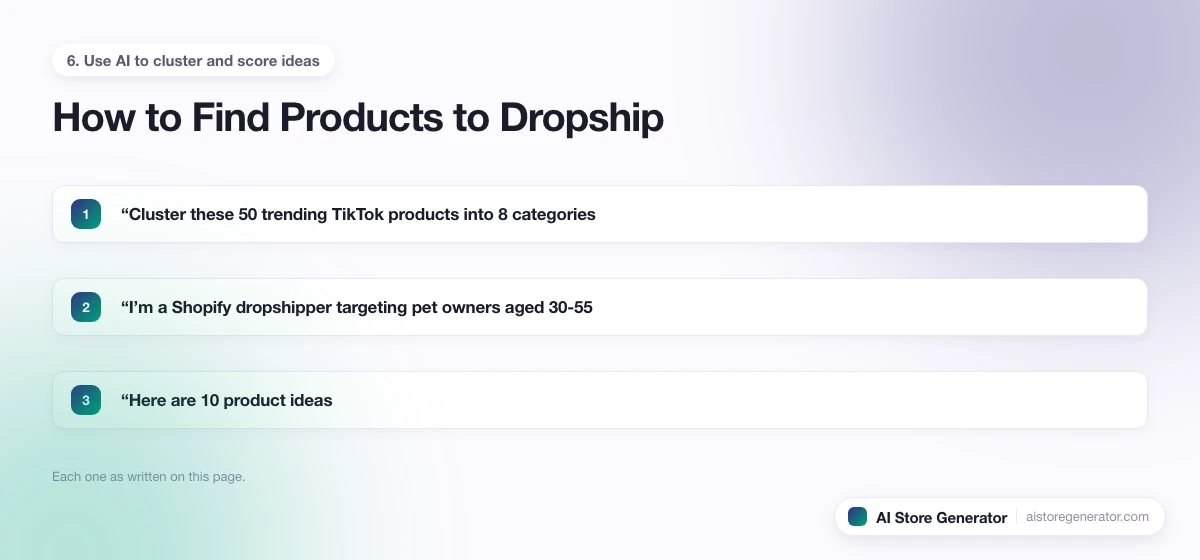
This is the angle most product-research guides skip. AI models can do in 10 minutes what would take a week of manual research. Three prompts you can paste straight into ChatGPT or Claude:
- “Cluster these 50 trending TikTok products into 8 categories. Score each cluster 1-10 on dropshipping fit using these criteria: shipping weight, margin headroom, refund risk, brandability.”
- “I’m a Shopify dropshipper targeting pet owners aged 30-55. List 20 product ideas that solve a specific frustration mentioned in this batch of Amazon reviews.”
- “Here are 10 product ideas. For each one, write the three biggest objections a Shopify customer would have, and a sentence that answers each objection.”
An AI shortlist is a reason to look, never a reason to list. That distinction, and the other places AI helps or quietly costs you money in a store, is the subject of our page on AI dropshipping.
The output is a starting point, not the answer. You still validate every idea with Google Trends, ad libraries, and supplier checks. But AI compresses the brainstorming step from days to minutes, and it surfaces angles you wouldn’t think to search for.
7. Mine Amazon and AliExpress reviews for unmet pain points
Open a top-selling product in your category. Read every 3-star review. People buy products and post 3-star reviews when something is almost right but not quite. That gap is the product opportunity.
A bestselling cat water fountain with 12,000 reviews has hundreds of complaints about the pump running dry. That review pile is a feature brief for a smarter fountain with a low-water alarm. Find a supplier on Alibaba that already makes one. You just found a product with built-in proof of demand and a clear angle competitors aren’t using.
8. Track viral product hashtags on TikTok and Pinterest
#TikTokMadeMeBuyIt has been tagged on more than 100 billion views. Sort by “recent,” not by “top.” Recent shows what’s selling now. Top shows what sold a year ago.
Pinterest Trends (trends.pinterest.com) shows search momentum 6-12 months ahead of Google Trends. Pinterest users plan purchases earlier than TikTok users react to ads. Use Pinterest for evergreen home, beauty, and craft products. Use TikTok for impulse-buy gadgets that demo well on camera.
9. Read Reddit, Etsy, and Kickstarter for unmet needs
Reddit threads in r/BuyItForLife, r/CrappyDesign, r/somethingimade, and niche communities flag products people want but can’t find at the right price. Etsy “trending” surfaces handmade categories about to go mainstream. Kickstarter shows what hardware buyers funded with their own money in the last 90 days.
Each platform skips the fake hype of paid ads. The signal is “people put their own money toward this.” That is stronger than a million paid impressions on a product nobody actually bought.
10. Build a wishlist from your own frustrations
Keep a running note of every product you wish existed. Every conversation where someone says “they should make X” goes in the note. Once a month, run the list through the scorecard above and against Google Trends.
Half of the durable dropshipping niches started this way. The founder noticed a gap in their own life, looked for it, found nothing, and built a store around the solution. Stores built this way also write better copy, because the founder already speaks the buyer’s language.
The margin worksheet
A 3x markup looks great until you do the real math. Run every candidate through this worksheet before you list it. Each line is a real cost most beginners forget.
- Product cost. Quoted by the supplier, including any sample shipping fee averaged across the test.
- Inbound shipping. Per-unit cost from supplier to fulfillment.
- Outbound shipping. Per-unit cost from fulfillment to buyer. Use your slowest expected route.
- Payment processor fees. Roughly 2.9% + $0.30 for Shopify Payments in the US. Higher for international cards.
- Refund and return rate. Build in 3-8% by default. Higher for sized goods or fragile items.
- App and platform fees. Shopify plan, upsell apps, email tool, fulfillment app. Convert to a per-order cost.
- Customer acquisition cost. Real ad spend per converted customer, not per click. New stores commonly spend $25-45 per first-time buyer.
Subtract every line from your selling price. The remainder is your true net per sale. Anything under $15 net is fragile. Anything under $10 is a hobby.
The math also tells you the right selling price. If your scorecard says the product is worth selling but the math says you need $59 instead of $39 to clear $20 net, raise the price. Buyers pay for a clear value story, not for a discount on a commodity.
Shopify-specific product fit
A product that works on Amazon may not work on Shopify. Shopify dropshippers carry a cost stack Amazon sellers don’t, and they earn traffic differently. Three filters every candidate has to pass.
AOV survives Shopify Payments fees. If your average order value is under $25, the flat $0.30 processor fee eats noticeably into margin. Aim for $35+ AOV through bundles, upsells, or a higher base price. The fixed-fee math punishes low-ticket stores hardest.
Shipping route matches the buyer. A US buyer who waits 18 days for a package from Yiwu refunds more, chargebacks more, and writes worse reviews. Use a US-based 3PL or a supplier with a US warehouse for any product over $25. Faster shipping is the single biggest lever on refund rate.
Product story supports a content moat. Search-driven traffic compounds. Pure ad-driven traffic does not. Pick products where the buyer would Google a question, read a blog post, and click through to your store. That makes the product an SEO asset, not just an ad asset.
The third filter is the one we lean on hardest when the AI Dropshipping Store Builder sets up a new store. The catalog fills with products that have search-supported demand, not just paid-ad demand, so the store earns organic traffic alongside whatever you spend on ads.
The evergreen vs trending split
Every dropshipping catalog needs both. Trending products give you fast wins. Evergreen products pay the bills.
A workable split is 70% evergreen, 30% trending, weighted by inventory and ad budget. Evergreen products earn search rankings, repeat customers, and stable margins. Trending products give you cash to reinvest and test new categories. Without the evergreen base, you ride the algorithm and pay for every customer twice.
Test trending products at small budgets. Promote winners into evergreen status only after they’ve sold reliably for 60-90 days across at least two ad channels. Cut the rest fast. The trending product is a test, not a commitment.
This is the same logic we apply across profitable dropshipping niches and the best dropshipping niches to start in. The strongest stores anchor to one or two evergreen categories and use trending picks as bait at the top of the funnel.
Picking products that earn search traffic
Paid ads are rented attention. Search rankings are owned attention. The product you choose decides which kind you get.
Three SEO-friendly product traits to look for:
- There is an informational keyword buyers search before purchase. “How to clean a cat water fountain” outranks any ad for the fountain itself, and it earns clicks for free for years.
- The product solves a Googleable problem. Pain points beat aesthetics for content. A “back pain at the desk” product gives you 50 article ideas. A pretty mug gives you one.
- The price is high enough to justify writing helpful content. A $60 product justifies a 1,500-word buying guide. A $9 phone case doesn’t.
Build a content calendar that mirrors the catalog. Every product gets a buying guide, a comparison post, and an FAQ. Internal links pull readers into product pages. Over six months, that content engine compounds and lowers your cost per acquisition.
Red flags to avoid
Skip any product that hits one of these. The downside isn’t worth the upside, and the time you save not chasing it goes into a real winner.
- Hazardous shipping. Lithium batteries, aerosols, anything flammable. Couriers reject or surcharge.
- Trademark or IP risk. Branded characters, logos, sports teams. Shopify removes the listing and the supplier vanishes.
- Fragile or oversized. Glass, ceramic, mirrors. Damage rates over 5% kill the model.
- MAP-violating. Minimum advertised price rules block you from competing on cost.
- Electronic certification required. FCC, CE, RoHS. Without paperwork, customs holds shipments.
- Seasonal cliff. Pumpkin-shaped anything. Sells for 30 days, dies for 11 months.
- TikTok hype with no infrastructure. Suppliers can’t keep up, prices crash, and refunds spike when the wave breaks.
For the category-level version of this list, the page on dropshipping niches to avoid walks five of the biggest sinkholes in more detail.
Tools worth using
Free first. Paid only when the free tools stop telling you something new. The point isn’t to stack subscriptions; it’s to compress the time between idea and validated shortlist.
- Free essentials: Google Trends, Meta Ad Library, TikTok Creative Center, Amazon Best Sellers, AliExpress, Pinterest Trends, Reddit.
- Free Shopify-specific:
/products.jsonand/collections/all?sort_by=best-sellingURL tricks, plus a theme-and-app detector for any store you’re studying. - Paid research apps: Sell The Trend, Niche Scraper, Dropship.io, Ecomhunt. Useful once you have $200+ a month in margin to reinvest.
- Paid Amazon-side: Helium 10 or Jungle Scout for category sales velocity if you also cross-list.
- AI assistance: ChatGPT or Claude for clustering, scoring, objection mapping, and review mining.
Avoid stacking five paid tools at once. Most successful dropshippers run one paid research tool, the full free stack, and disciplined manual review. The discipline matters more than the tooling.
Where AI Store Generator fits
Once you have your product picks, the long part is normally building the Shopify store: theme, product pages with proper SEO, collection pages, policy pages, structured data, internal links, and a brand voice that ties the catalog together. AI Store Generator builds that full store in under five minutes around the products you choose. The catalog ships SEO-ready, with collection pages, FAQ blocks, and product descriptions targeting the keywords your buyers actually search.
You still pick the products and run the marketing. The setup work that usually eats two weeks is done before you wake up the next morning, which means you can test more product ideas in the same window of time.
Common mistakes
Even good research goes wrong when these habits creep in. Most launch failures are not bad products. They are good products tested badly.
- Falling for the first viral video. One TikTok hit is a hypothesis, not a product line. Validate it with three more methods before you list it.
- Skipping the margin worksheet. A 3x markup that ignores shipping and refunds is a 1.4x reality.
- Testing too many products at once. Two or three products per test budget, not ten. You can’t read the data with ten.
- Ignoring shipping speed. A 14-day delivery on a $39 impulse buy refunds at 12%. The cheap supplier is the expensive one.
- Buying every paid tool. Free tools cover 80% of the signal. Add paid ones only when you’ve burned out the free signal.
- Copying the catalog without copying the story. A successful store sells a brand and a problem, not a SKU list.
What to do next
Pick three products that score 25 or higher on the scorecard. Order samples. Run the margin worksheet against the real cost. If the math holds, build the store and test paid ads with a $300-500 budget split across two ad channels.
If product research is the part you wanted to skip past, anchor on one of the proven categories first. High-ticket dropshipping niches cut the margin problem in half by raising the price point. Vetted dropshipping suppliers handle the supply side once your shortlist is set. When you’re ready to launch, the walkthrough on how to start a dropshipping business on Shopify covers the launch checklist step by step.
FAQ
How many products should I research before picking one?
Build a shortlist of 20-30 candidates per niche, then narrow to three. Three is enough to A/B test creatives and not so many that you can’t read the data. After the first test, replace any product that scores under 22 on the scorecard with a fresh candidate. The shortlist should always be larger than what you’re actively testing.
What is the easiest product category for a beginner?
Pet products, home and kitchen, and beauty have the steadiest year-round demand and forgive average creatives. Beginners often get tempted by fast-moving electronics, but refund rates are higher and supplier reliability is worse. Start with categories that survive a mediocre first ad, then expand to higher-risk categories once you have repeatable creative. If you are still mapping which product categories are even open to you, and which ones are restricted, what you can dropship lays out the full picture.
How much money do I need to test a product?
A working test budget is $300-500 per product across at least seven days. Less than that and you’ll cut a winner too early because of normal day-to-day variance. The full launch math sits in how much money you need to start dropshipping, which breaks down product test budgets, store setup costs, and the working capital you need beyond ads.
Should I use AI tools for product research?
Yes, as a multiplier, not a replacement. AI models cluster ideas, mine reviews for pain points, and score candidates faster than any manual workflow. They miss real-world supplier reliability, ad fatigue, and refund patterns. Use AI to draft the shortlist. Use manual research and sample orders to validate it.
Can I dropship without picking a niche?
Technically yes. Practically, single-niche stores convert 2-3x better than general stores at the same ad spend. Customers trust a store that looks like it knows the category. Pick a niche, then pick the products inside it. The dropshipping niches guide covers how to choose one that matches your interests, budget, and ad style.
How often should I refresh the product catalog?
Review the catalog every 30 days. Add one or two new candidates from your shortlist. Cut anything that has stopped converting after a fair test. Evergreen winners get refreshed creative every 60-90 days. Trending picks get a full re-evaluation every 30, because the half-life is short and the cost of holding dead inventory is real.