
A lot of people hear about dropshipping and picture an easy way to sell things online without buying any of them first. That part is true. The full picture is a bit more interesting, and worth understanding before you spend any time building a store.
This page explains what dropshipping actually is, how the model works in practice on Shopify, what kinds of products people sell with it, and where it stops being a magic shortcut and starts being a real ecommerce business.
Short Answer
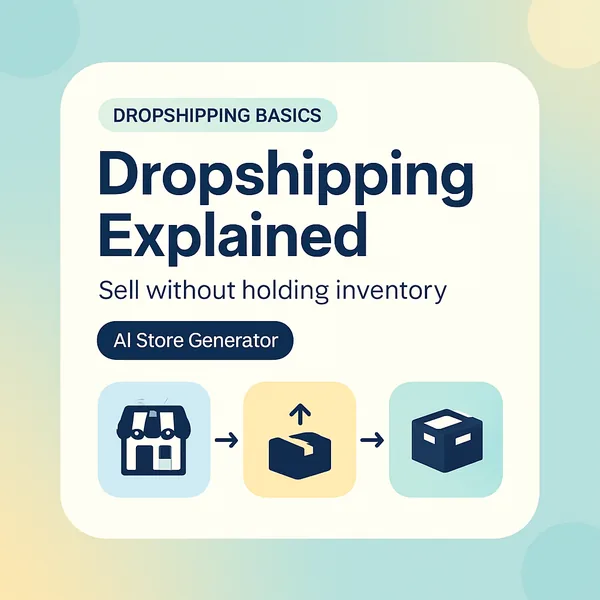
Dropshipping is a way of running an online store where you do not keep any of the products in stock yourself. A customer buys from your store, you forward the order to a supplier, and the supplier ships the product directly to the customer. You keep the difference between what the customer paid and what the supplier charged.
You handle the storefront, the marketing, the pricing, and the customer relationship. The supplier handles inventory, packing, and shipping.
That is the whole model in one paragraph. Everything else is detail about how to do it well. If you met the word somewhere else, on a supplier site or a product page you were buying from, what does dropship mean explains what it is telling you in each of those places.
A Slightly Longer Definition
Dropshipping is a retail fulfillment method, not a separate kind of business. You are still running an ecommerce store. You still need products people want, a site that earns trust, traffic that converts, and prices that leave a real margin after costs.
What changes is the fulfillment model. In a traditional ecommerce store, you buy inventory in bulk, store it somewhere, pack each order yourself, and ship it. In a dropshipping store, that whole back end is handled by a third party.
So the model is best described as:
- A storefront you own and control
- A supplier you do not own but rely on
- A workflow where customer orders trigger supplier shipments
- A margin that exists between your retail price and your total cost
The reason this is attractive is simple. You do not need to buy inventory before you know what people want.
How Dropshipping Works Step by Step
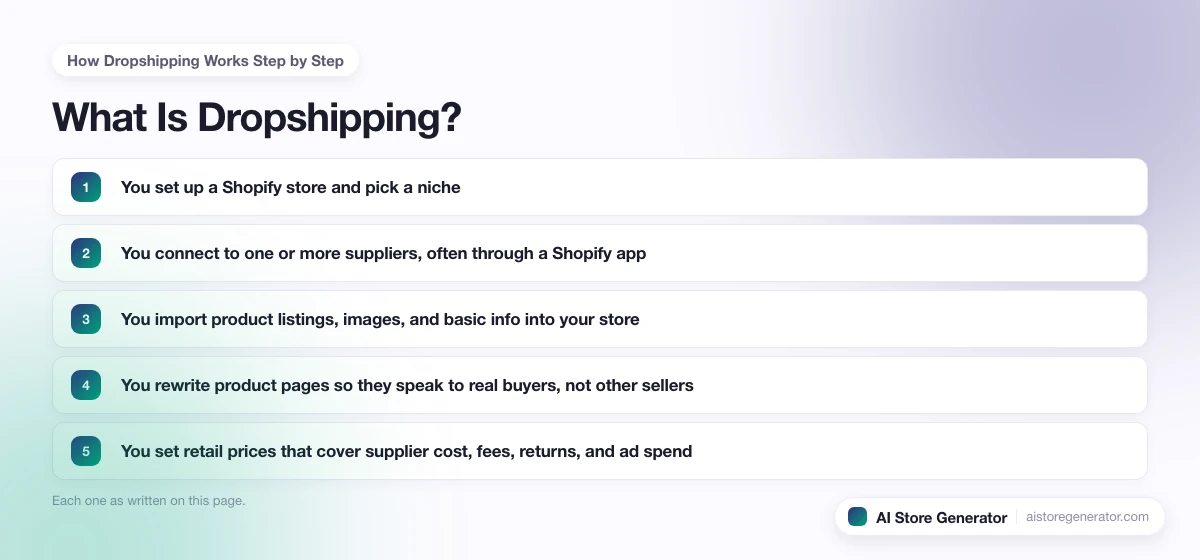
The day-to-day flow on a Shopify dropshipping store usually looks like this:
- You set up a Shopify store and pick a niche.
- You connect to one or more suppliers, often through a Shopify app.
- You import product listings, images, and basic info into your store.
- You rewrite product pages so they speak to real buyers, not other sellers.
- You set retail prices that cover supplier cost, fees, returns, and ad spend.
- You publish the store and start sending traffic to it.
- A customer buys a product.
- Shopify takes the payment and sends the order details to your supplier.
- The supplier picks, packs, and ships the product directly to the customer.
- You handle customer support, returns where needed, and any followup marketing.
You are the brand the customer sees. The supplier stays invisible. That is one of the things beginners underestimate. The customer does not care that the product came from a third party. If anything goes wrong, your store gets the email, the chargeback, and the review.
What People Sell With Dropshipping
Almost any physical product can be dropshipped, but a few categories show up again and again because they suit the model well:
- Niche pet products
- Home and kitchen tools
- Phone and tech accessories
- Print-on-demand apparel
- Jewelry and small accessories
- Beauty and skincare
- Outdoor and travel gear
- Hobby and craft supplies
- Plus-size and specialty clothing
Categories that are harder to dropship include heavy items with expensive shipping, branded products you do not have the right to resell, very low-margin commodity items, and anything with strict legal or safety rules. None of those are impossible, they just need more work and clearer suppliers.
The product question matters more than the model. A weak product on a perfectly built store is still a weak product. Dropshipping does not fix that part for you.
Why Beginners Pick Dropshipping
Dropshipping is popular because it lowers the biggest practical barrier to starting an online store: cash tied up in inventory.
In traditional retail, you might spend hundreds or thousands of dollars on stock before you ever know if customers want it. With dropshipping, that order does not happen until the customer has already paid you.
That changes what beginners can do:
- Test product ideas without committing money to inventory
- Run a store from a laptop with no warehouse
- Sell internationally if the supplier ships globally
- Switch products or niches without sitting on dead stock
- Start small and scale only what is already working
It is genuinely a useful model. It is not, however, a passive income button. The store still has to be good, the products still have to be right, and the traffic still has to come from somewhere.
What Dropshipping Actually Costs
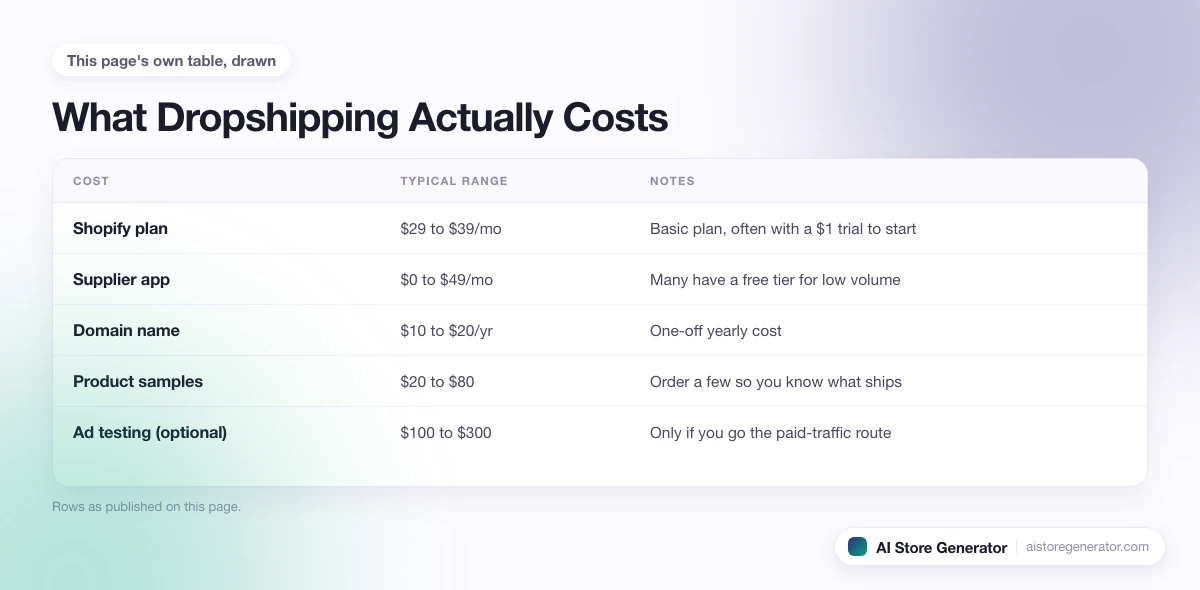
Most explanations skip the numbers, so here is a concrete picture. You save the inventory cost, but a working store still has real running costs. A typical lean start on Shopify looks roughly like this:
| Cost | Typical range | Notes |
|---|---|---|
| Shopify plan | $29 to $39/mo | Basic plan, often with a $1 trial to start |
| Supplier app | $0 to $49/mo | Many have a free tier for low volume |
| Domain name | $10 to $20/yr | One-off yearly cost |
| Product samples | $20 to $80 | Order a few so you know what ships |
| Ad testing (optional) | $100 to $300 | Only if you go the paid-traffic route |
You can realistically start for under $150 if you lean on organic traffic and skip paid ads at first. On the income side, dropshipping margins usually land between 15 and 30 percent after supplier cost, shipping, and payment fees. On a $40 order that is roughly $6 to $12 in profit before marketing. The stores that make real money keep supplier costs low and earn most of their traffic through search rather than renting it through ads.
What Dropshipping Is Not
Some of the confusion around dropshipping comes from how it is marketed online. So it helps to clear up a few things:
- Dropshipping is not affiliate marketing. You own the store, set the prices, take the payment, and own the customer relationship. Affiliates send traffic to someone else’s store.
- Dropshipping is not reselling on a marketplace. You are running your own Shopify store, not selling on Amazon or eBay under their rules. You can also do those, but they are different setups.
- Dropshipping is not print-on-demand, although print-on-demand is a type of dropshipping. With print-on-demand, the supplier prints a custom design on a blank product and ships it.
- Dropshipping is not free. You still pay for Shopify, apps, payment fees, ads, and any tools you use.
- Dropshipping is not automatic. Even with apps that import products, you still need to build the store, pick the right items, write product pages, and keep the customer experience tight.
If a guide promises a hands-off business that prints money while you sleep, that is the wrong picture of the model.
How Dropshipping Works on Shopify
Shopify is the most common platform for dropshipping because it covers the parts beginners would otherwise have to build themselves: hosting, checkout, payment, taxes, shipping settings, product management, and a large app marketplace.
A typical Shopify dropshipping setup includes:
- A Shopify plan
- A theme that suits the niche
- A supplier app or integration
- Product pages with custom copy and images
- Collection pages organized around real category searches
- Standard pages: about, contact, shipping, returns, privacy, terms
- Payment and tax configuration
- A homepage that explains the store quickly
- Some kind of plan for organic traffic, paid traffic, or both
That is a lot of moving pieces for a first-time store owner. It is also where most beginners get stuck, because the work to set up the structure correctly is bigger than it looks. If you want that launch process broken into steps, the Start a Dropshipping Business on Shopify walkthrough covers it in more detail.
Where AI Store Generator Fits
AI Store Generator was built to handle the setup work that slows people down before they ever launch.
Instead of opening a blank Shopify account and trying to figure out collections, product pages, copy, and SEO structure on your own, you describe the kind of store you want. The tool produces a Shopify dropshipping store with products, pages, collections, and an SEO-first structure already in place.
That matters because dropshipping stores are not won at the homepage level. They are won at the product page, the collection page, and the supporting content that brings traffic in. A clean structure across all of those is what separates stores that grow from stores that quietly stall.
You still own the business. You review the store, adjust anything you want, connect Shopify, and work on traffic. The difference is that you are not starting from a blank screen.
What Beginners Get Wrong About Dropshipping
This is where most beginner explanations stop, but it is the most useful part to understand.
The single biggest mistake is treating dropshipping as a product game instead of a store game. Beginners look for a winning product, import it, run ads, and expect sales. When the sales do not come, they blame the product and start the cycle over.
The pattern that actually works is the opposite. Pick a niche you can build a real store around. Build that store with proper product pages, collection pages, and supporting content. Then layer in product testing on top of a foundation that can convert traffic.
Other common mistakes:
- Pricing too low because you are afraid of scaring people off
- Using supplier descriptions on product pages with no rewrite
- Skipping policies, FAQs, and trust pages
- Choosing suppliers without checking shipping times or refund rules
- Running ads to a homepage instead of a real product or collection page
- Treating SEO as something to handle later
- Mixing too many unrelated products under one store
These are not personality flaws. They happen because nobody told the beginner that the store has to do real work even before traffic shows up.
A Quick Reality Check
Use this short test before deciding dropshipping is the model for you:
| Question | What you want to be able to say |
|---|---|
| Can you describe your customer in one sentence? | Yes, with a clear niche and a clear use case. |
| Are you ready to write or edit product pages? | Yes, even if it is just a few hours per week. |
| Can your prices cover product cost, fees, returns, and ads? | Yes, with a real margin left over. |
| Do you have a plan for traffic? | Yes, organic, paid, or a mix you can sustain. |
| Are you willing to handle customer questions? | Yes, including refunds and supplier issues. |
| Can you commit to running this for at least a few months? | Yes, long enough to learn what works. |
If most of these are a no, the issue is not dropshipping. The issue is that any ecommerce business needs those answers, and no fulfillment model removes them.
If most of these are a yes, dropshipping can be a strong way to start.
Stop Reading, Start Building
Dropshipping is easier to understand once you have a real store on your screen.
A blank Shopify account is hard to picture. A built store with product pages, collections, and a clear niche is much easier to react to. AI Store Generator gives you that starting point in minutes: a Shopify dropshipping store with products, pages, and an SEO-first structure already in place.
You decide what to keep, what to change, and how to launch. The point is to skip the part where you spend weeks reading and still have nothing to look at.
FAQ
What is dropshipping in simple terms?
Dropshipping is a way of running an online store where you do not hold any inventory. A customer buys a product from your store, you send the order to a supplier, and the supplier ships the product directly to the customer.
Is dropshipping the same as ecommerce?
Dropshipping is one type of ecommerce, not a separate business model. You are still selling products online. The difference is in how those products are stored and shipped. With dropshipping, the supplier handles fulfillment instead of you.
How much does it cost to start a dropshipping store?
You can start a lean Shopify dropshipping store for under $150. That covers a basic Shopify plan, a domain, a supplier app on a free or low tier, and a couple of product samples. Costs rise mainly if you add paid ads to test products, which can run a few hundred dollars on top.
Do I need money to start a dropshipping store?
You need some money. There are platform fees, app fees, payment fees, and usually some ad spend to test products. The savings come from not buying inventory in advance, but the rest of the store still costs something to run.
What profit margin is normal for dropshipping?
Most dropshipping stores run margins of 15 to 30 percent after supplier cost, shipping, and payment fees. On a $40 order that is roughly $6 to $12 before marketing. Keeping supplier costs low and earning traffic through search instead of ads is what protects that margin.
Is dropshipping a good business for beginners?
It can be, because it lowers the inventory risk that stops most people from starting an online store. It is not a shortcut around the work of running a real ecommerce business: choosing products, building a trustworthy store, pricing properly, and bringing in traffic.
Can AI build a dropshipping store for me?
Yes. AI Store Generator builds a Shopify dropshipping store with products, product pages, collections, and SEO structure already set up. You review the store, connect Shopify, and start working on traffic instead of building every piece from scratch.
What is the difference between dropshipping and print-on-demand?
Print-on-demand is a type of dropshipping where the supplier prints a custom design on a blank product, then ships it. The fulfillment model is the same: no inventory on your side. The product is just made to order instead of pulled from supplier stock.
How do I make money dropshipping?
Your profit is the difference between your retail price and your total cost per order. Total cost includes the supplier price, shipping, payment processing fees, returns, app and platform fees, and any ad spend. To make real money, those costs have to leave a margin you can scale.