
Search for the best print on demand sites and every result is the same page: a ranked list scored on catalogue size, base price, print quality and shipping speed. All four of those sit on each company’s own product pages, so you can check them yourself in a few minutes. What none of those lists tell you is when the money reaches your bank account, and that is the number that decides whether you can afford to keep selling. One site pays you monthly, but only after holding each sale for 30 to 60 days first. Another charges your card for production roughly 24 hours after the sale, while your own checkout takes three business days to pay you. We read eight companies’ published payment terms on 14 October 2026 and compared them on that, because it is the half of the decision nobody publishes.
Two kinds of site, and only one of them pays you
Before any comparison makes sense, split the field in two. The ranked lists mix both kinds together, which is why their scores never quite add up.
The first kind is a print provider you plug into your own store. Printify, Printful, Gelato and CustomCat work this way. You own the storefront and the checkout, so your customers pay you, not them. Then they bill you for production and shipping, and the difference is yours. Printify’s own documentation is blunt about why: it cannot withdraw money from your store’s customer payments, so it has to charge you separately. What that margin has to cover each month is worked through on our print on demand business page.
The second kind is a marketplace you sell on. Redbubble, Society6, Zazzle and Amazon Merch on Demand work this way. You upload a design and they handle the store, the checkout, the customer and the returns desk. They collect the money and pay you a royalty later, on their schedule, once you clear their threshold. You get no customer list and no control over when you are paid.
That split decides the direction your cash flows. On the store route money leaves your account before it arrives. On the marketplace route it only ever arrives, but much later than you expect.
What each site’s own terms say about getting paid
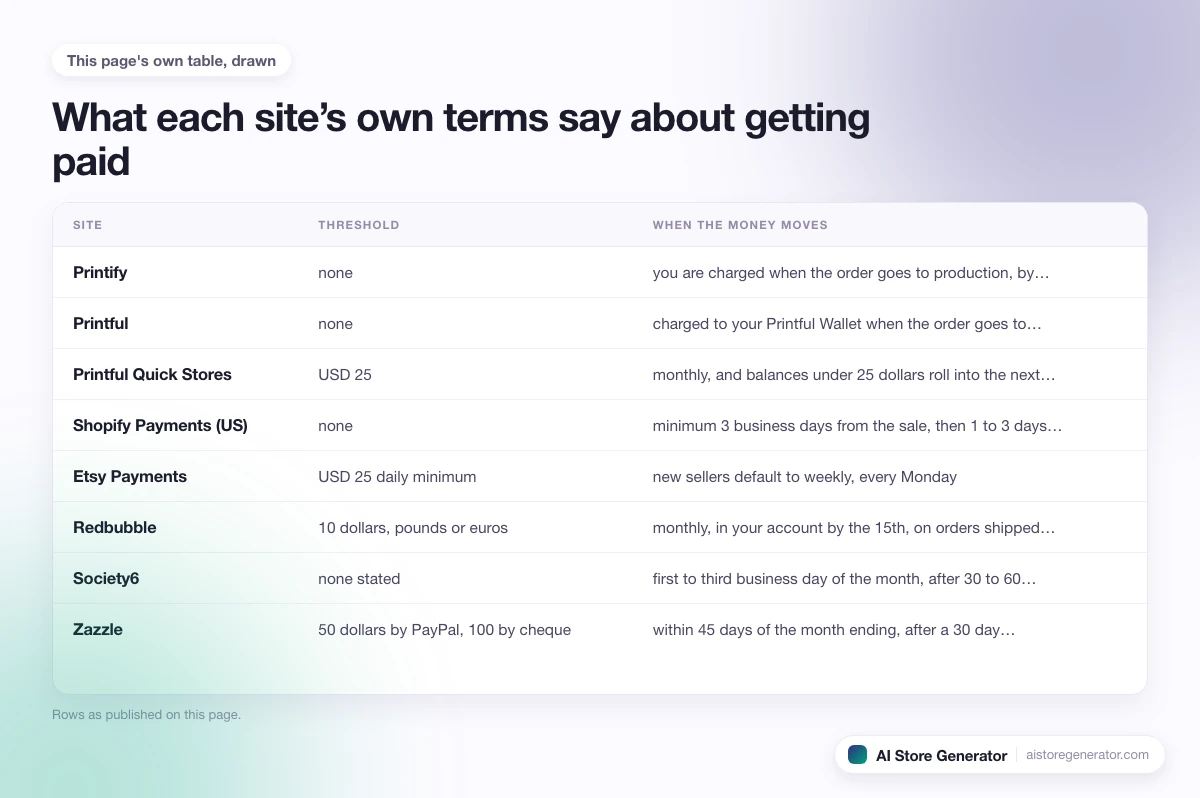
Every figure below comes from the company’s published help documentation, read on 14 October 2026. Terms change, so check the live page before you plan around a number.
| Site | Who pays you | Threshold | When the money moves |
|---|---|---|---|
| Printify | your own checkout | none | you are charged when the order goes to production, by default 24 hours after the sale |
| Printful | your own checkout | none | charged to your Printful Wallet when the order goes to production |
| Printful Quick Stores | Printful | USD 25 | monthly, and balances under 25 dollars roll into the next month that clears it |
| Shopify Payments (US) | Shopify | none | minimum 3 business days from the sale, then 1 to 3 days for your bank |
| Etsy Payments | Etsy | USD 25 daily minimum | new sellers default to weekly, every Monday |
| Redbubble | Redbubble | 10 dollars, pounds or euros | monthly, in your account by the 15th, on orders shipped the previous month |
| Society6 | Society6 | none stated | first to third business day of the month, after 30 to 60 days pending |
| Zazzle | Zazzle | 50 dollars by PayPal, 100 by cheque | within 45 days of the month ending, after a 30 day clearance |
Two things in that table are worth reading twice. Redbubble lowered its threshold from 20 to 10 on 1 July 2026, which is recent enough that most published lists still quote the old figure. And Society6 works its own example in its own documentation: an art print that ships on 15 January is paid between 1 and 3 March. That is about six weeks after the customer’s card was charged.
The gap nobody budgets for
Here is the arithmetic that catches people on the store route.
Printify charges you as soon as the order is sent to production. By default that happens 24 hours after the order lands. Shopify Payments, meanwhile, has a minimum settlement time of three business days in the United States, and Shopify counts business days only. Its own worked example says a Friday charge pays out on Wednesday, with up to three more days for your bank.
So a Friday sale looks like this. Saturday, Printify takes the production and shipping cost off your card. Wednesday at the earliest, Shopify sends you the customer’s money. You funded that order for four days out of your own pocket, and longer if your bank is slow. Nothing has gone wrong. That is the system working as designed.
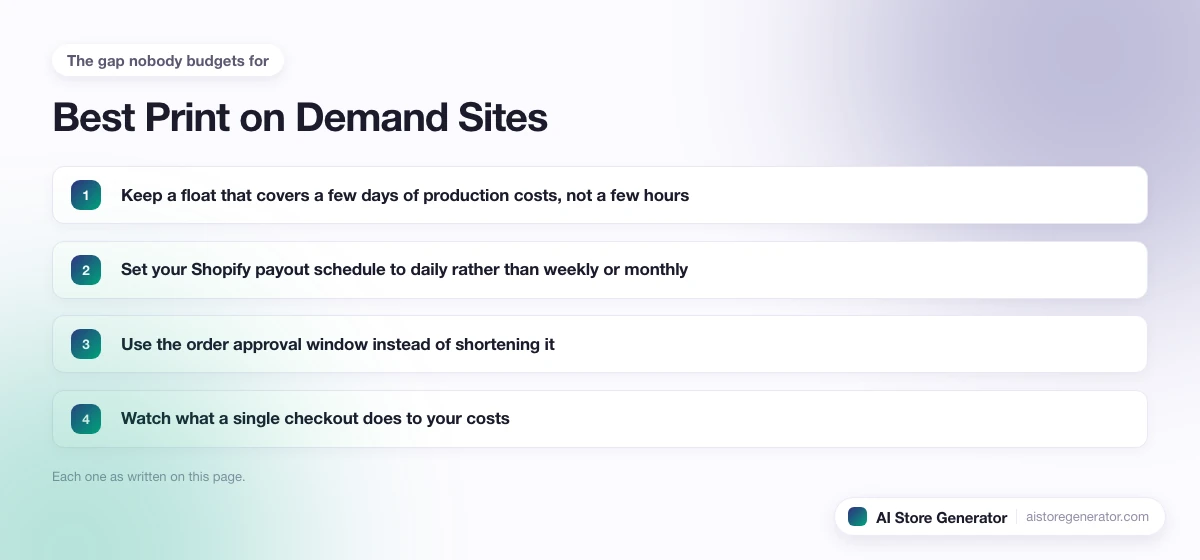
The gap does not matter on order one. It matters on order forty, in the week before a bank holiday, when forty production charges have landed and none of the matching payouts have. The fix is not clever, it is just unglamorous:
- Keep a float that covers a few days of production costs, not a few hours.
- Set your Shopify payout schedule to daily rather than weekly or monthly. All three are available, and daily shortens the gap at no cost.
- Use the order approval window instead of shortening it. Printify lets you choose manual approval, one hour, 24 hours, or a set time each day. The default of 24 hours is the one that buys you time.
- Watch what a single checkout does to your costs. Two items from two different print shops is two shipping charges to you, and that is covered on our Printful and Printify comparison.
We build these stores for a living, and the question nobody asks before launch is when the first payout lands. The instinct, once a store is live, is to speed the supplier up by setting order approval to one hour, which feels like good service and simply widens the gap you are funding. We stopped treating the launch checklist as finished until there is a float sitting behind it, because a store that cannot pay for its own orders in week three stalls for a reason that has nothing to do with the products.
Pending is not the same as paid
On the marketplace route the trap is different. The payout date is published, so people plan around it, and then the money is not there.
That is because almost every marketplace runs a clearance period before the payout clock even starts. Zazzle holds earnings for 30 days of clearance, then pays within 45 days of the month ending. Society6 holds each sale pending for 30 to 60 days, then pays in the first three business days of a month. Redbubble calculates your balance from orders that shipped in the previous month, not orders that were placed. In every case the sale has to age before it becomes payable.
Two details inside those terms are worth knowing before you choose a site.
Society6 states that an earning can be cancelled at any time before it is paid, pending or not, if the customer gets a refund. Redbubble states that if your account is suspended, your balance is frozen under its user agreement. Money you have earned on a marketplace is not money you hold.
Selling on Etsy adds a third layer
Etsy is worth its own paragraph, because plenty of people run a print provider and an Etsy shop together and get hit by both schedules at once.
New Etsy sellers are paid weekly by default, every Monday, and you can change that to daily, biweekly or monthly. There is a 25 dollar daily minimum in US dollars, so a slow day simply does not pay out. Updating your bank details puts a five day hold on your funds.
Then there is the reserve, which is the part that surprises people. Etsy can hold back a percentage of the money from every new physical sale, and its own list of triggers includes having made your first sale on Etsy. Adding tracking that Etsy can verify releases those funds early, which is the single most useful thing a new shop can do about it. Released funds land at 6pm Eastern on the day they clear. If you are weighing Etsy against running your own store, the thing to compare is not the fee percentage, it is how long each one sits on your money.
So which site is actually best
The honest answer depends on which problem you would rather have, and the payout terms tell you what each problem is.
Pick a marketplace if you have no audience and no appetite for funding orders. Redbubble, Society6 and Zazzle take the whole operation off you, including the money, and the cost is a long wait, a threshold and no customer list. The 10 dollar threshold on Redbubble is the lowest bar to a first real payment of any site here.
Pick your own store with a print provider if you want the margin and the customer list, and can carry a few days of production cost. That route pays you faster than any marketplace once it is running, because your checkout settles in days rather than weeks. It also makes you the person who answers the email when a print arrives crooked, which is compared company by company on our print on demand companies page.
If that second route is the one you want, the practical blocker is rarely the supplier. It is the store: the products, the pages, the structure that makes any of it findable. AI Store Generator builds that part for you against a print provider, so the first thing you deal with is traffic rather than setup. The full walkthrough sits in our Shopify print on demand guide, and you can start a Shopify store whenever you are ready.
Frequently Asked Questions
What are the best print on demand sites?
For selling through your own store, Printify and Printful are the two most widely used print providers, and neither charges a subscription to start. For selling without a store, Redbubble, Society6, Zazzle and Amazon Merch on Demand handle the storefront and pay you a royalty. The better question is which payment terms suit your cash position, because that differs far more between them than catalogue size does.
Which print on demand site pays out fastest?
Running your own store does, once it is going. Shopify Payments settles in a minimum of three business days in the United States, with daily payouts available. Every marketplace here is slower, because each one runs a clearance period of 30 days or more before the sale even becomes payable.
What is the lowest payout threshold in print on demand?
Of the sites checked here, Redbubble has the lowest at 10 dollars, pounds or euros, lowered from 20 on 1 July 2026. Zazzle is the highest at 50 dollars by PayPal or 100 by cheque. Shopify Payments has no minimum payout amount in the United States at all.
Do I have to pay for print on demand orders before I get paid?
On the store route, usually yes. Printify charges you when the order goes to production, which by default is 24 hours after the sale, and your own checkout takes several days to pay you. On the marketplace route you never pay anything, because the marketplace collects the money and keeps its cut before paying you a royalty.
What happens to my earnings if they are under the threshold?
They roll over. Redbubble accumulates them until you clear 10, and only deducts account fees from new earnings rather than the rolled-over balance. Printful’s Quick Stores holds anything under 25 dollars until a month clears it. Zazzle will pay out below its threshold on request, but charges a processing fee to do it.
Are print on demand sites free to start?
Printify, Printful, Redbubble, Society6 and Zazzle all let you open an account and list products without paying up front. On the store route the real cost is the first order’s production charge, which arrives before the customer’s money does.
Can I use more than one print on demand site at once?
Yes, and plenty of sellers do. Just track the schedules separately, because a store route and a marketplace route pay on completely different clocks, and running both means money going out weekly while money comes in monthly.
Which print on demand site is best for beginners?
If you want a first payment quickly and no risk, a marketplace with a low threshold. If you want to build something you own, your own store with a print provider, started with a float that covers a few days of production costs. The mistake is choosing the store route and then discovering the funding gap in week three.