
Search for print on demand companies and you get the same page fifteen times: a ranked list, scored on catalog size, base price, print quality and shipping speed. All four of those are printed on the company’s own product pages, so you can check them yourself in about ten seconds each. What none of those lists tell you is what the company does once an order has already gone wrong, and that is where the money actually moves. One company gives you thirty days to report a bad print. Another gives you ten, and says so in a clause that calls silence after day ten a complete waiver. One treats a print sitting half an inch off target as acceptable rather than defective. We read five companies’ own published policies on 7 October 2026 and compared them on that, because it is the half of the decision nobody publishes.
The two kinds of print on demand company
Before any comparison makes sense, split the field in two, because the lists that rank for this term usually mix them together.
The first kind is a print provider you plug into your own store. Printify, Printful, Gelato and CustomCat work this way. You own the storefront, the customer relationship and the email address the complaint arrives at. They print and ship. You keep the margin between your retail price and their base cost, and you absorb anything their policy declines to cover. What that margin has to cover each month, and how many orders it takes to clear it, is worked through on our print on demand business page.
The second kind is a marketplace you sell on. Redbubble, Zazzle and Merch by Amazon work this way. You upload a design, they handle the store, the checkout, the customer and the returns desk. You get a royalty instead of a margin. You also get no customer list, no pricing control, and no way to move the audience anywhere else.
That split matters more than any feature table, because it decides who answers the angry email. If you are weighing it up for a Shopify store specifically, the Shopify print on demand guide walks through the first route end to end.
What each company does when the order goes wrong
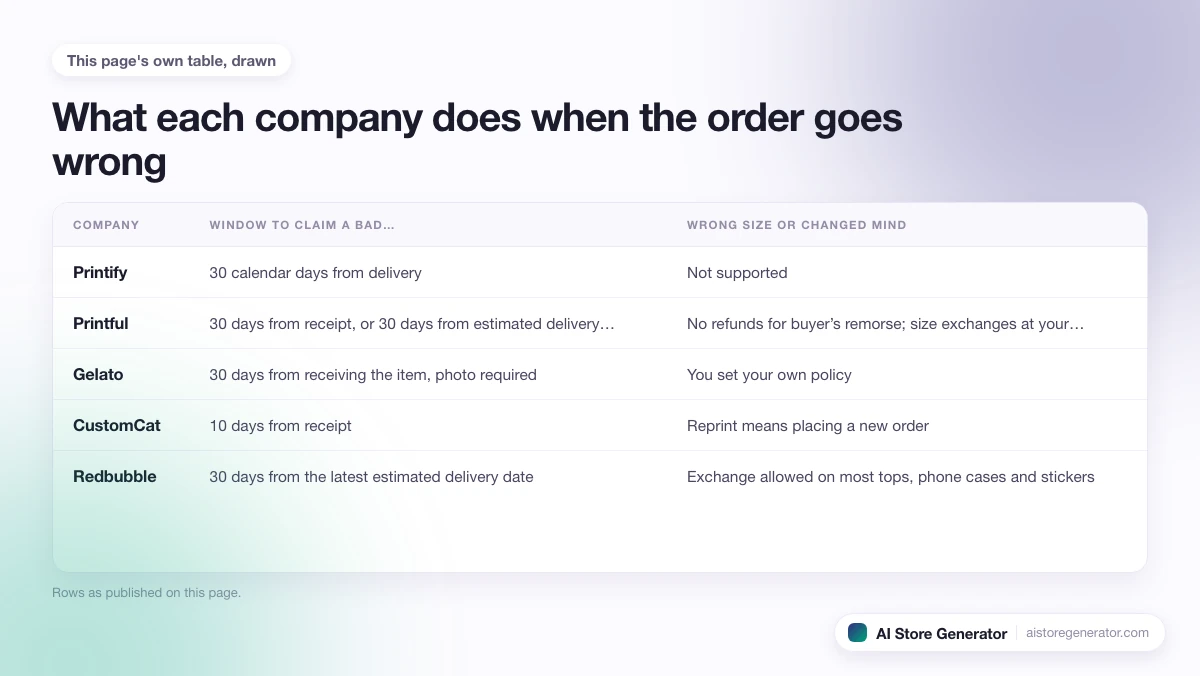
Every figure below comes from the company’s own published returns or terms page, read on 7 October 2026.
| Company | Window to claim a bad print | Wrong size or changed mind | Who faces the buyer | The clause worth knowing |
|---|---|---|---|---|
| Printify | 30 calendar days from delivery | Not supported | You | 0.5 inch print placement tolerance on DTG, DTF, embroidery and all-over print is not a defect |
| Printful | 30 days from receipt, or 30 days from estimated delivery if lost in transit | No refunds for buyer’s remorse; size exchanges at your expense and discretion | You | An address the courier calls insufficient makes you liable for the reshipment cost |
| Gelato | 30 days from receiving the item, photo required | You set your own policy | You | No returns and no return address at all, because every item is personalised |
| CustomCat | 10 days from receipt | Reprint means placing a new order | You | After day ten, their terms call it “a complete waiver of any and all such disputes” |
| Redbubble | 30 days from the latest estimated delivery date | Exchange allowed on most tops, phone cases and stickers | Redbubble | Returns valued over $250 before discounts carry a 20% restocking fee |
Five rows, and already the ranked lists look thin. Four of the five give you a month. One gives you ten days. Three of the five will not cover a wrong size under any circumstances, which means the most common complaint in apparel is a cost you carry yourself.
Printify
The widest catalog of the four store-connected providers, the lowest base costs, and a network of independent print shops rather than its own factories. That network is the trade: your order goes to whichever provider you selected, and quality varies between them.
Two things in its policy are worth reading before you commit. First, the 0.5 inch placement tolerance on DTG, DTF, embroidery and all-over-print products. A print that sits up to half an inch from where your mockup showed it is within tolerance and does not qualify for a reprint. Second, where the money goes when a claim succeeds: refunds are issued to your Printify Balance, not straight back to your card. You can withdraw it, but approval takes up to two business days and the bank can take up to ten more on top. If your billing currency is not USD or AUD, it goes back to the original payment source instead.
The claim window is 30 calendar days from delivery, no return of the faulty item is needed, and a photo is required. Wrong size, wrong colour or a change of mind are explicitly not covered. Printify is the provider we connect by default, and the print on demand service page explains why.
Printful
Prints in its own facilities, which is why its quality is the most consistent of the four and its base costs the highest. The policy is where it gets interesting, and it is the one most people have not read.
Claims for misprinted, damaged or defective items go in within 30 days of receipt. Packages lost in transit get 30 days from the estimated delivery date. Errors on their side are covered at their expense. So far, standard.
Then: buyer’s remorse is not refunded, and returns and size exchanges are “to be offered at your expense and discretion”. If you accept one, you place and pay for the replacement order yourself. If a customer gives an address the courier considers insufficient, the parcel comes back to Printful’s facility and you are liable for the cost of reshipping it. Same if the customer never claims it. And unclaimed returns sitting at their facility get donated to charity after 30 days. If you have no billing method on file, a parcel returned for a bad address is donated at your cost with no refund issued.
None of that is hidden. It is on their public return policy page. It is simply not in any of the fifteen lists ranking for this search. The other half of choosing between these two is what each app does inside your store once it is connected, which is covered in Printful vs Printify.
Gelato
Local production in more than thirty countries, which is the whole reason to pick it: a buyer in Australia gets printed in Australia, so delivery is faster and cross-border shipping costs less. For a store selling to several continents, that is a real structural advantage.
Report quality problems within 30 days of receiving the item, with a clear photo. A validated claim gets a free replacement sent to your customer, or a refund if a replacement will not arrive in time. Damage, wrong quantities and poor quality are covered when they are not caused by the artwork you supplied.
Two limits to note. Gelato does not support returns and does not provide a return address, because every item is personalised. And colour variation is explicitly excluded: they list machine type, machine settings, paper type, room humidity and how recently the machine was cleaned as factors, and state that variation from those sits within acceptable tolerance and is not covered by the quality guarantee. For orders returned to sender, you place a new order within 30 days of the estimated delivery date and they refund the product cost of it, so you pay the shipping twice but the print once.
CustomCat
US-based, fast turnaround, and the shortest claim window on this page by a wide margin. Their Terms of Service tell you to examine products for defects immediately on delivery and before any alterations, and to raise any dispute within ten days of receipt. The next line is the one to read twice: failure to notify them inside that window “shall constitute a complete waiver of any and all such disputes.”
Ten days is tight for a store owner, because the clock runs from when your customer received the item, not from when your customer told you. A buyer who opens the parcel, is annoyed, and emails you a fortnight later has already passed it. If you use CustomCat, the practical answer is an automated post-delivery email that asks the question early enough to matter.
Redbubble and the marketplace route
Redbubble sits on the other side of the split. It owns the storefront and the customer, so its returns desk is not your problem. A buyer with an imperfect item can return free within 30 days of the latest estimated delivery date and gets a replacement or a Redbubble voucher, minus shipping. Most tops, phone cases and stickers can be exchanged for a different size, style or colour inside the same window. Returns worth more than $250 before discounts carry a 20% restocking fee, and Redbubble reserves the right to refuse a return outright where it suspects abuse.
The cost of that convenience is everything downstream. A royalty instead of a margin, no customer list, no email address to remarket to, and no way to lift the audience onto a store of your own later. Marketplaces are a reasonable place to test whether a design sells. They are a poor place to build something you want to own.
The four questions to ask before you pick
Catalog size and base cost are easy to check and easy to compare, so they are already priced into everyone’s decision. These four are not.
- How many days do I get, and from when? Thirty from delivery is the norm. Ten is not. Note which event starts the clock, because delivery and your customer telling you are often a week or more apart.
- Who pays for a wrong size? Usually you. Build it into your retail price rather than discovering it on your first exchange.
- Where does a refund land? A credit sitting in a supplier balance is not the same as money back on your card, especially in month one when cash is tight.
- What counts as a defect? This is the one that decides most arguments. Half an inch of placement drift, or colour variation from room humidity, may be within tolerance and therefore yours to eat.
Answer those four before you list a single product and your first bad order is an annoyance. Skip them and it is a surprise invoice. There is a fifth question that belongs with them, which is how long each company holds your money before it pays you, and that is set out site by site on our best print on demand sites page.
What we see when we build these stores
We build print on demand stores for a living, and the supplier question we get asked is almost always about catalog size. The question we never get asked beforehand, and get asked constantly afterwards, is who pays for the return. That gap is the whole reason this page exists.
The other thing worth saying: the stores that handle a bad order well are the ones that set a returns policy on the storefront before launch, not after the first complaint. It takes twenty minutes. Most of the stores we see stall on it for months and then write it in a panic with an unhappy customer waiting.
Picking a company and getting a store live
If you have settled on the store-connected route, the sequence is a Shopify account, a supplier account, products chosen, and a storefront with its policy pages already written. Shopify runs the store itself. The supplier prints and ships. AI Store Generator builds the storefront around both, with products already listed against the supplier and the sizing, shipping and returns pages in place, which is the part people skip.
For which products are worth listing first, print on demand products that sell covers the categories that move, and the supplier comparison for Shopify goes deeper on the three store-connected providers side by side.
Frequently Asked Questions
What are the best print on demand companies?
For a store you own, the four most commonly used are Printify, Printful, Gelato and CustomCat. Printify has the widest catalog and the lowest base costs, Printful the most consistent print quality, Gelato the best economics for international orders, and CustomCat the fastest US turnaround. Best depends on where your buyers are and how much consistency you need.
Which print on demand companies are free to start?
Printify, Printful and Gelato all have free tiers, so you pay a base cost only after a customer has bought something. Paid plans on top of them mostly buy lower base costs, which only pays off at volume.
Do print on demand companies accept returns?
Mostly no, because every item is made for one order. Printify states that returns and exchanges are not supported for the wrong size, wrong colour or a change of mind. Printful does not refund buyer’s remorse and leaves size exchanges to you, at your expense. Gelato provides no return address at all. All three will replace or refund a genuine manufacturing fault.
How long do I have to report a misprint?
Printify, Printful and Gelato all allow 30 days, counted from delivery or receipt. Redbubble allows 30 days from the latest estimated delivery date. CustomCat’s terms give you ten days from receipt, after which they treat the dispute as waived.
What is print placement tolerance?
It is how far a print can sit from its intended position and still count as correct. Printify sets 0.5 inches for DTG, DTF, embroidery and all-over-print products, so a print inside that margin is not treated as a defect and does not qualify for a free reprint. Most companies have a tolerance; few publish the number.
Can I use more than one print on demand company?
Yes, and plenty of stores do, usually to cover a product one supplier does not carry or a region another ships to faster. The cost is operational: two catalogs, two sets of base costs, two claim windows and two policies to remember when something goes wrong.
Print on demand companies or a marketplace: which should I start with?
A marketplace is the cheaper way to find out whether a design sells, because it costs nothing and someone else runs the checkout. A store you own is the only way to keep the customer, the margin and the email list. If you intend to build something rather than test something, start with your own store.
Who handles customer service with print on demand?
You do, on every store-connected provider. The supplier deals with you, you deal with the buyer. Marketplaces are the exception: Redbubble’s own customer service handles returns and exchanges, which is the main thing you are trading your margin for.