
You have probably seen a headline calling dropshipping a scam. And a YouTube video calling it a passive income machine. Somewhere between the two is the actual answer, and it depends on which kind of safe you are asking about.
Dropshipping is a legal, legitimate business model. It has been for more than 20 years. But safe is not a yes or no question. There are five different kinds of risk in a dropshipping business, and you can be exposed to any of them without knowing it. This page walks through each one and shows you how to close the gaps.
The short answer
Yes, dropshipping is safe as a business model. It is not a scam, it is not a pyramid scheme, and it does not involve holding customer money in ways that are inherently risky.
What makes a specific dropshipping business unsafe is a set of decisions the owner makes: which supplier they pick, which products they sell, whether they collect the right taxes, and how they handle customer data. Every one of those is under your control. If the model itself was rigged, ten to twenty percent of dropshippers would not be running profitable stores year after year.
If you are still deciding whether the numbers work at all, read is dropshipping profitable first. Profit and safety are different concerns, and the margin math is a better place to start.
The five kinds of safe
Most articles on this topic collapse everything into one bucket. That is why they read as either “yes, it is fine” or “watch out for scams” without ever telling you what to do. Split the question into these five dimensions and the answers get concrete.
- Financial safety. Will you lose the money you put in?
- Product safety. Will the products you sell hurt or disappoint your customers?
- Legal safety. Can you get sued or fined for how you operate?
- Data safety. Are your customers’ details protected once an order runs through your store?
- Brand and personal safety. Are you exposed to scams, IP theft, and reputation damage aimed at the seller side?
Each one has its own risks and its own checks. Take them in order.
Financial safety: how much of your money is at risk
The biggest thing dropshipping has going for it is a small starting budget. You do not buy inventory before you sell. If a product does not sell, you have not lost the wholesale cost, only the cost of the store, the domain, and any ads you ran.
That still leaves real money on the table. A realistic first three months looks like this:
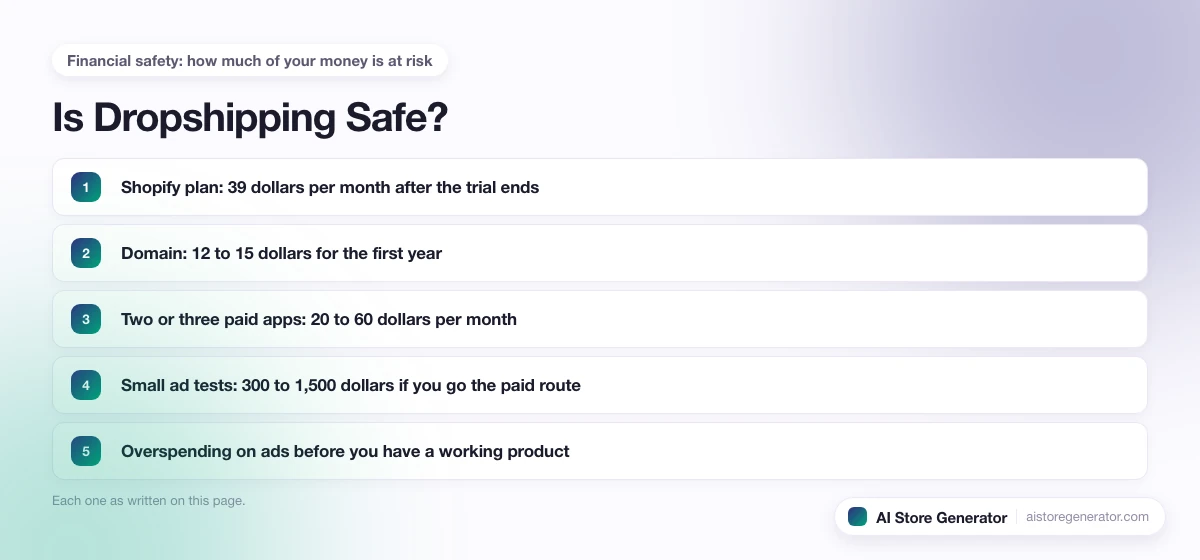
- Shopify plan: 39 dollars per month after the trial ends
- Domain: 12 to 15 dollars for the first year
- Two or three paid apps: 20 to 60 dollars per month
- Small ad tests: 300 to 1,500 dollars if you go the paid route
For a full breakdown of what you should actually plan to spend, read how much money you need to start dropshipping.
The financial risks that matter are these:
- Overspending on ads before you have a working product. This is where most of the “I lost 5,000 dollars dropshipping” stories come from. Cap early ad tests at 50 to 100 dollars per product and kill anything that does not show a signal.
- Paying suppliers outside a protected platform. If a supplier asks you to send money by wire, Zelle, or crypto instead of through AliExpress, Alibaba Trade Assurance, or a card, walk away. There is no dispute path if they disappear.
- Chargebacks eating your margin. Every refunded order costs the sale plus 15 to 20 dollars in chargeback fees. If more than one percent of your orders end in a chargeback, your payment processor will flag your store.
- Not accounting for return shipping. International returns can cost more than the product. Set your return policy so this is not a surprise.
Financial risk in dropshipping is manageable, but only if you treat every dollar spent before your first sale as tuition, not investment.
Product safety: what you are actually shipping
This is the risk most beginners underestimate. When you dropship, you are the retailer of record. If the product is dangerous, mislabeled, or counterfeit, the customer complaint, the platform strike, and any legal action come to you, not the supplier.
The main product safety risks:
- Recalled or banned items. Baby products, small magnets, unregulated electronics, and cheap batteries turn up on AliExpress after they have been recalled in the US or EU. Check the US Consumer Product Safety Commission recall database, and the EU Safety Gate database, for anything in a regulated category before you list it.
- Fake compliance marks. A CE mark or an FDA label printed on a listing does not mean the product was tested. Ask the supplier for the actual certificate as a PDF. If they cannot send one, do not sell the product in that region.
- Counterfeit or branded knockoffs. Selling anything with a Nike swoosh or an Apple logo that did not come from Nike or Apple exposes you to trademark and copyright claims. Meta ad accounts, Shopify Payments, and Amazon Seller accounts all get shut down when a brand files a report.
- Products that damage in shipping. Glass, ceramics, and anything with lithium batteries have specific packaging and courier restrictions. A supplier who says “no problem” without asking follow-up questions is not a safe supplier.
The rule that catches most of this: if you would not give the product to your own family, do not sell it. This sounds obvious, and it is the check most stores fail.
Legal safety: what can come back to you
Dropshipping is legal in every major market, but the way you run it can create legal exposure. The main areas to watch:
- Business registration and taxes. In most US states, you need a sales tax permit once you cross a nexus threshold, usually 100,000 dollars in sales or 200 transactions per year in that state. In the UK, VAT registration kicks in at 90,000 pounds. In the EU, cross-border sales use the OSS scheme. Ignoring these does not save you money; it just accumulates a bill.
- Truth in advertising. Claiming a product “cures” or “treats” anything without evidence is a Federal Trade Commission issue in the US. Same for fake urgency countdowns and inflated original prices.
- Consumer protection. Return policies must be visible before checkout in the EU. Shipping times must be disclosed clearly in the UK and Australia. Vague or missing policies can trigger regulator complaints.
- Intellectual property. You cannot sell a product with someone else’s trademark, copyrighted image, or patented design. This includes AliExpress supplier photos when the brand did not license them.
For a deeper look at the legal ground rules, read is dropshipping legal, which walks through each of these in more detail. And if you are near the point of registering your business, the dropshipping business setup guide covers the paperwork side.
Data safety: your customers’ information
When a customer buys from your store, you touch their name, address, email, phone number, and payment card. In the EU and California, mishandling any of that is a legal issue under GDPR and CCPA. Even without those laws, a data breach on your store ends the business.
The main data safety checks:
- Use a payment processor that never exposes card numbers to your store. Shopify Payments, Stripe, and PayPal all handle card data on their side. You never see it. Never store card numbers yourself.
- Vet every app before installing. A dropshipping app with access to customer orders sees every name and address. Only install apps from developers with a Shopify Partner or App Store listing and real reviews.
- Do not share customer data with your supplier past what they need for shipping. They need the customer name and shipping address to fulfill. They do not need the email address, phone number, or order value.
- Publish a real privacy policy and cookie notice. Not a template with your store name pasted in. If you use analytics, retargeting pixels, or email tools, they need to be listed.
An SSL certificate, which shows up as the padlock in the browser, is not optional. Every Shopify store has one by default, but if you ever move to a custom setup, verify it before going live.
Brand and personal safety: scams aimed at sellers
The scam stories in the news are usually about consumers getting burned by a fake store. There is another side that gets less attention: scams that target the dropshipper.
The common ones:
- Fake wholesale directories. A site charges you a membership fee to access “verified” suppliers, then the list turns out to be public AliExpress sellers or ghost accounts. Legitimate supplier discovery does not require a paid directory. See how to find dropshipping suppliers for the free methods.
- Chargeback fraud rings. A buyer orders, receives the item, then files a “did not arrive” chargeback. If you cannot show tracking that proves delivery, you lose. Always use a tracked shipping option, and enable chargeback insurance if your processor offers it.
- Fake influencer promotions. Someone offers to promote your store for a fee upfront. They vanish after payment. Never pay a promoter before you see the post live and the analytics attached.
- Ad account hijacking. Malware in a “free” Shopify theme or an unverified Chrome extension can steal your Meta or Google Ads login. Only install themes from the Shopify Theme Store or a verified partner.
- Copycat stores. Once a product starts working, another store will clone your product page, your ad creative, and sometimes your entire theme. This does not usually kill you, but it is why building on organic search and brand instead of pure ad arbitrage matters. If your niche is already saturated with copycats, read is dropshipping saturated for how to spot it early.
The 7-point supplier safety check
Most of the risk above traces back to one decision: which supplier you use. Run every supplier through this check before you list a product.
- They have been trading for at least 12 months. New accounts have not built a track record. Check the store age on AliExpress or the registration date on Alibaba.
- Reviews come from multiple buyers over months. A hundred five-star reviews all posted in the same week is a bot signal.
- They respond to a real question within 24 hours. Ask something specific about packaging, materials, or shipping speed. Vague or copy-paste answers mean nobody is home.
- They accept platform-protected payment. AliExpress escrow, Alibaba Trade Assurance, or a card. Wire transfer and crypto only means no protection.
- They can send a real product certificate for regulated categories. CE, FDA, RoHS, whatever applies. A photo of a label does not count.
- Shipping times match what they promise. Order a sample. If it takes 40 days when they said 20, your customers will get the same experience.
- They provide tracking that updates the whole way. Some cheap shipping methods stop updating once the parcel leaves the origin country. You need real end-to-end tracking or you will lose every chargeback dispute.
A supplier who passes all seven is not guaranteed to be perfect. One who fails two or more is almost certainly going to cause a problem. If you want a fuller view of the supplier side, the dropshipping suppliers guide covers the main platforms and what to check on each.
When dropshipping stops being safe
Certain decisions flip a legitimate dropshipping business into an unsafe one. If you catch yourself doing any of these, stop before you have a bigger problem.
- Using fake review widgets that generate five-star reviews you did not earn.
- Setting a fake original price and marking down to look like a discount.
- Running countdown timers that reset when the page reloads.
- Selling into a country whose laws you have not looked at, especially anything medical, cosmetic, or food.
- Refusing refunds outside a “no returns” policy that would not stand up in your customer’s local court.
- Continuing to sell a product after two or more customers report a safety issue.
Each of these is common in shady dropshipping playbooks. Each of them can end your business, either through a platform ban, a chargeback wave, or an actual legal complaint.
Where AI Store Generator sits in the safety picture
A lot of what goes wrong in a new dropshipping store happens because the owner did not know the store needed a privacy policy, a terms page, a real refund policy, or a properly configured tax setup. These are not exciting to build, so they get skipped.
AI Store Generator builds a Shopify store with the required legal pages, SEO-structured product and collection pages, and tax and shipping settings preconfigured. The point is not just speed. It is that the store ships with the boring safety and compliance basics already in place, so you do not launch a store that is quietly exposing you to legal or platform risk on day one.
That does not replace the checks in this article. You still pick the products, pick the supplier, and set the return policy. It removes the setup risk, not the operating risk.
Is dropshipping safe for beginners
Yes, with two caveats. Beginners tend to make two specific mistakes that create most of the horror stories:
- They pick the first supplier they find on AliExpress without running the 7-point check.
- They spend most of their starting budget on ads for a product that has not been validated with a small test batch.
Fix those two habits and dropshipping is one of the lower-risk ways to start an ecommerce business. You are not holding inventory. You are not signing warehouse leases. You are not making minimum-order commitments to a manufacturer. Your worst case is that your first product does not sell and you are out a few hundred dollars in ad tests and platform fees.
If you are still weighing the whole thing, how to start dropshipping walks through the practical starting steps.
Frequently asked questions
Can I lose all my money dropshipping?
You can lose what you spend on the store, the domain, apps, and ads. You cannot lose more than you put in unless you sign up for a paid course or wholesale program that requires a large upfront payment. Set a cap on what you will spend before your first sale and stick to it.
Is my customer’s credit card safe on my Shopify store?
Yes, as long as you use Shopify Payments, Stripe, PayPal, or another PCI-compliant processor. Card details never touch your store. You should still publish a privacy policy and use SSL on every page, which Shopify does by default.
Can I get sued as a dropshipper?
You can be named in a lawsuit for selling a defective product, infringing a trademark, or violating consumer protection law. Real cases exist, mostly around counterfeit branded goods and unsafe children’s products. Vet suppliers, avoid brand-imitation products, and register your business in a way that separates personal from business liability.
Is dropshipping from AliExpress safe?
The platform itself is safe. Your risk depends on which seller you pick. Use the 7-point supplier check above and stick to sellers with 12+ months of history and real reviews.
What if my supplier disappears mid-order?
If you paid through AliExpress or Alibaba, open a dispute inside the platform. You will usually get your money back. If you paid outside the platform, you have no recourse. This is the single biggest reason to never pay a supplier by wire or crypto.
Is dropshipping a Ponzi scheme?
No. A Ponzi scheme pays existing investors with money from new ones. Dropshipping sells physical products to end customers. The two have nothing in common. The confusion comes from paid “gurus” who sell courses on how to dropship, some of which are misleading. The business model itself is not a scheme.
What to do next
Safety in dropshipping is not one decision. It is a set of habits: pick suppliers who pass the 7-point check, sell products you would use yourself, keep the legal pages up to date, protect customer data, and cap spending on unproven products.
Do that and dropshipping is one of the safer online businesses you can start. Skip it and you will be one of the horror stories. When you are ready to build the store itself, the AI dropshipping store builder is the fastest way to launch with the compliance basics already in place.