
Maybe your traffic’s flatlined.
Maybe your product pages don’t rank for anything useful.
Maybe you’re just tired of guessing what “optimized” even means.
So you search for a Shopify SEO agency, hoping for a team that can finally get your products in front of buyers.
Fair. But here’s the problem:
Most “SEO agencies” aren’t built for Shopify.
And most Shopify “experts” aren’t built for SEO.
That leaves you stuck between vague promises, bloated retainers, and slow results with Shopify SEO.
This guide walks you through what to look for, what to avoid, the exact questions to ask before you sign, and how to work out whether a retainer can pay for itself. And if you’d rather skip the agency model altogether? We’ll show you a better way to launch smart from day one and how to run a free Shopify SEO audit.
What the Search Data Says About Hiring
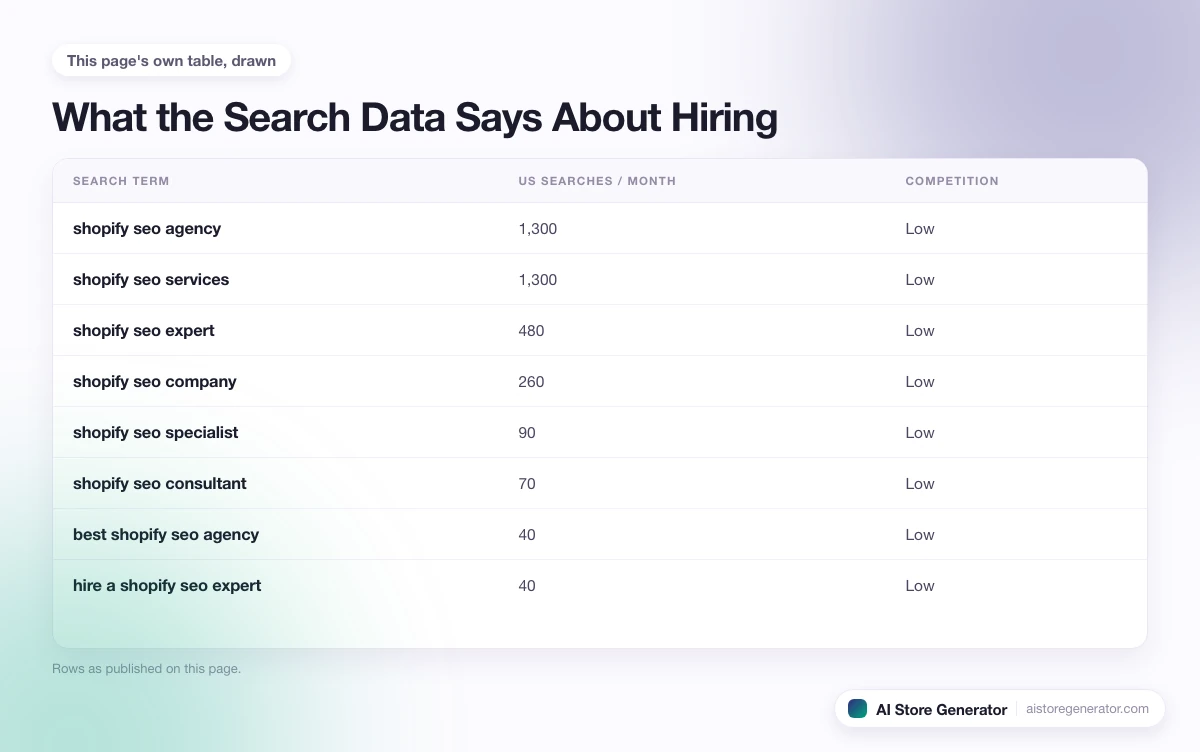
Before the advice, here is the market you are shopping in. These are US search volumes from Google Keyword Planner, averaged over the twelve months to August 2026:
| Search term | US searches / month | Competition |
| shopify seo agency | 1,300 | Low |
| shopify seo services | 1,300 | Low |
| shopify seo expert | 480 | Low |
| shopify seo company | 260 | Low |
| shopify seo specialist | 90 | Low |
| shopify seo consultant | 70 | Low |
| best shopify seo agency | 40 | Low |
| hire a shopify seo expert | 40 | Low |
Two things fall out of that. First, demand is small but concentrated: a few thousand store owners a month are actively looking to pay someone, and they mostly search for an agency rather than a freelancer or a consultant.
Second, and more useful to you: top-of-page bids on “shopify seo agency” run from $6.65 to $45 per click in the same data. An agency willing to pay $45 for one visitor needs each signed client to be worth thousands. That is why almost every result you land on is a sales page rather than a guide, and why the cheapest quote in your inbox is usually a reseller rather than the team that would touch your store.
What Makes Shopify SEO So Different?
Let’s clear this up now: Shopify is not like WordPress, Wix, or static HTML sites.
It’s eCommerce-first. And that changes how SEO should work.
Here’s what makes Shopify-specific SEO its own job, and why it has its own Shopify SEO checklists:
You Don’t Control Your URLs
Shopify forces structure like /products/ and /collections/ into your site. It’s non-negotiable and agencies have to know how to work within it, not against it.
Duplicate Content Happens Fast
Product pages get reused across collections. Blog content gets paginated weirdly. Without proper structure, Google sees your site as confusing, or worse, spammy.
Page Speed Isn’t Just Hosting
Shopify stores get bloated fast with theme code, apps, and oversized images. If your agency isn’t optimizing for performance inside Shopify, you’re going to fall behind. Half of that battle is won or lost when you choose an SEO-ready Shopify theme.
SEO is Product-Driven
Unlike blogs or local service sites, Shopify SEO revolves around product pages, collection pages, and commercial intent. Agencies that don’t understand how to map keywords to buy-ready traffic will waste your budget writing blog posts no one sees.
Filters and Sorting Can Bury You
Every filter combination your theme offers can spawn a crawlable URL. On a catalogue of a few hundred products that can turn into tens of thousands of near-identical pages competing with each other. A team that has worked on Shopify will ask about your filter setup in the first call. A team that has not will never mention it.
What a Good Shopify SEO Agency Actually Does
Any agency can promise “rankings.” It goes beyond just SEO services.
A legit one delivers traffic and conversions.
Here’s what a real Shopify SEO company should bring to the table:
Technical SEO Audit
Not a PDF template. A deep look at crawlability, page speed, duplicate content, URL conflicts, broken links, and sitemap issues.
Keyword Research + Page Mapping
They should identify commercial keywords (the kind buyers actually search) and map them directly to your product, collection, and info pages.
On-Page Optimization
This means rewriting product titles, descriptions, headers, meta data, and even image alt text. And yes, every single product page matters.
Internal Linking
It’s one of the most ignored ranking factors. An actual Shopify SEO agency will build content clusters, smart navigation, and collections that connect pages in a meaningful way.
Structured Data
This is how you get rich snippets, review stars, product info, and pricing in the search results. Most agencies skip this. Yours shouldn’t.
Content Strategy (That Fits eCom)
They don’t need to blog like a SaaS company, but a good agency can help you publish high-intent, keyword-rich collection and guide content that drives long-tail traffic.
Transparent Reporting
You should know exactly what’s improving: rankings, traffic, conversions, click-throughs. No vanity metrics. No fluff.
12 Questions to Ask Before You Sign
Most vetting advice tells you to check reviews and ask for case studies. Useful, but every agency passes that test. These twelve are harder to fake, because a team that has never worked inside Shopify cannot answer them. Ask them on the first call and write the answers down.
- Will you edit the theme code, or only work app-side? You want a named person who touches Liquid. “We’ll install an SEO app” is not a technical service.
- How will you handle products that sit in several collections? A good answer names the canonical choice between the /collections/ path and the bare /products/ path, and explains why.
- What is your plan for filter and sort URLs? They should want to see your filter setup before quoting.
- Who owns the Search Console and Analytics properties? The correct answer is you, on your own Google account, with them added as users. Anything else and your history walks out the door with them.
- Will you write to the product template or to each product? Templates scale across thousands of SKUs. Hand-written copy belongs on your best sellers. A team that only does one of the two is guessing.
- Which of your people will actually touch my store, and are they employees? Ask for names and roles, not a team page.
- Show me a Shopify store you moved, with the Search Console screenshot. Not a slide with a percentage on it. The actual graph, with dates.
- What happens in the first 30 days, item by item? Vague onboarding is a preview of vague delivery.
- How many pages will you rewrite per month, in writing? Put a number in the contract or you will get whatever is left after their bigger clients.
- Is theme weight and app bloat in scope, or out? Speed work usually needs developer hours. Find out now whether those hours are included or billed separately.
- What do you report on besides rankings? Organic revenue, assisted conversions, and non-branded clicks are the numbers that matter.
- What is the notice period, and what do I keep if I leave in month three? Content, documentation, and access should all be yours.
If you are new to all of this and the answers are washing over you, read the Shopify SEO for beginners guide first. Going into a sales call knowing what a canonical tag does changes the entire conversation.
How Much Does a Shopify SEO Agency Cost?
You’ll see a wide range, depending on scope, catalogue size, experience, and how much developer time is included. These are the bands most quotes fall into in 2026:
| Engagement | What it actually buys | Typical quote |
| Freelancer or marketplace | A few hours a month, usually meta data and on-page copy | $100 – $500 / mo |
| One-time technical audit | Crawl, canonicals, speed, and a prioritised fix list you implement | $500 – $5,000 |
| Entry retainer | Small catalogue, on-page work plus light content | $1,000 – $2,500 / mo |
| Mid-market retainer | Technical plus content plus reporting, with a named team | $2,500 – $8,000 / mo |
| Shopify Plus or enterprise | Large catalogues, several regions, developer resource included | $8,000 – $15,000+ / mo |
Cross-check these bands against Shopify’s own guide to what SEO costs, which prices the wider market rather than Shopify stores specifically.
Notice that the audit tier and the entry retainer overlap. That is not an accident. A one-time audit you actually implement often beats six months of a thin retainer, especially on a store under a few hundred products.
If your store is brand new or still finding product-market fit, those prices may feel heavy. And they are.
Which is exactly why so many sellers are looking for leaner, smarter alternatives.
Work Out Whether the Retainer Can Pay for Itself
Here is the calculation almost nobody runs before signing. It takes a minute and it will tell you more than any case study.
Extra organic sessions needed each month = retainer ÷ (average order value × gross margin × conversion rate)
A worked example. Say the retainer is $2,500 a month, your average order is $60, your gross margin is 40 percent, and your site converts at 2 percent.
- Gross profit per order: $60 × 0.40 = $24
- Orders needed to cover the retainer: $2,500 ÷ $24 = 105 orders a month
- Sessions needed to produce those orders: 105 ÷ 0.02 = 5,208 extra organic sessions a month
Now compare that to the organic traffic you get today. If you are on 2,000 sessions a month, that retainer is asking organic to more than triple and then hold, just to break even. Not to profit. To break even.
Take the number to the agency and ask when their own forecast clears it. A good team will talk you through the months, the pages, and the assumptions. A weak one will change the subject to rankings. That single question separates the two faster than any reference call.
What to Watch Out For (Red Flags Everywhere)
Here’s what low-quality agencies will do, and why it hurts your store.
They Use Generic Templates
If they say “We can do your SEO, just like we do for plumbers and realtors”… run. Shopify SEO is not a one-size-fits-all service.
They Outsource Everything
Cheap SEO shops often resell work to freelancers who barely touch your store. You get slow updates and copy-paste results.
They Push Blog-Heavy Strategies
SEO isn’t just content. Especially not in eCommerce. If your blog is ranking but your products aren’t, what’s the point?
They Promise “Fast Rankings”
That’s not how SEO works anymore. You’re building authority, not buying a shortcut. If they’re promising top 3 spots in 30 days, they’re probably doing something shady or nothing at all.
They Report Rankings but Never Revenue
A monthly deck full of green arrows next to keywords nobody buys from is the easiest report in the world to produce. Ask for organic revenue and non-branded clicks in month one, so the format is set before there is anything to hide.
They Want Admin Access With No Written Scope
Staff access to your store and your Search Console is reasonable. Handing it over before the deliverables are written down is not. Scope first, keys second.
When an Agency Is Genuinely the Right Call
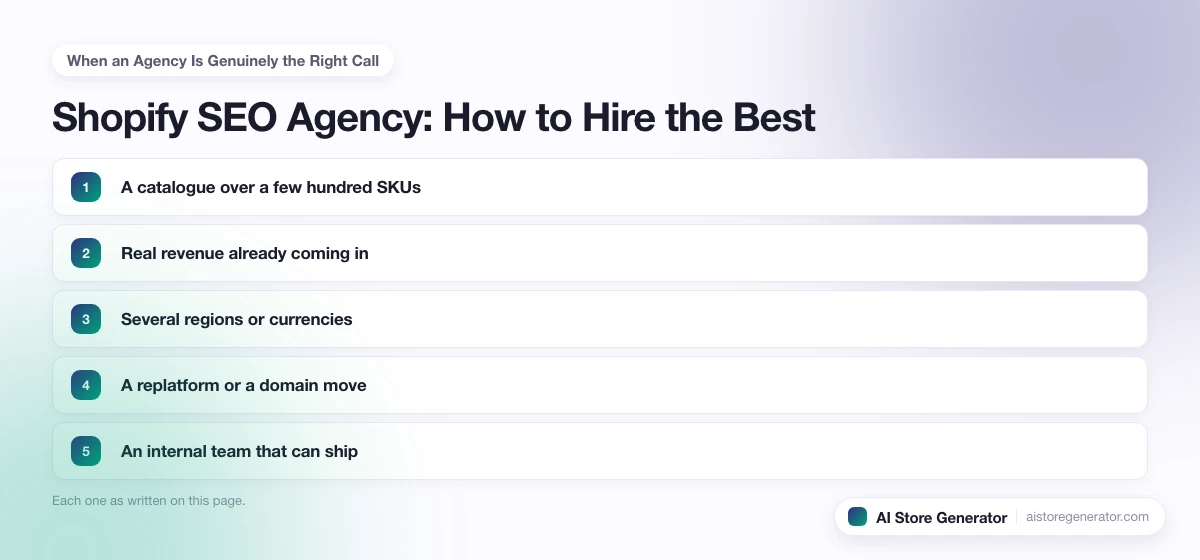
Plenty of guides on this topic, including earlier versions of this one, make the case in one direction only. That is not honest. There are situations where hiring is clearly the better decision:
- A catalogue over a few hundred SKUs. Template-level work compounds across every product, and that is where an experienced team earns its fee several times over.
- Real revenue already coming in. On a store doing serious volume, a 10 percent organic lift can cover a mid-market retainer on its own.
- Several regions or currencies. Market routing and hreflang go wrong quietly, and they are expensive to unpick a year later.
- A replatform or a domain move. One bad redirect map can cost you a year of rankings. This is the single best use of outside expertise there is.
- An internal team that can ship. Advice only pays off when somebody implements it. If nobody on your side has the time, a retainer just buys you a folder of documents.
And the mirror image. Hiring is usually the wrong call when you are pre-launch, when product-market fit is still an open question, when nobody internally can implement, or when the budget covers three months and then stops. SEO bought quarterly and cancelled in month four is the most expensive version of it you can buy.
How Long Before You See Anything
Ask an agency for a timeline and you tend to get “SEO takes time.” Here is the more useful version, broken down by the kind of work, using the ranges agencies themselves quote:
| Type of work | When movement usually shows |
| Technical fixes: crawling, canonicals, speed | 4 to 8 weeks |
| Product and collection page rewrites | 6 to 12 weeks |
| New guide and category content | 3 to 6 months |
| Link earning and authority building | 6 to 12 months |
Use it as a check on the contract. If the agreement has a twelve-month lock-in but the first three months are all technical work, you should be seeing something by week eight. If you are not, have that conversation while you can still walk away cheaply.
The Better Alternative: Built-In Shopify SEO from Day One
If you haven’t launched yet, or if you’re rebuilding, here’s a better idea:
Start with a store that already does the SEO work for you.
That’s why we created AI Store Generator and wrote up some SEO tips for Shopify.
Instead of hiring an agency to fix your store after it’s live, you generate a store that’s already:
- Structured for SEO
- Built with clean semantic HTML
- Optimized with metadata, alt text, and internal links
- Fast on mobile and desktop
- Pre-written with SEO-optimized product and page copy
No plug-ins. No patches. No $3,000 retainers.
Just a Shopify store that launches with SEO best practices baked in from minute one.
That also changes the shape of any agency conversation you have later. A store that starts clean does not need a team to undo six months of mistakes first, which is where a lot of early retainer money actually goes. If you want to compare the two routes, we broke down picking an SEO app and SEO tools built into the store itself.
If you want to grow from day one, this is how you do it smarter, not slower.
Try AI Store Generator
Build a Shopify Store in 2 Minutes
FAQ
Does Shopify do SEO?
Shopify handles the basics for you: clean URLs, automatic sitemaps, canonical tags, mobile-ready themes, and editable titles and descriptions. It does not do keyword research, write your product copy, fix duplicate collection pages, or build internal links. Those are the jobs that actually move rankings, and they are either yours or somebody you pay.
How much does Shopify SEO cost?
Ongoing retainers typically run $1,000 to $8,000 a month, with Shopify Plus and multi-region stores quoted higher. One-time technical audits land between $500 and $5,000, and freelancers often work for $100 to $500 a month. What you pay matters less than what is written into the scope, so compare deliverable counts rather than headline prices.
How much does it cost to hire a Shopify expert?
Independent Shopify specialists usually charge $50 to $150 an hour, or a few hundred dollars a month on a light retainer. Certified partner agencies charge more because the fee covers project management, developer time, and content production. For a single defined job, such as a technical audit or a theme speed pass, hourly is normally cheaper than a retainer.
Is SEO still worth it in 2026?
For an ecommerce store, yes, and for a specific reason: paid traffic stops the day you stop paying, while a product page that ranks keeps selling. What has changed is that thin content no longer works, and AI answers absorb some informational searches. Buying-intent searches, which is what product and collection pages target, still send people to stores.
Is Shopify good for SEO?
It is solid out of the box and limited in a few places. You get fast hosting, sensible URLs, and automatic technical hygiene. You cannot change the /products/ and /collections/ URL structure, and blog features are basic compared with WordPress. None of that stops Shopify stores from ranking. It just means the work happens inside those constraints.
Should I hire a freelancer instead of an agency?
For one clear job, a freelancer is often the better deal: an audit, a theme speed pass, a batch of product page rewrites. Agencies earn their premium on large catalogues, several regions, and work that needs a developer and a writer at the same time. The risk with marketplace gigs is not skill, it is scope. Get the deliverables in writing either way.
So, Do You Need a Shopify SEO Agency?
If you’ve got a growing store, product-market fit, and budget to scale, then yes, the right Shopify SEO agency can make a real difference to your business. Run the break-even number first, ask the twelve questions, and get the deliverables written down.
But if you’re still trying to get your store off the ground, or you just want to launch fast and clean, a smartly built store with SEO embedded in the foundation is the better play.
That’s AI Store Generator. No noise. No confusion. Just a ready-to-sell, ready-to-rank Shopify store in minutes.