
Most Shopify dropshippers eventually hit the same wall. Ads are working, orders are landing, and then refund requests start piling up because every package takes three weeks to arrive from China. The fix everyone reaches for is a US-based supplier. The problem is that the supplier directory you searched is half-full of Chinese sellers renting US warehouse space, and the real American suppliers want a wholesale account, not a Shopify app. This page walks through how to tell the two apart, where to find suppliers that actually ship from American warehouses, the questions that surface the truth in 24 hours, and the margin math that decides whether a US supplier is right for your store.
The Short Answer
Real US dropshipping suppliers live in three places: curated Shopify supplier networks with a US filter (Spocket, Zendrop, Doba, DropCommerce), wholesale and manufacturer directories (Inventory Source, Worldwide Brands, ThomasNet), and direct relationships with American brands you contact yourself. The fastest way to weed out fakes is the 24-hour test: ask any supplier whether they can give you a USPS or UPS tracking number within 24 hours of an order. If they can, they hold inventory in a real US warehouse. If they say “processing takes 3 to 4 days,” they are dropshipping from China through a US-flagged listing. US suppliers cost 30 to 50 percent more per unit but ship in two to five business days, which makes them worth it for paid-ad stores, premium niches, and any brand that needs predictable delivery to win repeat customers.
Why US Suppliers Are Worth the Higher Cost
The economics changed in the past two years. Shipping a small package from Ohio to a New York customer now costs around six dollars. The same package from Guangzhou costs twelve and arrives in two to three weeks instead of two to three days. That gap used to be the whole reason dropshippers tolerated AliExpress. It is no longer the reason.
What you gain with a US supplier is shorter shipping, easier returns, better packaging quality, and the ability to honor delivery dates that paid ad customers actually expect. What you give up is product cost. A 12 dollar item on AliExpress is usually 18 to 25 dollars from a US wholesaler. The win comes from charging more, refunding less, and keeping more customers.
US suppliers also remove a category of problems that quietly drains your time: lost packages, mistranslated shipping labels, and customs delays. None of those exist when the product ships domestically.
Real US Suppliers vs Fake US Suppliers
The single biggest mistake new dropshippers make is trusting a “Ships from USA” tag. Many suppliers advertise as US-based because they rent a small warehouse in California or New Jersey, but the inventory still ships from China the moment an order comes in. The customer waits 14 days, blames you, and the chargeback lands on your Shopify account.
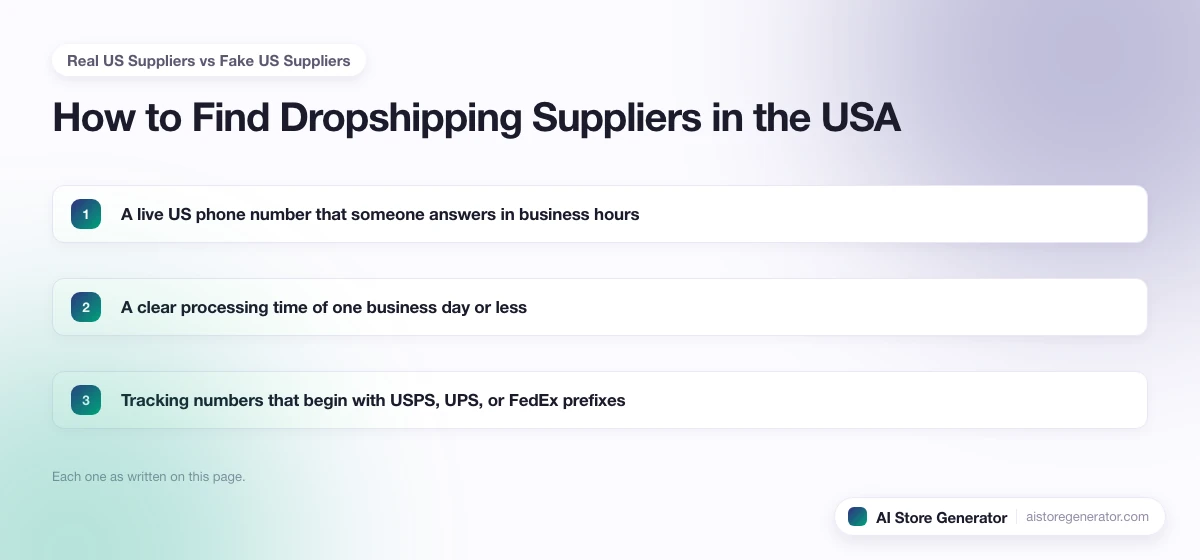
Three signals separate a real US supplier from a relabeled Chinese one:
- A live US phone number that someone answers in business hours. Not an info@ email, not a chat widget, an actual phone number with someone who knows the catalog.
- A clear processing time of one business day or less. Real US warehouses pick and pack same-day or next-day. Anything slower means the inventory is overseas.
- Tracking numbers that begin with USPS, UPS, or FedEx prefixes. A China Post or YunExpress tracking number means the package is leaving Asia, no matter what the listing said.
The 24-hour test is the cleanest filter. Place a sample order, then email the supplier and ask them to confirm the tracking number within 24 hours. Real US suppliers reply with a tracking link the same day. Fakes ask for “processing time” and ghost you until day four.
Five Ways to Find a Real US Supplier
Each route has a different payoff. Most stores need two of them, not one.
1. Curated Shopify supplier networks with a US filter
Apps like Spocket, Zendrop, Doba, DropCommerce, and SaleHoo all let you filter to US-based suppliers. The product range is narrower than AliExpress, but every listing has a real warehouse behind it. Install once, filter to US, sort by shipping speed, and start your shortlist. This is the fastest way for a brand-new Shopify store to start shipping in five days or fewer.
2. Wholesale and dropshipping directories
Inventory Source, Worldwide Brands, and Wholesale Central maintain searchable lists of vetted American wholesalers and dropshippers. The vetting is real, but the directories themselves cost money to access. The trade-off is that the suppliers behind a directory paywall tend to be older, more stable, and willing to give better terms because they know the buyers are serious.
3. ThomasNet for manufacturer-direct sourcing
ThomasNet is the North American directory of factories. Most listings are industrial, but the consumer-product manufacturers there are the suppliers nobody else in your niche is using. Going direct to a manufacturer means private-label pricing, custom packaging, and the strongest brand story possible, in exchange for a higher minimum order and a longer onboarding conversation. This is where the white-label playbook in dropshipping strategy starts.
4. Trade shows and local sourcing
ASD Market Week, MAGIC, and IGES are American trade shows where US wholesalers and manufacturers actively look for ecommerce buyers. If you can attend in person, suppliers take you more seriously than any cold email ever will. The booth conversations also tell you which suppliers are actually interested in dropshipping volume versus the ones who only want pallet-quantity wholesale orders.
5. The Google Maps and LinkedIn tactic
Search Google Maps for “[your product category] manufacturer [state name]” and you will see real American producers most directories never list. Cross-check the company on LinkedIn for an active sales lead, then email them directly. This route is slower, but the suppliers you find this way have never been pitched by another dropshipper, which means cleaner terms and less competition on identical product listings.
A Quick Shortlist of US Dropshipping Suppliers Worth Checking
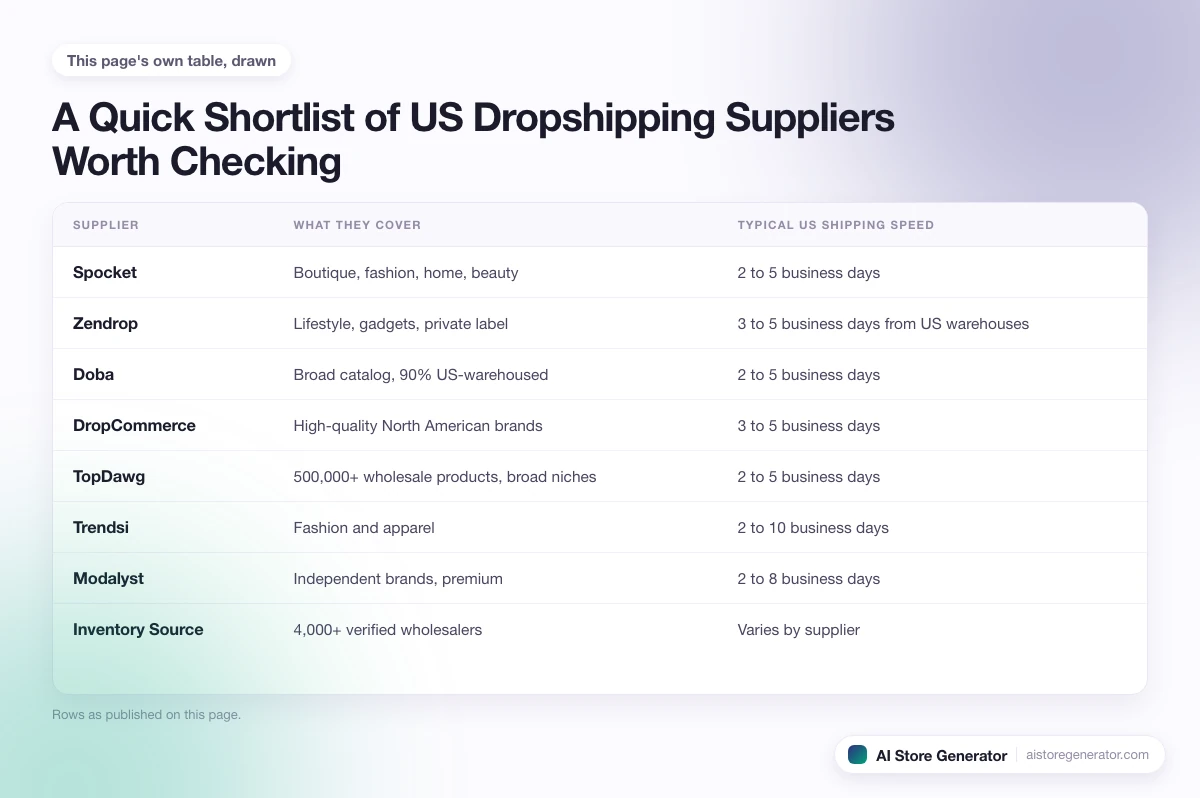
These are the platforms and suppliers that consistently show up as genuinely US-based across recent buyer reports:
| Supplier | What they cover | Typical US shipping speed |
|---|---|---|
| Spocket | Boutique, fashion, home, beauty | 2 to 5 business days |
| Zendrop | Lifestyle, gadgets, private label | 3 to 5 business days from US warehouses |
| Doba | Broad catalog, 90% US-warehoused | 2 to 5 business days |
| DropCommerce | High-quality North American brands | 3 to 5 business days |
| TopDawg | 500,000+ wholesale products, broad niches | 2 to 5 business days |
| Trendsi | Fashion and apparel | 2 to 10 business days |
| Modalyst | Independent brands, premium | 2 to 8 business days |
| Inventory Source | 4,000+ verified wholesalers | Varies by supplier |
| Printful and Printify | Print on demand, apparel and accessories | 2 to 5 business days from US print centers |
The right pick depends on the niche, not the brand. A fashion store should start with Trendsi or Spocket. A home goods store should look at Doba or DropCommerce. A custom apparel store should compare Printful and Printify side by side. For supplier types more broadly, the dropshipping suppliers overview covers the trade-offs across all categories, not only US-based ones.
The Vetting Checklist for Any US Supplier
The 24-hour test is the first filter. After a supplier passes that, run the rest of the checklist before you import a single product into your Shopify store:
- Confirm the physical warehouse address on Google Street View. A real warehouse looks like a real warehouse.
- Ask for a sample. Pay for it. The way they pack and ship the sample is exactly how they will pack and ship every customer order.
- Check the tracking carrier. USPS, UPS, FedEx, or DHL Express domestic is fine. China Post, YunExpress, or 4PX means the package is moving through a China-to-US lane.
- Read the return policy carefully. A US supplier that hides their return policy or routes returns to a Chinese address is not really a US supplier.
- Ask about MOQ. Real US wholesalers usually want a 500 to 2,000 dollar monthly commitment to give you wholesale pricing. A “no MOQ” US supplier is either a dropshipping-first network or a relabeled Chinese 3PL.
- Verify the supplier is the actual seller, not a middleman reselling another supplier. Search the product image in Google Images and see how many other store sites are reselling the identical photo.
- Check that they support real-time inventory sync with Shopify. Manual inventory updates create overselling and refund chargebacks.
- Ask whether they offer blind shipping. A US supplier that puts their own logo on the box defeats the entire point of dropshipping.
- Request a buyer reference, especially another Shopify store currently working with them. Real US suppliers can give one.
- Read their dropshipping-specific terms. Many US wholesalers limit you to certain product categories, ban Amazon resale, or restrict paid advertising on branded keywords.
A supplier who clears all ten of these is one of maybe one in fifteen on most directories. That is what makes the real US suppliers worth keeping.
A Cold Outreach Email That Actually Gets Replies
US wholesalers ignore generic “do you offer dropshipping?” emails because they get fifty of them a week. The version that works treats the supplier like a business partner from the first sentence:
Subject: Dropshipping inquiry, [your niche] Shopify store
Hi [name],
I run an online store in the [niche] category and I am looking for a US-based supplier to add to my fulfillment mix. We expect 30 to 80 orders a week within the first quarter and would like to introduce your [product line] to the store.
Three quick questions before we go further:
1. Do you offer dropshipping with blind shipping (no supplier logo on the package)?
2. What is the typical processing and shipping time from order to tracking number?
3. What does your pricing look like for a store doing 100 to 400 units a month?
Happy to share my store URL and any other detail you need. Thanks for your time.
[Your name]
Three details make this version work: a real volume estimate the supplier can plan for, three specific questions a sales rep can answer in five minutes, and the offer to share the store URL on request rather than dumping it in the first email. Suppliers reply to this format because it sounds like a buyer who already knows how dropshipping works.
The Hidden Cost: US Sales Tax Nexus
This is the part nobody else writes about. The minute a US supplier fulfills orders for your store from a US warehouse, you may have created sales tax nexus in that supplier’s state. That can mean registering for a sales tax permit, collecting tax on orders shipped to customers in that state, and filing returns on a schedule the state sets.
The rules vary by state and by how the dropship relationship is structured. Some states treat the supplier as your agent, others do not. The safe move is to talk to a US sales tax specialist before you scale to a level that triggers economic nexus thresholds, which can be as low as 100,000 dollars in sales or 200 transactions in a single state. The legal and tax considerations for dropshipping business setup covers the foundation, but anything state-specific needs a professional. This is not legal or tax advice, only a warning that the cost of US suppliers is not just the higher unit price.
Margin Math: Can Your Store Afford US Suppliers?
Here is the calculation that decides the question for you. Take any product currently in your store sourced from China.
- Cost from AliExpress: 8 dollars
- Cost from a US supplier: 14 dollars
- Selling price: 32 dollars
- Shopify and payment fees: roughly 1.30 dollars
- Shipping to customer (free shipping offer): you absorb 6 dollars from the US supplier, 4 dollars from China
The China version nets around 18.70 dollars per sale. The US version nets around 10.70 dollars. That is an 8 dollar gap per order before any marketing.
The question is what each version saves you in refunds, chargebacks, and customer support. A store with a 4 percent refund rate from slow Chinese shipping that drops to 1 percent on US shipping recovers the gap quickly. A store running paid ads where customers expect 4-day delivery cannot survive without the US route. A store selling 6 dollar costume jewelry probably cannot afford US sourcing yet. The margin math says yes when the product is at least 25 dollars and the customer expects fast delivery. It says no on tight-margin impulse buys.
When US Suppliers Are the Wrong Choice
US sourcing is not always the right answer. Skip it when the product is a low-cost impulse item, when your store is testing new winners that have not proven yet, when you sell to international customers more than domestic ones, or when the product is genuinely only made in China at any reasonable price (most consumer electronics, most novelty goods, most low-priced fashion accessories).
For testing winners, AliExpress dropshipping is still the cheapest sandbox. For factory-direct pricing on a proven winner, Alibaba dropshipping is the next step. US sourcing is the third step, not the first one. A working playbook is to validate with AliExpress, scale with Alibaba bulk orders, and add a US supplier once a product is consistently selling 80 or more units a week.
Build the Store Before You Pick the Supplier
A US supplier is only valuable when there is a store ready to receive the products. Most beginners spend a month comparing supplier directories before they have a single Shopify page built, which is the wrong order.
Use AI Store Generator to build the store, the product pages, the collections, and the SEO structure in under five minutes. Then plug in a US supplier that fits the niche and the margin. The store gives you something to evaluate the supplier against. Once orders start flowing, the work moves to fulfillment, returns, and inventory tracking, which is covered in Shopify dropshipping operations. If the store does not exist yet, start a dropshipping business on Shopify is the place to begin.
FAQ
Who are the best dropshipping suppliers in the USA?
The most consistently US-based options on Shopify are Spocket, Zendrop, Doba, DropCommerce, TopDawg, Trendsi, Modalyst, Printful, and Printify. The right pick depends on niche. Spocket and Trendsi lead for fashion. Doba and DropCommerce lead for general consumer goods. Printful and Printify lead for print on demand. For a single broad starting point, Spocket has the largest filtered selection of US suppliers in one app.
How do I find dropshipping suppliers in the USA?
Filter for “US” inside a Shopify supplier app, search wholesale directories like Inventory Source or Worldwide Brands, look up manufacturers on ThomasNet, attend a US trade show like ASD Market Week, or search Google Maps and LinkedIn directly for niche manufacturers in your category. Most stores use two routes at once: a directory for breadth and a direct relationship for the bestseller.
Are there real US dropshipping suppliers or are they all China?
Real US dropshipping suppliers exist, but a large share of “ships from USA” listings are Chinese suppliers renting US warehouse space. The 24-hour tracking test is the cleanest way to tell them apart. Real US suppliers can provide a USPS, UPS, or FedEx tracking number within a day of the order. Relabeled Chinese suppliers cannot.
How much faster do US suppliers ship than AliExpress?
US suppliers usually deliver in 2 to 5 business days. AliExpress delivers in 10 to 30 days depending on shipping method and carrier. For paid-ad stores and premium niches, that delivery gap is the difference between a profitable customer and a refund.
Is using a US dropshipping supplier more expensive?
Yes. Product cost from a US supplier is usually 30 to 50 percent higher than the same item on AliExpress. The trade-off is faster shipping, fewer refunds, cleaner returns, and better packaging, all of which let you charge a higher price and retain more customers.
Do I need a US business to use US dropshipping suppliers?
Many US suppliers will work with international sellers, but some require a US business entity and a resale certificate to give wholesale pricing. The supplier paperwork usually takes one to two weeks. Curated supplier networks like Spocket and Zendrop generally do not require a US business and accept international Shopify store owners.
Will US suppliers create sales tax liability for my store?
They can. When a US supplier ships orders from a warehouse in a state, the dropshipping relationship can create sales tax nexus for your store in that state. The rules vary by state. Talk to a US sales tax specialist once your monthly revenue is large enough to matter, especially before crossing the 100,000 dollar or 200-transaction threshold in any single state.
How long does it take to onboard a US dropshipping supplier?
A supplier app like Spocket or Zendrop takes minutes to install and connect to Shopify. A direct relationship with a US wholesaler or manufacturer takes one to four weeks to set up: paperwork, sample order, terms negotiation, and inventory feed integration. The longer route is worth it on a product that is already selling consistently.
How does AI Store Generator work with US dropshipping suppliers?
AI Store Generator builds the Shopify storefront, the product pages, the collections, and the SEO structure in under five minutes. You then connect a US supplier to handle fulfillment through Spocket, Zendrop, or a direct supplier feed. The store is ready to sell on day one, which means the supplier you pick is the only variable left to test instead of the entire store build.