
Alibaba is the platform most dropshippers reach for after AliExpress stops feeling like a real business. The prices are lower, the suppliers are factories instead of resellers, and the products can be customised with your brand. It also has more rules, more upfront work, and more ways for a beginner to lose money. This page walks through how Alibaba dropshipping actually works in 2026, the three different operating models the platform supports, how to tell a real factory from a trading company, how to negotiate MOQs and use Trade Assurance, and the cost math that decides whether Alibaba is the right next step for your store.
Short Answer
Alibaba is a B2B wholesale marketplace where you order from the same Chinese factories that supply AliExpress sellers, usually at 30 to 70 percent lower cost. To dropship from Alibaba you have three real options. You can use the Alibaba Dropshipping Center, which lists suppliers willing to ship single units but with a small catalogue. You can hold a bulk order at a third-party fulfillment warehouse for faster delivery and lower per-unit cost, at the price of upfront cash. Or you can work with a sourcing agent who buys from Alibaba on your behalf and dropships each order with branded packaging.
Each model trades cash, speed, and effort differently. Alibaba is rarely a beginner’s first supplier. It is the upgrade once a product has already proven itself on a smaller platform.
Alibaba vs AliExpress: What Actually Changes
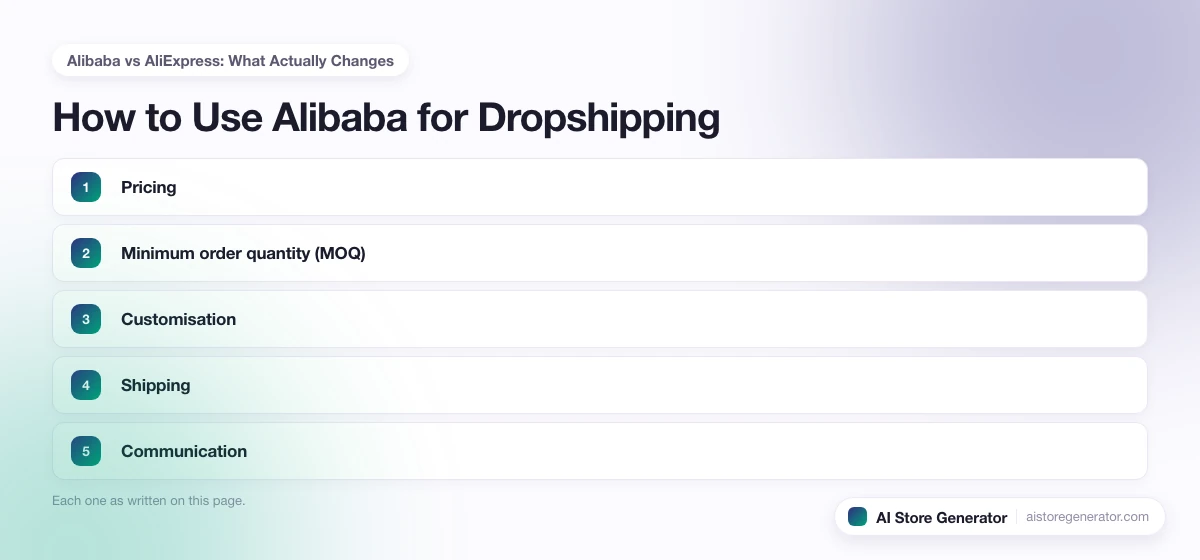
The two platforms are owned by the same parent company but solve opposite problems. AliExpress is a retail marketplace where you can buy a single unit at retail price and ship to a customer the next day. Alibaba is a wholesale marketplace where you negotiate with factories for bulk orders at factory prices. AliExpress is built for testing. Alibaba is built for scaling.
A few honest differences worth knowing before you switch:
- Pricing. The same product on Alibaba is typically 30 to 70 percent cheaper than on AliExpress. A $7 phone case on AliExpress is often $2.50 on Alibaba at 100 units.
- Minimum order quantity (MOQ). AliExpress has no MOQ. Alibaba listings show MOQs from 10 to 1,000 units, depending on the product and the supplier.
- Customisation. Most Alibaba suppliers will print your logo on the product or the packaging at no extra setup cost for a few hundred units. AliExpress sellers almost never do this.
- Shipping. AliExpress ships per order with set rates. On Alibaba you arrange shipping yourself, which means dealing with sea, air, and express options at very different price points.
- Communication. Alibaba is a relationship platform. You chat with the supplier, negotiate, and place orders by message. AliExpress is one-click checkout.
- Risk. Alibaba uses Trade Assurance (an escrow system) to protect both sides. AliExpress uses Buyer Protection. Both work; the dispute paths are different.
Most dropshippers test new products on AliExpress, then migrate the winners to Alibaba once daily orders pass roughly 10 to 15 units. The deeper view of how AliExpress works as the testing layer is in the dropshipping with AliExpress guide. If sourcing suppliers is still new to you, the dropshipping suppliers overview compares all four supplier types and where Alibaba fits among them.
The Three Ways to Dropship From Alibaba
Most guides describe Alibaba dropshipping as if it is one workflow. There are actually three, and they suit very different stages of a store.
Option 1: The Alibaba Dropshipping Center
Alibaba launched a dedicated Dropshipping Center in 2020. It surfaces suppliers who explicitly accept single-unit orders and ship direct to your customer. The catalogue skews toward small commodity items: phone accessories, basic electronics, household goods, low-priced apparel. Higher-ticket and custom products are usually not in the Dropshipping Center because the supplier needs MOQ economics to make the order worthwhile.
What the Dropshipping Center looks like in practice:
- Sign in to Alibaba and open the Dropshipping Center.
- Filter by category, response rate, supplier age, and Trade Assurance support.
- Message three to five suppliers asking about shipping time, branded packaging, return policy, and replacement on damaged items.
- Order samples from the two best responders.
- Import the chosen products to Shopify using the official Alibaba dropshipping app or by listing manually.
- Fulfill orders by syncing them from Shopify and confirming each one through the supplier panel.
This is the lowest-friction Alibaba option and the closest experience to AliExpress. The trade-off is a smaller product range and shipping speeds that are usually similar to AliExpress, not the faster speeds Alibaba is sometimes credited with.
Option 2: Bulk Order Plus Third-Party Fulfillment
The next level up is buying a small bulk order from a real factory and storing it at a third-party fulfillment warehouse, often in the US or EU, that ships individual orders to your customers. The factory side is Alibaba. The dropshipping side is a 3PL.
The math works once you have a product that is already selling. A $20 hero product sourced for $4 at MOQ, shipped to a US 3PL in bulk, and fulfilled domestically often delivers in three to five days at $3 to $5 per order, which beats AliExpress comfortably on customer experience and on margin. The upfront capital is the catch: a 200-unit order at $4 each plus shipping is roughly $1,200 before the 3PL takes its setup fee.
This model is the most common path for a store that started on AliExpress and now wants real margins, faster delivery, and the option of branded packaging. The downside is risk: you own the inventory. A product that stops selling becomes a write-off.
Option 3: Sourcing Agent
The third path is contracting a sourcing agent in China who handles the Alibaba side for you. The agent finds suppliers, negotiates prices, does quality control, stores the inventory, and ships each order from China with branded packaging. You pay a per-product cost plus a small fee per order.
Agents are normally introduced by other dropshippers or found through fulfilment-focused communities. The good ones quote prices well below Alibaba retail because they have factory relationships and bulk-buy across multiple clients. They also remove the entire negotiation and quality-control workflow from your side, which is the biggest hidden cost for a non-Chinese-speaking dropshipper.
Most stores reach this model around the 100-orders-a-month line, where the agent fee becomes worth it because you no longer have time to manage the supplier relationship yourself.
How to Vet an Alibaba Supplier Before You Order
The most expensive Alibaba mistake is paying a deposit to a supplier who turns out to be a trading company pretending to be a factory, or worse, a fake listing. A real factory makes the product. A trading company buys from other factories and resells with a markup, often with no quality control. Both can be useful, but knowing which you are dealing with shapes the price you should expect.
The ten-minute vetting that catches most issues:
- Check the supplier badges. Look for Verified Supplier and Trade Assurance support at the top of the listing. Gold Supplier is paid status and does not mean verified, but it does mean the supplier paid for visibility and is more likely to respond.
- Read the company profile. Verified Suppliers have a business license, factory photos, and registered staff count. A “1-5 employees” company is almost never the factory.
- Ask for the factory address and business license. Real factories share both on request. Trading companies dodge or give vague answers like “based in Shenzhen.”
- Ask for a product video. A real factory can film the production line within a day. A trading company has to ask their supplier first, which takes a week.
- Sort their products by category. A factory makes a tight range (all silicone phone cases, or all stainless steel kitchenware). A trading company shows a random catalogue: phone cases, dog beds, kitchen knives, drones.
- Check the response time and rate. 24 hours and 90%+ response rate is the bar. Slower than that is a refund-handling nightmare later.
- Search the product image on Google. If the same image appears on twenty other Alibaba listings, you are looking at a stock photo from the original factory and the listing you found is a reseller.
- Ask about Trade Assurance terms. A serious supplier offers Trade Assurance for first orders and explains the dispute path. A vague response means they would rather get paid outside the system.
- Send the test question. “Can you ship 1 sample to {country} this week? Quote the total cost including DHL Express.” A real supplier replies within 24 hours with a number.
- Order a paid sample. The sample is the only test that catches photo-vs-product mismatch and packaging quality. Pay for it. Free samples come with strings attached.
The wider supplier-vetting framework, including the written questions to send any supplier before connecting them to your Shopify store, is in how to find dropshipping suppliers.
Negotiating MOQ and Price
Alibaba MOQs are negotiable on most listings, especially for first orders. The listing price is the headline; the conversation is where the deal happens.
A realistic opener that works:
“Hi, I am sourcing for my Shopify store and would like to test your product with a 50-unit order. The listing shows MOQ 200. Would you accept a first trial order of 50 units at the 200-unit price tier? If the product sells we will return for repeat orders of 500 units within 60 days.”
Two thirds of suppliers say yes to a request like that. The framing matters: short-term smaller order, long-term commitment, no haggling over price. Suppliers care about repeat orders more than the first invoice. The follow-up order is where their margin sits.
Price tiers usually look like this:
- 1-50 units: full retail-style price (often close to AliExpress)
- 50-200 units: 20-30 percent off
- 200-500 units: 40-50 percent off
- 500-1,000 units: 50-60 percent off
- 1,000+ units: factory price, sometimes 70 percent off retail
The first tier where the math works for a dropshipping store is usually 200 units. Below that, the per-unit cost is too close to AliExpress to justify the cash and the complexity.
Sample Orders: What to Test and What to Spend
Sample orders are not optional on Alibaba. The supplier showcase photos rarely match the product you actually receive. The two unit tests that matter:
- Quality and packaging. Does it look and feel like the photos? Does the box arrive intact? Would a customer be happy to receive this?
- Shipping speed and tracking. Did the sample arrive in the quoted window? Did tracking update consistently?
Sample costs are usually $5 to $50 per unit plus express shipping in the $30 to $80 range. Treat the sample as a $100 insurance policy against a $2,000 wasted bulk order.
A trick that catches inconsistent suppliers: order two samples from the same supplier two weeks apart, ideally to two different addresses. Quality should be identical. If the second sample is worse, the production line is inconsistent.
Trade Assurance and How Disputes Actually Work
Trade Assurance is Alibaba’s escrow system. The buyer pays through Alibaba, the funds sit in escrow, and the supplier only gets paid when the product ships and the buyer accepts it. If something goes wrong, Alibaba mediates the dispute. Most stores will need this at least once.
The path when a Trade Assurance order goes wrong:
- Confirm the issue with photos and a video of the unboxing. Alibaba almost always sides with the party with better evidence.
- Raise the dispute within 15 days of delivery. Late disputes are usually denied.
- Upload the evidence to the Trade Assurance dispute panel.
- Wait. Most disputes resolve within 7 to 30 days.
- If Alibaba sides with you, the escrowed funds are refunded to your original payment method.
Trade Assurance does not cover orders paid outside the system. Many suppliers will offer a discount for wire transfer or PayPal “to keep the order simple.” That discount is buying you a chance of losing the entire deposit with no recourse. For first orders, always use Trade Assurance.
Shipping: Sea, Air, Express, or DDP
Alibaba does not handle shipping. You arrange it, either with the supplier through their freight forwarder or directly with a forwarder of your own. The four options dropshippers use:
- Express (DHL, FedEx, UPS). 3 to 7 days, around $6 to $12 per kilogram. Best for samples and small batches under 50 kilograms.
- Air freight. 7 to 14 days, $4 to $7 per kilogram. Best for batches of 50 to 200 kilograms.
- Sea freight (LCL). 30 to 45 days, $50 to $150 per cubic metre. Best for full bulk orders over 200 kilograms.
- DDP (Delivered Duty Paid). The supplier or forwarder handles customs and duties end to end. Costs more per kilogram but removes the customs surprise on arrival.
For dropshipping into the US, the $800 de minimis rule is the rule that defines the math. Orders below $800 enter the US duty-free. Express shipments under that threshold often arrive without customs friction. Bulk orders over $800 attract duties at 0 to 30 percent depending on the product code, which has to land in the landed-cost calculation before the product goes live.
The Real Landed-Cost Math
Most beginners look at the Alibaba listing price and assume that is the cost. The landed cost includes everything else.
| Line item | Example |
|---|---|
| Alibaba unit price at 200 units | $2.60 |
| Air freight share per unit | $0.40 |
| Customs duty share per unit (US, 5%) | $0.13 |
| 3PL receiving + storage share per unit | $0.15 |
| Landed cost per unit | $3.28 |
Add the per-order pick-pack-ship fee from the 3PL (usually $2 to $4) and the per-order shipping label, and the all-in cost to fulfill a single sold unit lands around $7 to $9 in the US. If the retail price is $25 and your CPA is $8, that leaves about $8 to $10 of margin. That is sustainable. Alibaba at $1.50 per unit looking like a 90 percent margin is misleading.
Connecting Alibaba Orders to Shopify
The actual Shopify integration depends on which of the three operating models you chose.
- Dropshipping Center model. Install the official Alibaba & AliExpress Dropship app from the Shopify App Store. It pulls product listings and pushes orders to the supplier. Manual fulfillment is also workable for very low volume.
- Bulk + 3PL model. Connect Shopify to the 3PL’s order management system. Major US 3PLs like ShipBob, ShipMonk, and DCL Logistics have official Shopify apps. Orders flow automatically and tracking syncs back.
- Sourcing agent model. The agent provides a Shopify-compatible order export. You email the daily order file, or grant them a limited app access to fulfill from your store.
The Shopify side that beginners underestimate is the storefront itself. Alibaba hands you products. It does not build the store. The collection structure, the product page templates, the policy pages, and the SEO setup decide whether a $4 product turns into a $25 sale. AI Store Generator builds the Shopify store with an SEO-first structure, products, collections, and policy pages already in place, so when the first Alibaba order lands, it lands on a finished store rather than a half-built one.
OEM and ODM: When Custom Becomes an Option
Once a product proves itself, the next Alibaba conversation is usually OEM (Original Equipment Manufacturer) or ODM (Original Design Manufacturer). OEM means the factory makes the same product with your branding. ODM means they tweak the design to your spec.
A realistic OEM setup looks like:
- Order MOQ of 300 to 1,000 units with your logo printed on the product or the box.
- One-time setup fee of $200 to $800 for the print plate or moulding tweak.
- Per-unit cost rises around 10 to 20 cents to cover the customisation.
- Lead time goes from 7 days to 20 to 30 days for the first run.
OEM is the bridge from a dropshipping store to a real brand. It matters because customers searching for a product by photo on Google will not find your version on AliExpress. The differentiation alone is worth the setup work for a flagship product. The wider conversation about brand-building lives in Shopify dropshipping strategy.
When Alibaba Is the Wrong Supplier
Alibaba is not always the right answer. The cases where the model breaks:
- Brand-new stores with no validated product. Tying up $1,000 to $3,000 in inventory before you know what sells is the most common dropshipping mistake. Validate on AliExpress first.
- Regulated categories. Supplements, skincare, electronics needing FCC or CE marks, and anything battery-powered carries import paperwork most dropshippers cannot handle without an agent.
- Same-day or two-day delivery promises. Even bulk-stored Alibaba inventory in a US 3PL is three to five days domestic. Faster than that needs a US-native supplier.
- Branded products. Alibaba has counterfeit listings. Reselling them is the fastest way to lose a Shopify store and a payment processor.
- Tiny stores with no time for negotiation. The Alibaba conversation is the cost. If you cannot spend an hour a week messaging suppliers, the Dropshipping Center is the only option, and even that benefits from outreach.
For those situations the alternatives are AliExpress for testing, US-based supplier networks for fast delivery, and private agents once the volume justifies the cost.
Common Alibaba Mistakes Beginners Make
- Paying outside Trade Assurance. Wire transfers or PayPal “F&F” discounts have zero buyer protection. The 2 to 3 percent saving is not worth the risk on a first order.
- Skipping the sample. A $50 sample beats a $2,000 wasted bulk order every time.
- Believing the supplier’s shipping quote. Always cross-check sea or air rates with an independent freight forwarder.
- Ignoring the photos. Listing photos are usually owned by the factory. Watch for the same image on twenty competing listings; you are looking at a reseller.
- Not asking about repacking. Many factories will repack with your branding for free at 500 units. If you do not ask, they ship in their generic box.
- Buying too much on order one. A 200-unit first order is usually enough to test the supplier relationship before scaling.
- Forgetting customs duties. The product might be cheap; the import bill on bulk into the EU or UK can wipe the margin.
If the broader operational rhythm of a dropshipping store is the next gap, the Shopify dropshipping operations guide covers the daily workflows: order syncing, customer service, returns, and supplier reorder cycles.
The Standard Migration Path: AliExpress to Alibaba
The cleanest way to use Alibaba is as the second supplier in a store, not the first. The arc most successful dropshipping stores follow:
- Launch on AliExpress with 15 to 30 imported products.
- Test products with small ad spend or organic content. Most flop. One or two work.
- Once a product reaches 10 to 15 sales a day, find the same product on Alibaba and source 200 units at the bulk price.
- Ship the bulk order to a US or EU 3PL.
- Switch the Shopify SKU to fulfill from the 3PL. Margin doubles. Shipping drops to 3 to 5 days.
- Repeat for the next winner.
This is how most six- and seven-figure dropshipping stores are built. The store keeps the AliExpress catalogue for testing and the Alibaba-sourced 3PL inventory for the proven winners. If the launch sequence is still the gap, the start a dropshipping business on Shopify walkthrough covers the first 30 days end to end.
FAQ
Is Alibaba dropshipping legal?
Yes. Dropshipping from Alibaba is a legitimate sourcing model and the Alibaba Dropshipping Center is a built-in feature of the platform. The legal risk lives at the product level: counterfeit goods, items needing safety certifications, and tax compliance for your own country still apply the same way they do on AliExpress.
What is the minimum order quantity on Alibaba?
Listings show MOQs from 10 to 1,000 units depending on the product. The Dropshipping Center surfaces suppliers willing to ship one unit at a time. For traditional bulk orders, most suppliers will negotiate MOQs down to 50 to 100 units for first orders if you commit to a follow-up order at the standard tier.
How long does Alibaba shipping take?
Express (DHL, FedEx, UPS) takes 3 to 7 days at a cost of $6 to $12 per kilogram. Air freight takes 7 to 14 days at $4 to $7 per kilogram. Sea freight takes 30 to 45 days but costs a fraction per kilogram. Most dropshippers use express for samples and air or sea for bulk.
How do I pay an Alibaba supplier safely?
Use Trade Assurance for every first order. Trade Assurance is Alibaba’s escrow service. Funds sit with Alibaba until the supplier ships and you confirm the product is acceptable. Paying outside Trade Assurance with a wire transfer or PayPal is the most common way new dropshippers lose money on Alibaba.
Can I dropship from Alibaba directly to my customer?
Yes, through the Alibaba Dropshipping Center. The supplier ships from China direct to your customer with no inventory on your side. The trade-off is shipping time similar to AliExpress (10 to 25 days), a smaller product range than the main Alibaba marketplace, and the same need to set realistic shipping expectations on your Shopify store.
What is the difference between Alibaba and AliExpress?
Alibaba is a wholesale B2B marketplace where you buy from factories at bulk pricing with MOQs. AliExpress is a retail marketplace owned by the same parent company where you buy single units at retail price. AliExpress is faster to start; Alibaba scales better once a product has proven itself.
Do I need a business license to use Alibaba?
No. Alibaba accepts individual buyers. Some suppliers prefer to deal with registered businesses for larger orders, but registration is not required for the Dropshipping Center or smaller test orders. A business setup helps with tax accounting; the wider business-setup view lives in the dropshipping business setup guide.
How much money do I need to start dropshipping from Alibaba?
For the Dropshipping Center model, the upfront cost is similar to AliExpress: just the Shopify subscription and a few sample orders. For the bulk + 3PL model, plan for $1,000 to $3,000 in inventory plus shipping and the 3PL setup fee. For a sourcing agent, you usually need $500 to $1,000 in float for the first inventory buy.
What is Trade Assurance?
Trade Assurance is Alibaba’s escrow and dispute service. You pay through Alibaba, the supplier ships, and Alibaba holds the funds until you accept delivery. If the product is faulty or missing, you raise a dispute within 15 days, and Alibaba mediates. Most disputes resolve within 7 to 30 days.
How does AI Store Generator help with Alibaba dropshipping?
AI Store Generator builds the Shopify storefront, products, collections, and policy pages with an SEO-first structure already in place. When you start sourcing from Alibaba, the products land on a finished store instead of a blank Shopify account. The supplier still handles fulfillment; the tool removes the setup work that usually slows beginners down.