
AliExpress is the supplier almost every new dropshipper meets first. Open the app, click import, and the products land in Shopify in minutes. The marketing pages make it sound effortless, but the reality has more friction than the guides admit. Shipping is slow, photos belong to someone else, sellers disappear, and the margins look thinner once you actually count every fee. This page walks through how AliExpress dropshipping works on Shopify in 2026, what the real numbers look like after costs, how to vet a seller before you import their products, how to handle disputes when an order goes wrong, and the cases where AliExpress is the wrong choice.
Short Answer
AliExpress dropshipping means you list products from AliExpress sellers on your Shopify store, and when a customer buys, you place the same order on AliExpress with the customer’s shipping address. The seller ships directly to your customer. You never touch inventory. The model is legal, the platform allows it, and the startup cost is low. The trade-offs are slow shipping (typically 10 to 30 days to most countries), variable product quality, seller dependence, and margins that look healthy on paper but get thin after ads, payment processing, refunds, and customer-service time. AliExpress works best as a way to test products and validate a niche, then graduate to a faster supplier once you know what sells.
How AliExpress Dropshipping Works on Shopify
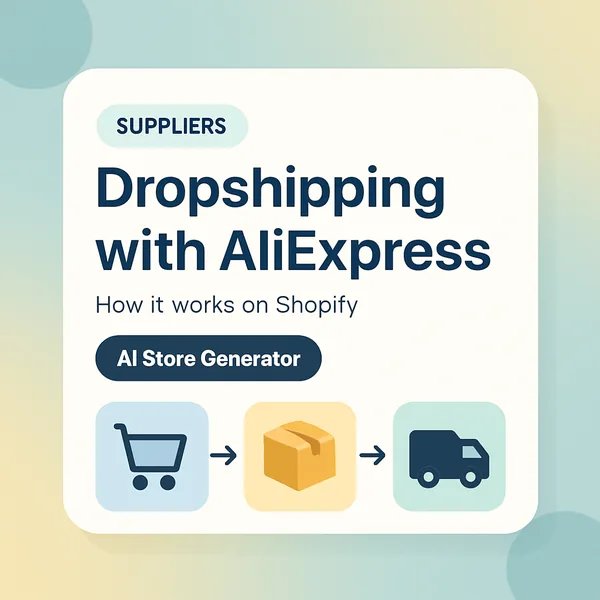
The technical setup is short. You install a connector app (DSers is the official AliExpress dropshipping app), link it to your AliExpress account and your Shopify store, and import products one click at a time. When a customer places an order on Shopify, the order syncs to DSers. You click fulfill, DSers places the order on AliExpress with the customer’s address, and the seller ships the product. Tracking syncs back to Shopify. The customer receives the package with no AliExpress branding if you set the “I do not want any messages or invoices in the package” note (most sellers respect it; some forget).
That is the happy path. The work that decides whether the store survives happens on either side of that workflow: which seller you imported the product from, how the listing reads on your own store, and how you handle the customer when something goes wrong. If the underlying business model is still new to you, dropshipping basics for Shopify covers the bigger picture before drilling into the AliExpress side.
Is AliExpress Safe and Legal?
Yes on both counts. Dropshipping is a legal business model, AliExpress explicitly allows it, and DSers is officially partnered with AliExpress. There is no rule against listing AliExpress products on Shopify at a markup. The legal risk lives elsewhere: counterfeit or branded products, items that infringe a trademark, restricted goods (electronics that need FCC or CE marks, supplements, items with battery shipping rules), and tax compliance for your own country. The rule of thumb is simple. If a product has a logo, a brand name, or a character on it that the seller does not own the rights to, do not import it.
The Real Cost: What’s Left After Every Fee
Most guides quote “50% margins” without doing the math. Here is the line-by-line view for a single $30 product sold on Shopify with paid ads driving the traffic.
| Line item | Amount |
|---|---|
| Customer pays | $30.00 |
| AliExpress product cost | $7.00 |
| AliExpress shipping | $4.00 |
| Shopify payment processing (2.9% + $0.30) | $1.17 |
| Refund and dispute reserve (3%) | $0.90 |
| Ad spend share at $10 CPA | $10.00 |
| What you keep before sales tax | $6.93 |
Just under $7 on a $30 sale is a 23% net margin, which is normal for paid-traffic dropshipping and very different from the “50% margin” headline. The numbers shift quickly. Organic traffic kills the ad line and the net jumps to $16.93. A higher-ticket product with the same fixed costs is much friendlier than a $12 product. A higher refund rate or chargeback hit eats the rest.
Two takeaways. First, AliExpress products under $15 are usually not worth selling unless they come with a much higher retail markup than 2x. Second, the model lives or dies on cheap traffic. Paid ads at $10 CPA only work if average order value clears $25 plus margin.
How to Vet an AliExpress Seller
Most guides say “look for a 95% rating.” That is the bare minimum and almost every active seller passes it. The vetting that actually matters takes ten minutes per product.
- Sort reviews by date and read the last 30. A 98% rating on a listing that has not had a positive review in six months means the rating is old and the seller has slipped.
- Read reviews on the variant you actually plan to sell. A blue version of a product might be flawless. The red version might be the one customers keep returning. Each variant has its own quality story.
- Check the seller’s store badge. “Top Brand” and “AliExpress Choice” sellers have stricter quality controls than no-badge sellers.
- Look for the same product on three or four stores. If multiple AliExpress sellers list identical photos, the lowest-priced one is almost always the original factory and the others are middlemen marking it up. Buy from the original.
- Send a test question through the chat. Ask shipping time to a specific country, or whether they ship without invoices. A real seller replies within 24 hours. A slow seller becomes a slow refund process later.
- Order one sample to your own address. This is the only test that catches photo-versus-product mismatch, real shipping speed, and packaging quality. The cost of one sample is much cheaper than a refund storm on day one of launch.
The broader vetting framework, including the written questions to send any supplier (AliExpress or not) before connecting them to your store, is in the dedicated how to find dropshipping suppliers walkthrough.
Honest Shipping Times by Region
Sellers list optimistic estimates. Customers experience the actual numbers. These are realistic delivery windows from AliExpress to the most common destinations on AliExpress Standard Shipping, which is what DSers picks by default.
| Destination | Realistic delivery window |
|---|---|
| United States | 12 to 25 days |
| United Kingdom | 14 to 28 days |
| European Union | 14 to 30 days (slower post-VAT changes) |
| Canada | 16 to 30 days |
| Australia | 14 to 28 days |
| Brazil | 25 to 60 days |
Paid options like AliExpress Premium Shipping or seller-arranged DHL cut these in half but eat the margin. If you are running paid ads to a US or UK audience, build the wait time into your store policy and your post-purchase email. Surprised customers file chargebacks. Informed customers wait.
Setting Up Shopify and AliExpress With DSers
The end-to-end setup takes one afternoon.
- Open a Shopify store. Pick a clean theme (Dawn, Sense, Refresh) and install the DSers app from the Shopify App Store.
- Connect DSers to your AliExpress account. Use the AliExpress login button inside DSers. This authorises DSers to place orders on your behalf.
- Import products one at a time. Resist the urge to import 200 products. Pick 15 to 30 products you have validated and personally believe in.
- Rewrite every product title and description. AliExpress copy reads like a translation. Your store needs human writing that speaks to one specific buyer.
- Replace the supplier photos where you can. Re-edit them, add a branded background, or build a lifestyle shot. The original photos sit on a thousand other stores.
- Set your shipping policy to reflect real delivery times. The two-line policy most stores ship with is the source of most refund disputes.
- Set a default DSers fulfilment option that hides invoices. This is a checkbox in DSers settings. Without it, the seller may include their own invoice in the package.
- Test the full flow. Place a real order on your store with your own card and DSers credentials. Watch the order flow through DSers to AliExpress, and confirm tracking syncs back. Cancel any test orders cleanly.
If the storefront, collections, and policies are still half-built when you connect DSers, the import step lands on a blank store. AI Store Generator builds the structure, products, and pages first so the supplier connection feels like a final step rather than the start.
Handling Disputes, Refunds, and Late Shipments
This is the part the guides gloss over. When something goes wrong (and on AliExpress it will), the dropshipper sits between two parties: the customer who paid you, and the seller you paid. AliExpress Buyer Protection covers the buyer side of the seller transaction. You as the dropshipper are the “buyer” in AliExpress’s eyes.
The realistic playbook:
- The customer reports a problem. Reply within 24 hours. Ask for a photo or short video. Confirm the order number.
- Open the AliExpress dispute within the 15-day window. Upload the customer’s photo as evidence. AliExpress sides with buyers in clear cases.
- Refund or replace the customer immediately. Do not wait for the AliExpress dispute to resolve. The customer’s relationship is with you, not AliExpress.
- Recover the cost from AliExpress once the dispute resolves. Most disputes are settled within seven days. The refunded money lands back on the card you used.
- Document repeat issues. If a specific seller produces two or more complaints in a month, pause imports from that seller. A small note in your DSers product list saves future headaches.
Late shipments are easier. Send a proactive email at day 10 (US) or day 15 (EU) if the package has not moved, offering a partial refund or a “ship a replacement if it does not arrive by X” promise. Customers who receive a proactive email almost never charge back. Customers who chase you down usually do.
Customer-Communication Templates
Three messages do most of the work.
Order delay (sent at day 10):
“Hi {first_name}, your order #{order_number} is moving through transit. Estimated delivery is between {date_A} and {date_B}. Tracking updates appear at {tracking_link}. If it does not arrive by {date_B}, reply to this email and we will send a replacement at no charge.”
Refund acknowledgement:
“Hi {first_name}, sorry that the product did not work out. Your refund of ${amount} has been processed and will appear in your account within five business days. There is no need to return the item. If anything else comes up, reply to this thread.”
Quality complaint:
“Hi {first_name}, thanks for sending the photo. That is not how the product should arrive. We will refund the order in full today, and you do not need to return the item. We are also flagging the seller so this does not happen to anyone else. Apologies for the experience.”
Save these as canned responses in your support inbox. They will run most of your customer service in the first six months.
The Photo and Brand Risk Most Guides Skip
AliExpress photos are not yours. The seller usually does not own them either; they were lifted from a brand catalogue, a Korean lifestyle account, or another store. Reusing them on Shopify is technically a copyright risk and a Meta Ads risk. Meta has flagged stores for using brand-protected images and pulled the ad account before the store owner could appeal.
The safer path:
- Take your own product photos from the sample order.
- Buy royalty-free lifestyle photos that fit the niche.
- Generate photos with a brand-safe AI image tool.
- Or use only the AliExpress photos that are clearly product-only on white backgrounds, which are less likely to be lifted.
Brand-name products carry the same risk in a worse form. A trademark holder can request that Shopify suspend your store with no warning. If a product on AliExpress has any brand logo, character, or distinctive design, treat it as off limits.
When AliExpress Is the Wrong Choice
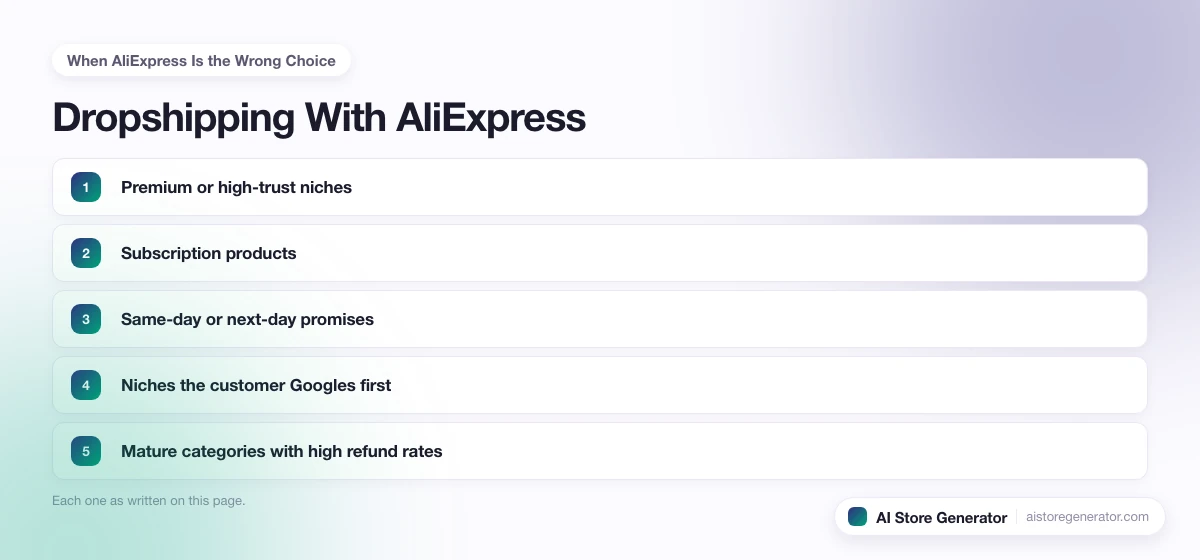
Not every store should source from AliExpress. The cases where the model breaks:
- Premium or high-trust niches. Skincare, supplements, and anything that goes on or in the body. Customers expect a brand story and shorter shipping. AliExpress kills both.
- Subscription products. Recurring billing depends on consistent supplier inventory. A seller going out of stock mid-month wrecks subscribers.
- Same-day or next-day promises. AliExpress cannot deliver on speed.
- Niches the customer Googles first. If a customer is likely to search the product image, they will find the same item on AliExpress for a third of your price. Better to source slightly different products or build your own private listings.
- Mature categories with high refund rates. Apparel sizing, electronics, anything that customers physically try on or test.
For these niches, US-based supplier networks or a private agent in China make more sense. The wider dropshipping suppliers overview compares the four supplier categories and what trades off between them.
When to Migrate Off AliExpress
The standard arc: launch on AliExpress, validate a winning product, then move that product to a private supplier within three to six months. Migration usually happens when one of three things hits.
- Daily orders pass 10 to 15. A private agent quotes a per-product price that beats the AliExpress retail price, often by 30% to 50%. The volume justifies the relationship.
- The shipping time becomes the bottleneck on conversion. A faster supplier doubles repeat purchase rates because the experience finally matches the promise.
- You want custom packaging, an insert card, or a real brand. AliExpress sellers will sometimes do branded packaging, but most will not. A private agent will.
The migration itself is straightforward. Contact a sourcing agent through Alibaba, Yiwu, or a fulfilment service, send them the AliExpress product link, ask for a quote and sample, and switch the DSers SKU to the new supplier address once the sample passes.
Where AI Store Generator Fits
The supplier is one half of a dropshipping store. The other half is the storefront, collection structure, product pages, copy, and SEO setup that turn supplier products into something customers actually want to buy. AliExpress hands you products. It does not build a store.
AI Store Generator builds the Shopify storefront with SEO-first structure, product pages, collections, and policy pages already wired up. You decide the niche and the supplier. The tool removes the weeks of setup work so when DSers imports the first product, it lands on a store that already looks like a real business. Pair that with a properly vetted AliExpress seller and the operating side of the store starts immediately.
Common Beginner Mistakes
- Importing 200 products on day one. A focused 20-product store sells faster than a 200-product store. Quality over feed dumps.
- Trusting product photos. Sample everything you plan to sell. Photos lie.
- Skipping the dispute reserve. Set aside 3% of revenue for refunds, replacements, and chargebacks. Stores without a reserve panic at the first wave.
- Ignoring the shipping note in DSers. Without “no invoice” enabled, the seller may ship the package with their own branded invoice. Customers see it and lose trust.
- Importing branded products. The fastest way to lose a Shopify store is selling counterfeits.
- Selling on price alone. Customers can find the same product on AliExpress. Compete on store experience, niche fit, or brand story.
- Forgetting the post-purchase email. A proactive shipping note prevents most chargebacks.
If the launch path itself is the next gap, the start a dropshipping business on Shopify walkthrough covers the launch sequence step by step.
FAQ
Is AliExpress dropshipping still profitable in 2026?
Yes, but margins are tighter than the marketing pages claim. Profitable AliExpress dropshipping needs a cheap traffic source (organic TikTok, SEO, or content), products with at least a 2x markup, and a strict refund policy. Stores running paid ads on $15 products with $7 product costs rarely break even.
How long does AliExpress shipping actually take?
Typical AliExpress Standard Shipping is 12 to 25 days to the United States, 14 to 30 days to most of Europe, 16 to 30 days to Canada, and 14 to 28 days to Australia. Paid carriers like DHL cut this to under 10 days but cost five to ten dollars more per order.
Which app should I use to dropship from AliExpress to Shopify?
DSers is the official AliExpress dropshipping app and is free for the entry tier. It syncs products, imports listings, and places orders on AliExpress automatically. AutoDS and Zendrop are paid alternatives with more automation and US-warehoused product options.
Do I have to tell my customers I dropship from AliExpress?
No, and most stores do not. Your customer is buying from your Shopify store. The seller behind the scenes is your business. The exception is shipping time. Be honest in your shipping policy. Surprises trigger refunds and chargebacks.
Can I use AliExpress product photos on my Shopify store?
Legally and platform-side, it is grey. Many AliExpress photos were taken from brands, Instagram accounts, or other stores. Using them risks copyright claims and Meta ad account suspensions. Safer to shoot your own from samples, or use clean white-background product shots with brand-safe replacements.
What happens if my AliExpress seller goes out of stock?
DSers will flag the SKU as unavailable. If you have already taken the customer’s payment, you have two options: refund the customer immediately with an apology, or substitute the order to a nearly identical product from another AliExpress seller (only with the customer’s permission). Never silently ship a different product.
Is DSers really free or are there hidden fees?
DSers has a free tier that handles up to three stores and a small number of products and orders per month. Past that, the paid plans start around $20 per month. The free tier is enough to launch and validate a store; paid tiers are for scaling.
Can I dropship branded products like Nike or Apple from AliExpress?
No. AliExpress has counterfeit listings of major brands; selling them on Shopify is a trademark violation and the fastest way to lose your store and payment processor. Stick to generic or unbranded equivalents.
What is the difference between AliExpress and DSers?
AliExpress is the marketplace where the products and sellers live. DSers is the Shopify app that connects your store to AliExpress and automates the order flow. You need both. AliExpress for the products, DSers for the workflow.