
Print on demand can be profitable, but the margin percentage most guides give you will not tell you whether your store is. Depending on whose guide you read, a print on demand tee earns anything from under 10% to 50%. Both ends are honest maths with different assumptions. The number that actually decides it is simpler: the most you can spend to win one sale before that order stops making money. If your sales cost less than that, the store is profitable. If they cost more, no margin figure will save it. This page shows you how to find that number for your own products, and what changes it.
Why the margin answers you have read disagree
Ask “is print on demand profitable” and you get percentages. One guide suggests aiming for about 40%. Another builds a tee from a $12 blank, $4 of shipping and a 50% markup. A third works through a $25 tee sold on Etsy and lands at a little over 8% once fees and marketing come out.
They disagree because they stop counting at different places. The 40% and 50% figures are mostly price against product cost. The 8% figure keeps going and subtracts the cost of getting the customer. That last cost is the one that sinks most stores, and it is the one a margin percentage hides. Even the product-cost figure moves with the size you sell; our guide to print on demand profit margin works it out size by size.
So the useful question is not “what margin should I aim for”. It is “how much is each sale allowed to cost me?”
The number that decides it: what one sale is allowed to cost
Every order leaves you some money after the printer, the shipping and the card fee are paid. Call that what the order leaves behind. It is the ceiling on what you can pay, in ads or anything else, to get that order. Spend less and you keep the difference. Spend more and you paid to make a sale.
Here is an example with round numbers. They are an illustration, not a quote from any supplier, so swap in your own:
| Line | Amount |
|---|---|
| Price the customer pays (free shipping) | $28.00 |
| Blank and print, charged by your provider | $12.00 |
| Shipping, charged by your provider | $5.00 |
| Card processing fee | $1.10 |
| What the order leaves behind | $9.90 |
In this example, $9.90 is the most a sale can cost before the order breaks even. If your ads bring in a buyer for $6, you keep $3.90. If they cost $15 per sale, you lose $5.10 on every tee you sell, and selling more makes it worse.
To find your own figure, take your price, subtract your provider’s product and shipping charge for that item, and subtract your card fee. Your exact card rate depends on your Shopify plan and country; you can see it in your Shopify admin under Settings, then Payments.
Three things that raise the ceiling
Once you see profit this way, the levers become obvious. None of them is “find a cheaper blank”, although that helps a little.
1. Sell more items per order
With most providers, the second item in a parcel ships for less than the first. A customer who buys two tees from the same provider costs you one sale but leaves behind nearly twice as much. Bundles, a matching mug, or a “complete the set” offer at checkout all push the ceiling up without touching your ad cost. This only works if both items come from the same provider; our print on demand suppliers guide explains why mixing providers in one order means paying first-item shipping twice.
2. Get the second order for close to nothing
A first-time buyer usually costs the most to win. A returning buyer, reached by email or because they remembered the store, costs very little. That means the same $9.90 order can lose money the first time and be almost pure profit the second. Stores that make print on demand work tend to have a reason for people to come back: a niche with new designs each month, a group or hobby that buys for events, or gifts that repeat every year.
3. Charge for the design, not the shirt
A plain-looking tee competes on price with every other tee. A design that speaks to a specific group, and that they cannot get in a shop, can carry a higher price. Every extra dollar on the price goes straight to what the order leaves behind, because the blank, the print and the shipping cost the same either way.
When Printify Premium makes you more profitable
Printify’s paid plan is the cost question people ask about most, and Printify’s own pricing page answers it in one line: start free and upgrade only when the discounts outearn the fee. Here is where that line actually falls, using Printify’s prices as listed on 23 October 2026.
- Billed monthly: Premium is from $39 a month, with up to 20% off all products. At the full 20%, you need to spend $195 a month on products before the discount covers the fee.
- Billed yearly: Premium works out from $24.99 a month. At the full 20%, the break-even is $124.95 a month of product spend.
In the example above, a $12 blank at 20% off saves $2.40 per tee. That is 17 tees a month on monthly billing, or 11 on yearly billing, before Premium starts paying you back. Below that, the free plan is the more profitable one. The discount is “up to”, so check what it actually is on your main products before you switch.
The fixed costs of running the store (your Shopify plan, any paid apps, Premium if you take it) sit on top of the per-order maths. Our print on demand business page adds those up and works out how many orders a month cover them.
Signs your store is not profitable yet
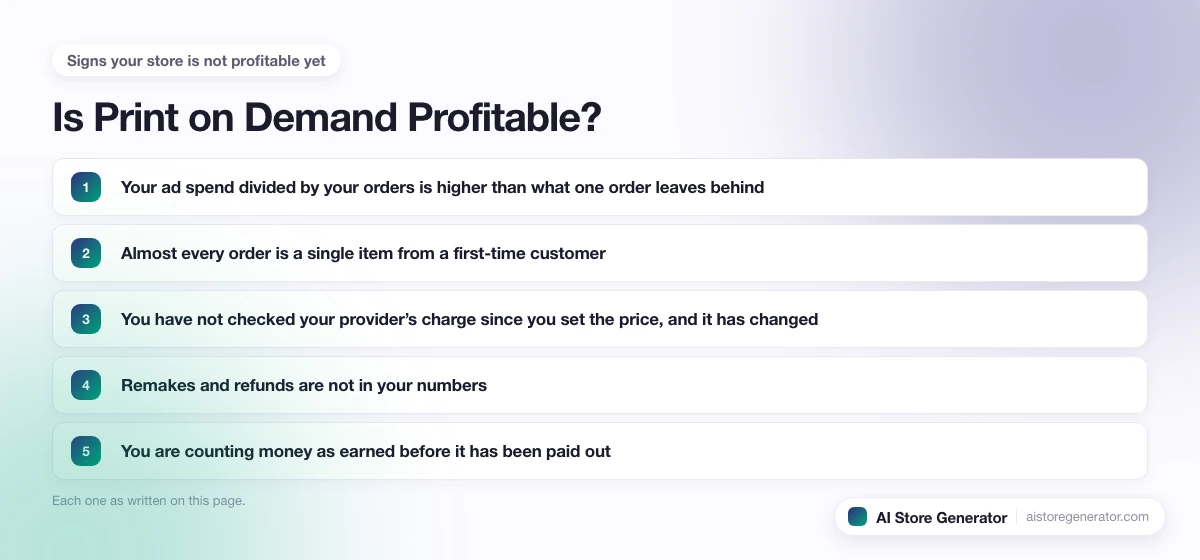
A store can look busy and still be losing money. Watch for these:
- Your ad spend divided by your orders is higher than what one order leaves behind.
- Almost every order is a single item from a first-time customer.
- You have not checked your provider’s charge since you set the price, and it has changed.
- Remakes and refunds are not in your numbers. Our print on demand websites guide covers how to write a returns policy that matches what your printer actually covers, so a wrong-size order does not come out of your pocket.
- You are counting money as earned before it has been paid out. The best print on demand sites page explains the gap between a sale and the money landing in your account.
None of these means the idea is bad. They mean the store has a cost problem you can fix, which is better news than a demand problem.
What we see when we build these stores
We build Shopify print on demand stores, and the pricing conversation almost always starts in the wrong place. People pick a price by looking at what similar shops charge, then ask whether that leaves enough margin. We do it the other way round: start from the provider’s charge for that exact product and shipping, add the card fee, and decide up front how much a sale is allowed to cost. The price comes out of that.
The other thing we no longer leave until later is the second product. A store that launches with one tee design has nothing to add to the cart, so every order is a single item paying full first-item shipping. Giving each design a second product from the same provider costs nothing to set up and is the cheapest margin improvement there is.
So, is print on demand worth it?
It is worth it if you can win sales for less than they leave behind, and if your niche gives people a reason to come back. It is a poor fit if your plan is to sell one generic design to strangers through paid ads alone, because the ceiling on what each sale can cost is usually lower than what cold traffic costs.
The model’s real strength is that testing is cheap. You do not hold stock, so a design that does not sell costs you a listing, not a box of unsold shirts. That makes it a good way to find out what a group will buy before you spend real money on it.
If you want to test a niche quickly, AI Store Generator builds a Shopify print on demand store from your niche and connects Printify, so you can put designs in front of buyers and see what the numbers do. The Shopify print on demand guide walks through each step, our Printful vs Printify comparison helps you choose the provider, and you can start a Shopify store when you are ready.
Frequently Asked Questions
Is print on demand profitable?
Yes, when each sale costs you less to win than the order leaves behind after the printer, shipping and card fee are paid. Work that number out for your main product before you spend anything on ads.
Is print on demand still profitable in 2026?
The basic maths has not changed: you still pay the printer only after a customer orders. What has changed is that more stores compete for the same buyers, so winning a first sale through ads tends to cost more. Stores with a clear niche and repeat buyers are in the best position.
Is print on demand worth it for beginners?
It is one of the cheapest ways to start selling online, because there is no stock to buy. Expect the first few months to be about testing designs and learning your costs rather than earning a steady income. Our guide to how to start print on demand lays out those first weeks in order.
How much do print on demand sellers make?
There is no reliable public figure, and income claims online are usually from people selling a course. What you can know is your own number: what each order leaves behind, times how many orders you get, minus your monthly costs.
What is a good profit margin for print on demand?
Guides suggest anything from about 40% to 50% before marketing. The more useful check is whether what one order leaves behind is higher than what it costs you to get that order.
Is Printify Premium worth it?
Only once your product spend is high enough. At $39 a month and the full 20% discount, you need to spend $195 a month on products to break even, or $124.95 a month if you pay yearly at $24.99 a month.
Is print on demand more profitable than dropshipping?
Not by default. Print on demand products usually cost more per item to make, but a unique design can carry a higher price and is harder to copy. Which one makes more depends on the price you can charge and what a sale costs you to win.
Is print on demand dead?
No. Printify alone lists more than 2,000 products and over 70 print providers, and people still buy custom and niche designs. What has faded is the idea that a generic design and paid ads are enough on their own.