
Most guides to starting print on demand give you the same list: pick a niche, make designs, choose a supplier, build a store, market it. The steps are fine. The order is what costs people time and money. The step that decides whether the business works is holding a printed sample of your own design, and on the most common setups you cannot do that cheaply until your store already exists. So the right way to start is to build the store first, keep it closed, and let the sample decide your price and your launch date. This page lays that out week by week.
Why the usual order trips people up
The standard advice puts the sample somewhere in the middle, or as a tip at the end. Order “one or two samples” while you are choosing a supplier, then go and build your store. That sounds sensible, until you read the providers’ own rules.
Printful gives sample orders a 20% discount, but only to accounts with a connected store. Its help center says the sample option becomes available “starting the next month” after you connect one. Connect your store on the 26th and your first discounted sample opens on the 1st. Printify takes a different line: there are no free or discounted samples at all, and every sample is charged at the regular price.
Neither rule is a problem once you know it. Both are a problem if you follow a list that tells you to sample first and set up later.
The order that works
Here is the sequence we would give a friend starting today. It takes most people three to four weeks, and most of that is waiting for a parcel.
- Pick one product and one buyer. Not a niche list. One product type, one kind of person, one reason they would buy it.
- Choose your print provider. Decide between Printful, Printify or another supplier before you design anything, because print areas and blank brands differ.
- Build the store and keep it closed. Connect the provider so its sample rules start working for you.
- Make three to five designs for that one product. Enough to test, not enough to get attached to.
- Order the sample. On Printful, in the first month your connected store qualifies. On Printify, whenever you are ready, at full price.
- Set your prices from what the sample cost to land. Not from the mockup.
- Open the store with a small catalogue. Then add products as the first ones prove themselves.
Week one: one product, one buyer, one provider
A niche like “dog lovers” is not a decision. “Hoodies for people who run with their dogs at 6am” is. The narrower version tells you what to design, what words to use and where those people spend time online. You can widen later; a store that tries to sell everything to everyone gives a visitor no reason to stay.
Choose the provider in the same week. Our Printful vs Printify comparison covers the differences that matter to your store, and the print on demand suppliers guide explains who actually prints and ships the order behind each app. The sample rules above are one more input: if you want the discounted sample, Printful rewards connecting early. If you would rather pay full price and sample immediately, Printify lets you.
Week one: build the store, but do not open it
This is the step the usual lists push to the end, and it is the one to bring forward. A closed store costs you nothing in reputation. It lets you connect your provider, start the clock on any sample allowance, and get the boring parts done while you design: your domain, your payment settings, your shipping rules, and a returns policy.
That returns policy matters more than it looks. Print on demand providers cover misprints and damage, but not a customer ordering the wrong size. Our print on demand websites page shows how to write a policy that matches what your printer will actually cover.
There is one trade-off. Store platform trials are short, so a store built in week one may be on a paid plan before your first sale. On Printful that cost buys you the discounted sample. On Printify it buys nothing on the sample, so if you are going with Printify you can order the sample first and build the store while the parcel travels.
If you want this part done for you, AI Store Generator builds a Shopify print on demand store from a description of your niche and connects Printify, so the closed store exists in an afternoon. The Shopify print on demand guide walks through each screen. You will need a Shopify account to put the store on.
Week two: the sample, and what it is really for
People think of a sample as a quality check. It is that, but it is also your product photography, your size guide, your delivery estimate and your price, all in one parcel. Treat it as the gate: nothing goes on sale until it has arrived and you have looked at it properly.
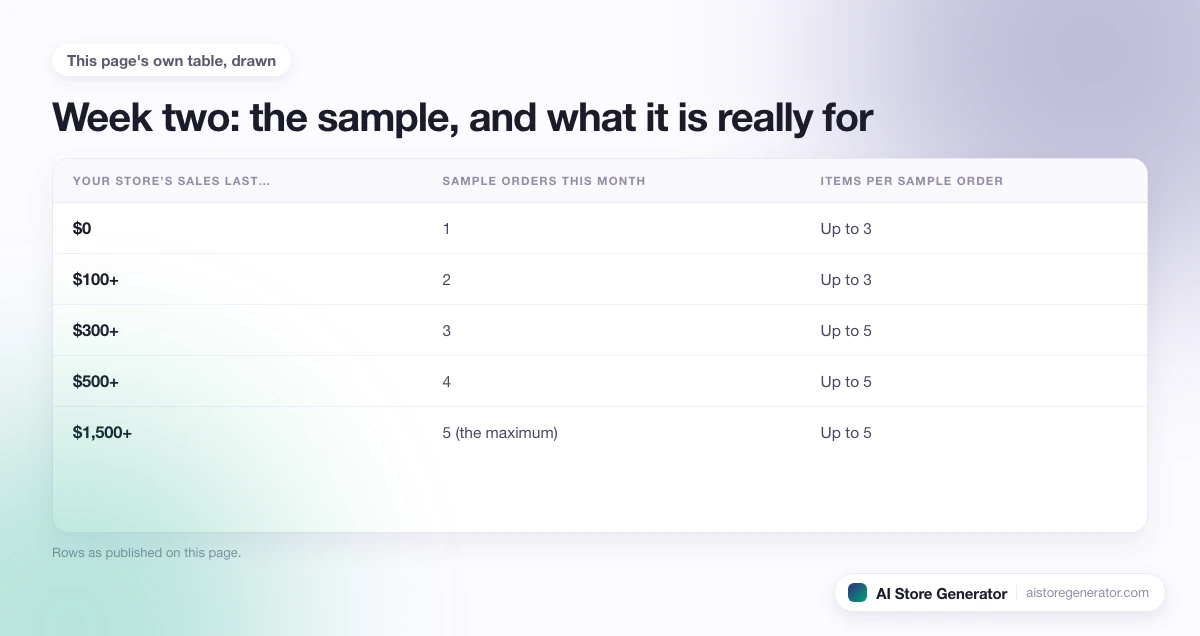
Printful’s allowance grows with your sales, so the first month is the tightest:
| Your store’s sales last month | Sample orders this month | Items per sample order |
|---|---|---|
| $0 | 1 | Up to 3 |
| $100+ | 2 | Up to 3 |
| $300+ | 3 | Up to 5 |
| $500+ | 4 | Up to 5 |
| $1,500+ | 5 (the maximum) | Up to 5 |
Source: Printful Help Center, “How do sample orders work?”, read 26 October 2026. Allowances reset on the 1st of each month (UTC) and unused orders do not carry over.
That first month gives you one order of up to three items. Spend it on your three strongest designs on the one product you picked, not on three different products. Three designs on one hoodie tell you which design sells the product. Three products with one design each tell you very little about any of them.
When it arrives, check these before anything else:
- The print against the mockup. Colors on fabric rarely match the screen. Printify’s own advice is to avoid designs that match the garment color on a sample, because they hide print problems.
- The fit against the size chart. Wear it, wash it once, and measure it again.
- The days it took. Count from the order to the doorstep. That number, not the provider’s estimate, goes on your shipping page.
- What the whole thing cost. Product, shipping and any tax, added up.
One detail for sellers outside the US: Printful notes that customs fees on a sample are based on the retail price you enter when ordering, and suggests setting it to the base price to keep fees down.
Week three: price from the parcel, not the mockup
Your landed cost from the sample is the honest starting point for a price. Our print on demand profit margin guide shows how to turn it into a price for each size you sell. Add what a sale costs you to win, because that is the cost a margin percentage hides. Our page on whether print on demand is profitable shows how to work out the most you can spend to win one sale, and the print on demand business page adds up the monthly costs that sit on top.
If the price you need is more than your buyer will pay, you have learned that before spending anything on ads. Change the product, change the provider, or charge for the design rather than the blank. All three are cheaper now than after launch.
Week four: open small, then grow
Open with the designs that survived the sample, photographed on the real item. A store with six products and real photos looks more trustworthy than one with sixty mockups. Add products in the order your first sales point to: more designs on the product that sells, then a second product for the same buyer.
From month two, a store that has made some sales on Printful gets a bigger sample allowance, so testing new designs gets cheaper exactly when you need it to.
What we see when we build these stores
We build print on demand stores for a living, and the step people most want to skip is the one that costs a few dollars and a week of waiting: holding the sample. The stores that wait for it launch with real photos and a delivery estimate they can stand behind. The ones that skip it tend to find out about a muddy print from a customer instead of from their own kitchen table.
A checklist before you open
- One product type and one clear buyer chosen
- Print provider picked and connected to a closed store
- Domain, payments, shipping rules and returns policy set
- Sample received, worn, washed and measured
- Delivery time counted from your own order
- Prices set from landed cost plus what a sale costs to win
- Product photos taken of the real item
Frequently Asked Questions
How do I start a print on demand business?
Pick one product and one buyer, choose a print provider, build your store and keep it closed, then order a sample of your own design. Set your prices from what the sample cost to reach you, and open with a small catalogue of the designs that passed.
How much does it cost to start print on demand?
There is no stock to buy, so the main costs are your store platform, a domain and your samples. Samples are the part most guides leave out. On Printify they are charged at full price; on Printful, accounts with a connected store get 20% off.
Can I start print on demand with no money?
Not quite. You can avoid buying stock, but you should still pay for at least one sample before you sell, and most store platforms charge a monthly fee after any trial. Budget for those two things and little else.
Do I need a store before I order a print on demand sample?
For Printful’s discounted samples, yes. They are only offered to accounts with a connected store, and the option opens the month after you connect. Printify does not discount samples, so connecting first makes no difference to the price there.
How long does it take to start a print on demand business?
Plan on three to four weeks. Building the store takes a day or two; most of the time is waiting for your sample to be printed and delivered, and that wait is worth it.
What should I sell first?
One product type you would happily wear or use yourself, with three to five designs aimed at one kind of buyer. Narrow beats broad when you are starting, because it tells you exactly what to design and who to show it to.
Is print on demand good for beginners?
Yes, because there is no stock and the provider prints and ships each order. The trade-off is thinner margins per item, so beginners do best when they price from real costs and keep the first catalogue small.