
The honest answer to how much money you need to start dropshipping sits between two bad versions of the truth. One says you can do it free. The other says you need five thousand dollars and a runway. Neither matches how real beginners actually launch a Shopify dropshipping store in 2026. This page lays out four realistic budget tiers, where every dollar goes inside each one, the hidden costs most guides skip, and the simple math that tells you when you have enough.
If you have not committed to the model yet, the dropshipping basics guide is the right place to start. If you already know you want to build, the how to start dropshipping walk-through covers the launch decisions before the spend. For everything beyond the money itself, including accounts, tools, suppliers, and skills, the what you need to start dropshipping checklist breaks it down.
The Short Answer
Most beginners need between $200 and $1,000 to launch a Shopify dropshipping store and run a real first test. Below $200 you can technically open a store, but you will not have enough money to gather meaningful data. Above $1,000 you can move faster, but you are not guaranteed faster results. The right number is the one that matches your traffic plan, not a fixed dollar value someone repeated on YouTube.
Four Realistic Budget Tiers
Pick the tier that matches the traffic plan you can actually commit to, not the one that sounds the most impressive.
Tier 1: $0 to $50 (organic only)
You skip paid ads completely. You use Shopify’s intro trial, a free theme, free supplier app tier, and one organic traffic channel like short-form video, SEO content, or a niche community. You may still pay for a domain if you want a real brand.
This tier works for people with time, patience, and a niche they can show up in. It does not work if you expect sales in week one. Most stores at this tier need two to four months to see the first repeatable sales.
Tier 2: $200 to $500 (lean paid test)
You pay for the basic Shopify plan, a domain, a supplier app, basic email, and a small ad budget of $5 to $10 per day for a few weeks. This is the most common real-world starting tier and it is the cheapest version that gives you actual ad data.
Below $200 you cannot run paid ads long enough to learn anything. At $200 to $500 you can test one product on one channel with enough budget to see signal. For how many products you can realistically test at each budget level, see how many products to start dropshipping with.
Tier 3: $1,000 to $2,000 (proper paid test)
You pay for everything in Tier 2 plus a stronger ad budget of $300 to $500 per month, a paid theme or premium app where it pays back, sample products for photos and quality checks, and a small buffer for refunds and chargebacks. This is the tier most paid-traffic case studies actually start at, even when they describe themselves as “low budget.”
At this level you can test two or three products on one channel, or one product across two channels, with enough budget to make decisions on data rather than guesses.
Tier 4: $3,000 and up (faster paid path)
You pay for full Tier 3, then add scaled ad spend, a paid agency tool stack, branded packaging samples, a logo and assets, and a real cash buffer for payment processor holds and refund waves. This is closer to what an experienced operator spends to open a new store. It is not a beginner-required tier. Spending here as a first-time store owner usually buys speed, not skill.
Where Every Dollar Actually Goes
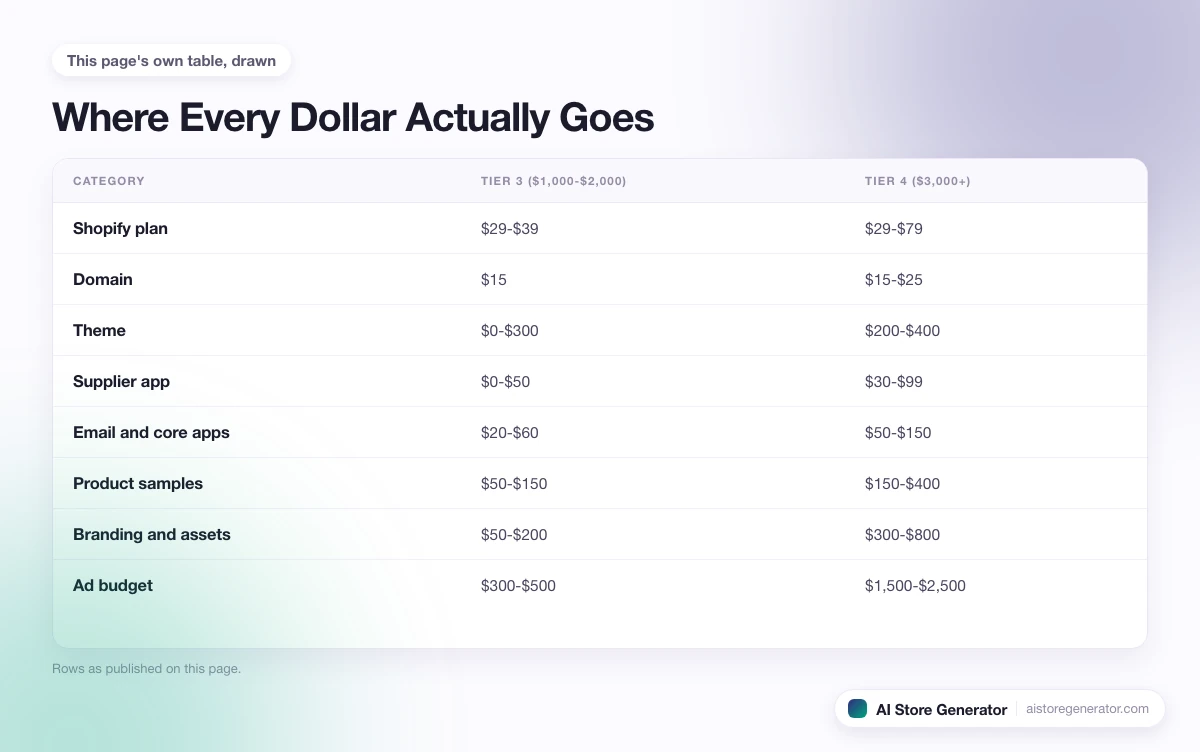
A flat cost list is not very useful without allocation. Here is roughly how the money breaks down inside each tier for the first month.
| Category | Tier 1 ($0-$50) | Tier 2 ($200-$500) | Tier 3 ($1,000-$2,000) | Tier 4 ($3,000+) |
|---|---|---|---|---|
| Shopify plan | $0 (trial) | $29-$39 | $29-$39 | $29-$79 |
| Domain | $0-$15 | $15 | $15 | $15-$25 |
| Theme | $0 | $0 | $0-$300 | $200-$400 |
| Supplier app | $0 | $0-$30 | $0-$50 | $30-$99 |
| Email and core apps | $0 | $0-$30 | $20-$60 | $50-$150 |
| Product samples | $0 | $0-$60 | $50-$150 | $150-$400 |
| Branding and assets | $0 | $0-$30 | $50-$200 | $300-$800 |
| Ad budget | $0 | $100-$300 | $300-$500 | $1,500-$2,500 |
| Buffer for refunds and holds | $0 | $0-$50 | $100-$300 | $500-$1,500 |
The numbers shift inside each tier, but the shape of the spend is what matters: most of Tier 1 is time, most of Tier 2 is platform plus a small ad test, most of Tier 3 is platform plus a real ad test, and most of Tier 4 is ads plus brand.
Hidden Costs Beginners Almost Always Miss
Standard guides list the obvious costs and stop there. These are the ones that quietly drain new stores in the first 60 to 90 days. A deeper look at dropshipping suppliers for Shopify covers what each supplier model actually adds to the monthly bill.
- Payment processor holds. Shopify Payments, Stripe, and PayPal commonly hold a percentage of new-store revenue for 7 to 30 days. If you launch with no cash buffer, an early sales spike can starve your supplier payments and ad spend at the same time.
- Chargebacks and disputes. A handful of chargebacks in the first 90 days is normal. Each one usually carries a $15 to $25 fee on top of the lost revenue. New stores with no buffer get squeezed quickly.
- Return and refund shipping. If you accept returns at all, the customer-facing return shipping is your cost in most setups. Even a 3 to 5 percent return rate adds up.
- Failed ad creatives. Most first ad sets do not work. The losses on the first round are not waste, they are the price of finding the one that does. Budget for two or three rounds, not one.
- App creep. Beginners install $5 here and $10 there until the monthly app bill is $80 to $150. Audit your apps every month.
- Customs and tariffs on supplier shipments. If your supplier ships from outside your customer’s country, customs charges can land on the customer or on you, depending on the terms. Either way it affects the relationship.
- Time you did not bill. The hours you put into the store are real money you are not earning elsewhere. Most guides skip this entirely.
The Cost That Is Not Money: Your Time
Building a real Shopify dropshipping store by hand takes most beginners 40 to 80 hours before the first product page is good enough to put paid traffic in front of. At a conservative $25 per hour of opportunity cost, that is $1,000 to $2,000 of unpaid labor before you have spent a dollar on ads.
This is the number almost no cost guide adds up honestly. It is also the largest hidden cost for any store that is not built with the help of a tool that handles the build phase. If your dollar budget is small but your time is also limited, the math gets harder fast.
How to Know When You Have “Enough”
A simple break-even check tells you whether your budget can carry a real test. Use your own numbers. If you are still gut-checking whether the model can earn at all, is dropshipping profitable walks through the realistic revenue picture, and the dropshipping niches framework covers how niche choice shifts both average order value and margin.
- Pick a target average order value. If you do not know yet, $40 is a reasonable beginner anchor.
- Subtract product cost, shipping, payment fees, app fees, and a returns buffer. What is left is your unit margin. For a $40 product the margin is often $12 to $18.
- Pick a target customer acquisition cost. Beginners on paid ads commonly start in the $15 to $30 range per first-time buyer.
- Divide your ad budget by your acquisition cost. That gives you an estimated number of buyers you can afford to test on.
- Multiply by margin. That gives you your gross profit assuming the test works.
- Compare it to your fixed monthly costs. If you cannot reasonably cover your monthly costs even with a good result, the budget is too thin.
Example: $400 ad budget at $20 acquisition cost is 20 buyers. Twenty buyers at $15 margin is $300 gross profit. After $50 of Shopify and apps, you are at $250 net before any reinvestment. That is a tight but workable lean test. If the same numbers gave you a negative result, the answer is not “spend more.” It is “raise prices, fix margin, or change channel.”
Where AI Store Generator Fits
The biggest hidden cost is the 40 to 80 hours of manual store build. That is the part the AI dropshipping store builder compresses. You describe the store you want and it produces a Shopify dropshipping store with products, product pages, collections, and an SEO-first structure already in place.
In Tier 1 and Tier 2, that means more of your time goes into the parts that actually move the needle: choosing the customer, writing real ad creative, and showing up on one traffic channel. In Tier 3 and Tier 4, it means more of your dollar budget goes into product testing instead of paying someone else to assemble the storefront.
The dollar costs in the table above do not change. The hours behind them do.
Common Mistakes With Starting Budgets
- Spending the whole budget on ads in week one. Without a finished store, the clicks waste themselves on a thin experience.
- Buying a premium theme before launch. Free themes work. Theme spend pays off after you have data, not before.
- Stacking five testing tools that do similar things. One product research tool is enough at the start.
- Skipping the cash buffer. Even $100 to $300 in reserve avoids most week-three crunches.
- Ignoring app subscriptions. A $9 app you forget about for nine months is $81 you cannot get back.
- Adding paid education before earning anything. Free product guidance is enough until your own store gives you specific questions to answer.
Frequently Asked Questions
Can you actually start dropshipping with no money?
Almost no money is more honest. You can start with $0 in cash if you use trial periods and free apps, but you still pay time and you cannot run paid ads. A Tier 1 launch is real, but it is slow and requires a traffic channel you can do for free. For the specific question of what happens at the $100 mark, see can I start Shopify dropshipping with $100?
Is $100 enough to start dropshipping?
It can cover a basic Shopify plan and a domain for the first month, but it does not give you a real ad test. Many beginners try this, run out before the ad data is meaningful, and conclude the model does not work. The model works. The budget was too thin to learn.
How much should you spend on ads in month one?
For a lean Tier 2 test, $100 to $300 in total across the month. For a Tier 3 test, $300 to $500. The absolute number matters less than committing to one channel and one product test for the full window rather than switching every few days.
How long does it take to make the money back?
Most stores do not return their initial spend in month one. A realistic expectation for a focused beginner is 60 to 120 days to a recovered Tier 2 budget and 90 to 180 days for Tier 3. Anyone selling faster results usually omitted ad spend, returns, or fees from their headline number.
What is the cheapest way to start dropshipping on Shopify?
A Tier 1 organic launch with a free theme, a free supplier app tier, and one organic channel you can stick with. Add a $15 domain when you are ready to brand. Skip premium apps, paid education, and ads until your own data gives you a specific reason to add them.
Start With a Real Store, Not a Half-Built One
The cheapest store is not the one that costs $0. It is the one that gets to a real, finished version fast enough that the budget you do spend can actually do its job. The AI dropshipping store builder handles the build phase so the dollars and hours you put in afterward go into the parts only you can do: the niche, the customer, the creative, the traffic, and the day-to-day operations once orders start coming in.