
Most beginner guides give you a 20-item checklist and call it a day. That’s not the real picture. Some of those items are non-negotiable, some are recommended but optional, and some are things people only think they need because a YouTuber said so. This page sorts them out.
By the end you’ll know exactly what you must have on day one to legally take an order and ship it, what you should add as you grow, what you can safely ignore, and what skills you’ll actually use running the business. If you’d rather skip the store-building part entirely, a tool like AI Store Generator builds the storefront for you so you can focus on the rest.
The short answer
The minimum to legally start dropshipping is: a product idea, a supplier you’ve talked to, a place to sell, a way to accept money, and enough cash to test the offer. Everything else is a layer you add on top.
In the US that “way to accept money” usually means a Stripe or PayPal account, which in turn means a tax ID. In the UK and EU you can often start as a sole trader on your existing bank account. The exact paperwork varies by country, but the shape of the list is the same everywhere.
Must-have requirements
These are the items you literally cannot operate without. If any one of these is missing, you can’t take a real order and ship it.
A niche or product category to focus on
A store that sells “everything” sells nothing. You need a defined slice of the market so your ads, your product page copy, and your supplier choice all point in the same direction. The slice can be wide (home gym gear) or narrow (left-handed power tools), but it has to be one slice.
If you’re stuck on what to pick, the dropshipping niches guide walks through how to evaluate demand, margin, and competition before you commit.
At least one supplier you have actually contacted
Browsing AliExpress doesn’t count. You need a supplier who has confirmed they can fulfil orders for you, told you their shipping times by country, and given you a price you can mark up. Ideally you’ve ordered a sample so you know the product matches its photos.
This is the single biggest reason new stores fail in week one: the order comes in, the supplier is out of stock or ships in 45 days, and the chargeback lands a month later. The supplier sourcing guide covers how to vet one properly before you list anything.
An online store
Customers need a place to land and buy. For most beginners this means a Shopify store on a $1-for-three-months trial, but it can also be a WooCommerce site, an Etsy shop with dropship-friendly suppliers, or in some cases an Amazon seller account. The website setup walkthrough covers the technical side step by step.
You don’t need a custom-designed theme or a developer. A clean stock theme with good product photos converts as well as a fancy one for the first hundred orders.
A payment processor
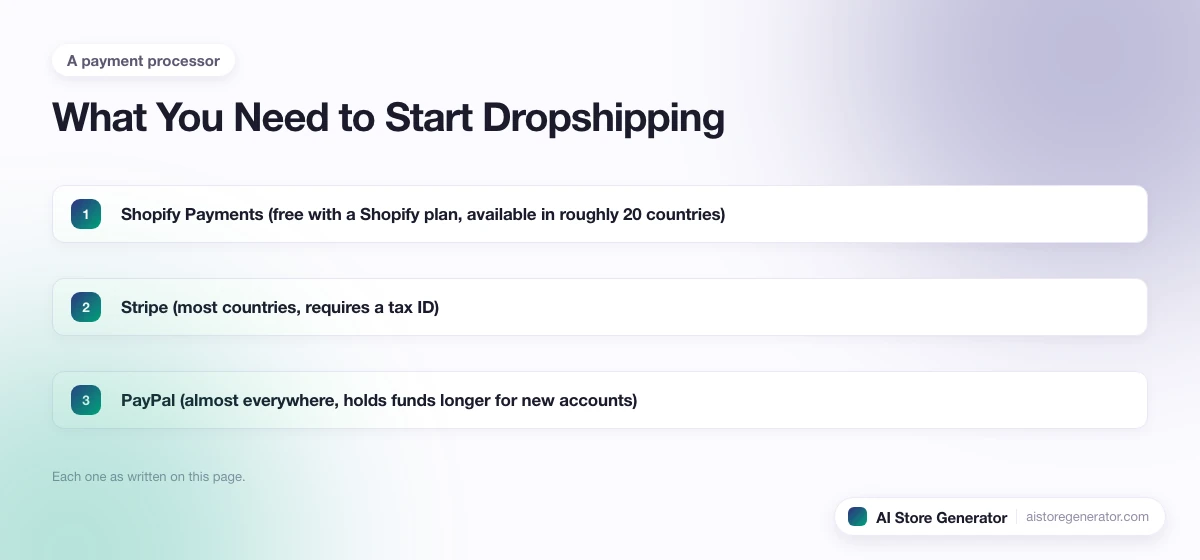
You need somewhere for the money to go. In practice that’s:
- Shopify Payments (free with a Shopify plan, available in roughly 20 countries)
- Stripe (most countries, requires a tax ID)
- PayPal (almost everywhere, holds funds longer for new accounts)
Apply for these the same day you launch, not the day you make your first sale. PayPal in particular often freezes early funds from new sellers for 21 days while they verify the account, and you don’t want that surprise during your first ad campaign.
A starter budget you can afford to lose
Most beginner stores don’t make money in month one. You need cash for the platform fee, the domain, sample orders, and ads to test whether the offer works. A realistic floor in 2026 is $300-$500 for a low-risk test, and $1,000-$2,000 to give the offer a fair shot. The budget breakdown goes through where each dollar goes.
Treat this as a tuition fee, not a guaranteed return. If losing it would change your rent situation, save up first.
Time
Plan for 10-15 hours a week minimum during the launch phase. That covers picking products, writing copy, testing ads, replying to customer emails, and reordering samples. After launch it can drop to 5-7 hours a week if the store is steady, or climb to full-time if you’re scaling.
If your week is already full, be honest about it. A store that gets two hours on Sunday usually stays a hobby.
Should-have requirements
These aren’t strictly required to take your first order, but every serious store has them within the first 30 days. Skip them and you’ll either get blocked by a platform or open yourself to legal risk.
A registered business entity (in most countries)
A US LLC, a UK Ltd, an EU sole trader registration, or the equivalent in your country. This separates business income from personal income, gives you a name to put on contracts, and is usually required to open a business bank account.
Sole proprietorships are the cheapest option and fine for testing, but offer no liability separation. An LLC costs $50-$300 depending on the state and gives you protection. There’s more detail on what’s legally allowed in is dropshipping legal.
A tax ID
In the US that’s an EIN, in the UK a UTR, in the EU a VAT number once you cross the threshold, and so on. Stripe and most B2B suppliers will ask for it. Getting an EIN takes 10 minutes on the IRS site and costs nothing.
A sales tax setup
If you’re selling to customers in the US, you need to collect sales tax in any state where you have nexus (a physical presence, employees, or enough sales volume). Shopify can calculate and collect it automatically once you tell it which states. Many beginners ignore this for the first few months and get a surprise letter later.
A domain you own
A store on your-name.myshopify.com looks like a side project. A real domain ($10-$15 a year) signals legitimacy and improves ad approval rates on Facebook and Google. Buy it on day one even if you launch on a free subdomain first.
Trust pages
Shipping policy, return policy, privacy policy, and contact page. Every payment processor and ad network checks for these. Shopify and most builders give you fillable templates. This takes an afternoon, not a weekend.
Analytics
Google Analytics 4, Meta Pixel if you’re running Facebook ads, and Google Search Console if you want organic traffic. Set these up before you run any traffic, not after. You can’t optimise what you didn’t measure.
Things people think you need but actually don’t
This is where most checklists pad themselves out. The following items get pushed hard by people selling courses, but they’re not requirements for a working dropshipping business.
- A warehouse. Dropshipping means the supplier ships direct to the customer. Owning inventory defeats the model.
- A business loan. If you need to borrow to fund a $500 ad test, the math isn’t working out anyway. Use savings you can absorb losing.
- Hundreds of products at launch. Most successful stores start with 5-20 products and add more as data comes in. The right product count to start with covers the trade-offs.
- Employees. A virtual assistant for customer support makes sense around 50+ orders a day, not before.
- A coding background. Modern store builders are drag-and-drop. If you can use Google Docs, you can build a Shopify store.
- A “winning product” from a paid course. The product that worked for someone else in 2024 is usually saturated by the time it hits the course. Find your own using public data.
- A US bank account if you’re abroad. Most countries have local Stripe support. Services like Wise and Payoneer cover the rest.
- An office or co-working space. Your kitchen table is fine for the first year.
Skills you’ll actually use day to day
Most checklists list tools and accounts, then go quiet on the skills. Here’s what you’ll actually be doing once the store is live:
- Writing short product copy that explains who the product is for and why it solves a problem. Not literary, just clear.
- Reading basic ad metrics. Cost per click, conversion rate, return on ad spend. You don’t need a marketing degree, but you do need to know when an ad is bleeding money.
- Customer service writing. Polite, fast, refund-when-it’s-easier replies. Most stores fail here, not at the product.
- Photo and copy judgement. Picking which of three product photos to put first, which headline to test. There’s no rulebook; you build it from experience.
- Spreadsheet basics. Tracking which products are profitable after ads, refunds, and supplier price changes.
You can learn each of these from free YouTube content as you go. Nobody walks in with all of them.
A realistic minimum bundle
If you want one tight summary of what you actually need to open for business this month, here it is:
- A defined niche
- One vetted supplier with sample in hand
- A Shopify trial (or equivalent)
- A domain
- A Stripe or PayPal account in your name
- An EIN or local tax ID
- Four trust pages filled out
- Google Analytics 4 connected
- $500 in ad budget you can afford to lose
- 10 hours a week for the first 90 days
That’s it. If a guide tells you to buy a $997 course or a list of “winning products” before you have these ten items, the priority is backwards.
Where AI Store Generator fits in
The store itself is the most time-consuming item on the list. Picking a theme, building product pages, writing the trust pages, setting up the checkout, connecting the apps. That’s typically 20-40 hours of work the first time you do it.
AI Store Generator handles that part. You tell it your niche, it builds the storefront, product pages, and policy pages for you, ready to connect a supplier and start testing. The rest of this list (the supplier, the budget, the tax ID, the skills) is still on you, but the technical setup is no longer the bottleneck.
That’s the practical version of what you need to start dropshipping. Get the must-haves, plan for the should-haves, ignore the myths, and start small enough that the first month’s losses are a tuition fee, not a disaster.