
Starting a dropshipping clothing business looks simple until your first customer emails asking to return a hoodie because the sleeves ran short. Apparel is the biggest category in ecommerce, and it also has the highest return rate and the thinnest first-year margins if you set up your store the way most beginner guides suggest.
This page is for someone who wants to sell clothes online without paying for inventory upfront. You do not need a warehouse, a photographer, or a fashion background. You do need a specific customer in mind, one or two vetted suppliers, sizing customers can trust, and honest pricing math. Miss any of those and returns will quietly eat everything.
The short answer
To start a dropshipping clothing business, pick one specific customer, order samples from two or three clothing suppliers before you list a single SKU, build a fast mobile-first Shopify store, price for a 55 to 65 percent gross margin, solve fit with a real size chart and on-body photos, and launch with one hero product instead of a full catalog. Everything else in the process serves those five moves. If your storefront is not built yet, AI Store Generator sets up a Shopify store around your customer in under five minutes so you can spend your first week on samples and photography instead of theme settings.
Is a dropshipping clothing business still worth it in 2026?
Yes, with two caveats.
Fashion and apparel account for roughly a third of the dropshipping market, and the global online apparel market is projected past 760 billion dollars in 2026. Demand is there. What has changed is the margin.
A realistic net margin on a dropshipped clothing store in year one sits between 5 and 15 percent of revenue after product cost, shipping, ads, payment fees, and returns. Gross margin per item lands around 55 to 65 percent if you buy from a supplier with genuine wholesale pricing. Anything less is a supplier selling to retail customers directly, which will cost you the whole margin gap.
Two shifts to know about:
- Competition on general clothing stores is brutal. There are over half a million Shopify stores in apparel already.
- Ad costs have risen, so paid social alone rarely pays for itself in month one.
The stores that still win start narrow, ship a small opening collection, and use organic content and email to keep customer acquisition cost down. If you want the wider view before drilling into apparel, the AI dropshipping store builder guide covers the whole model.
Pick a customer, not a “clothing store”
The single biggest mistake beginners make is opening a “clothing store.” That store competes with Shein, Amazon, and every other generalist. The store that wins picks one customer and dresses only that customer.
A customer segment is more specific than a niche. “Streetwear” is a niche. “23-year-old skaters in the Pacific Northwest who buy oversized graphic tees and hoodies for skate parks” is a customer. When you write copy, choose colors, style your product images, and pick suppliers, you can hold that person in mind and make every decision faster.
Some customer angles with room in 2026:
- Post-partum mothers who want soft fabrics with hidden nursing access
- Adaptive clothing for wheelchair users and people with limited mobility
- Plus-size activewear built for real workout ranges of motion
- Uniform-style workwear for tradespeople who want fewer daily decisions
- Modest fashion for teens and young adults
- Golf and pickleball apparel aimed at over-50 players
- Streetwear built around one subculture, one city, or one music scene
For demand signals across dozens of niches, the dropshipping niches guide is the wider read, and the practical evaluation at is clothing a good niche for dropshipping lays out where apparel rewards specialists and where it punishes generalists.
Vet suppliers by ordering a sample first
You cannot judge clothing quality from photos. Every experienced dropshipper says this in stronger terms after their first return spike. Order a sample from every supplier you shortlist before you list a single product on your storefront.
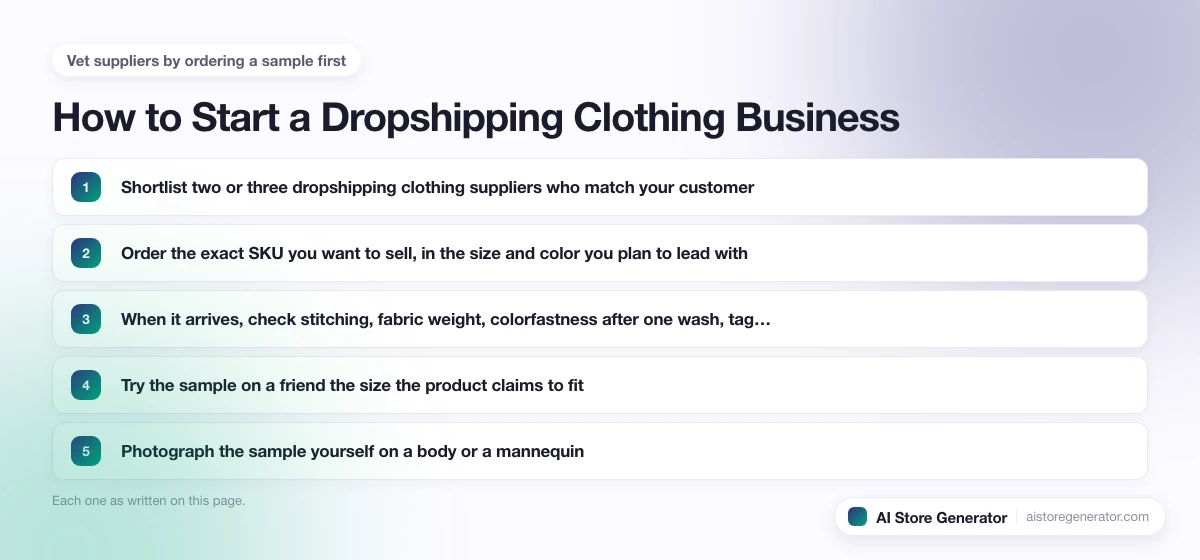
Five steps that separate real suppliers from resellers:
- Shortlist two or three dropshipping clothing suppliers who match your customer. Directories like Zopi, Spocket, DSers, and Trendsi make this easier because their listings are pre-filtered for Shopify integration.
- Order the exact SKU you want to sell, in the size and color you plan to lead with. Keep the sample under 30 dollars.
- When it arrives, check stitching, fabric weight, colorfastness after one wash, tag information, and shipping speed to your zip code.
- Try the sample on a friend the size the product claims to fit. That is your sizing sanity check.
- Photograph the sample yourself on a body or a mannequin. Those original photos are what will separate your store from every other listing running the same supplier stock images.
The wider walkthrough on sourcing and vetting sits at the dropshipping suppliers guide, with the practical checklist covered at how to find dropshipping suppliers.
Build a fast, mobile-first storefront
Fashion buyers shop with their eyes and bounce on slow pages. Over 60 percent of apparel traffic is mobile, and any page above three seconds of load time cuts conversion by nearly half. Two things matter most for a clothing storefront: the theme handles product images cleanly, and the checkout is short.
What to look for in a Shopify theme for apparel:
- Product pages that show swatches, size charts, and reviews above the fold
- Sticky add-to-cart on mobile
- Fast image loading with proper WebP support
- Collection pages that filter by size and color without a full reload
A tip most guides skip: skip the video hero. Clothing shoppers scroll to see product, not a lifestyle reel. A grid of six hero products above the fold beats any autoplay video for conversion.
This is where AI Store Generator shortens the timeline. Instead of hand-building your Shopify store, picking a theme, and writing collection descriptions from scratch, the tool generates a Shopify store in under five minutes with a mobile-optimized theme, SEO-ready product pages, and collection pages already set up around your customer. You still order samples and shoot original photos. The store setup work that usually takes a beginner two weeks compresses into an afternoon. For the domain, payment, and store-settings work that sits alongside the theme, how to set up a dropshipping website covers each step.
Price for a real margin
Clothing dropshipping has a pricing rule beginners break constantly: your first markup covers cost, and your second markup covers ads.
A working formula for apparel:
- Supplier cost times 2.5 to 3 = your retail price
- Aim for a 55 to 65 percent gross margin per unit
- Sweet-spot retail prices sit between 20 and 50 dollars for impulse buys and 60 to 120 dollars for premium items
Worked example on a t-shirt:
- Supplier cost: 12 dollars for the shirt plus 3 dollars for shipping = 15 dollars landed
- Retail price at 2.75x: 42 dollars
- Gross profit per unit: 27 dollars
- Subtract 6 percent payment fees (about 2.50), 4 percent return provision (about 1.70), and 12 dollars in ad cost per acquired customer
- Net profit per unit: roughly 11 dollars
If you price the same shirt at 30 dollars instead, gross profit drops to 15, and after fees, returns, and ads you are losing money on every order. That is the trap that quietly drains new stores in month two. For a fuller breakdown of how ad spend and per-order costs stack up over a launch quarter, how much money you need to start dropshipping has the numbers.
Solve fit before you launch
Fit is where clothing dropshipping stores lose their margin. The typical fashion return rate sits between 20 and 40 percent, and the top return reason is fit. If you cut returns from 30 percent to 15 percent, you double your net profit without changing anything else about your store.
Three practical moves that reduce returns:
- Publish a real size chart. Not the generic S/M/L one from the supplier feed. Measure the sample you ordered and publish inches for chest, length, sleeve, and waist for every size.
- Add a fit description written in customer language. “Runs one size small” and “the arm holes sit high” beats “regular fit” every time.
- Show the model’s height and clothing size in every product photo. A customer who reads “Model is 5’8″ and wearing size M” can predict fit better than any chart.
A more advanced move: install a sizing recommendation app that asks two or three questions and suggests a size. Tools like Kiwi Sizing and True Fit have free tiers and consistently cut returns by 15 percent or more.
Launch with one hero product
New clothing stores fail when they list 200 SKUs on day one and try to spread ad budget across all of them. The stores that win pick one hero product, put the entire launch budget behind it, and only expand once it is profitable.
A hero product launch plan:
- Pick the one item in your sample set that fits best and photographs cleanest
- Write ad copy and organic posts around that single item
- Post 15 to 20 short-form videos on TikTok and Instagram Reels showing the item from every angle
- Run one paid campaign at 20 to 50 dollars per day for 10 days
- Track cost per purchase, add-to-cart rate, and return rate on the hero item only
- When the hero item hits a payback period under 30 days, add a matching second SKU
This is the same launch pattern in the general how to start dropshipping walkthrough, applied to a clothing customer.
Common mistakes new clothing dropshippers make
- Opening a “clothing store” instead of picking a specific customer segment
- Skipping the sample order and finding out about a fit issue after 20 refund requests
- Copying supplier stock photos directly instead of shooting on a real body or mannequin
- Pricing too low to look competitive, then losing money on every sale
- Listing 100 SKUs before validating one
- Ignoring the size chart and hoping customers self-select correctly
- Running paid ads before the product page converts on organic traffic
- Choosing a supplier in a different time zone from your customer without a backup for shipping delays
- Writing a generic FAQ instead of a fit-and-returns policy customers can actually understand
- Waiting for the “perfect” brand identity before shipping the first version
What to do next
Your first two weeks look like this. Confirm your customer segment. Order samples from two suppliers. Shoot original photos of the item that fits best. Write a size chart from your sample measurements. Price for a 60 percent gross margin. Pick one hero SKU and prepare 20 short-form videos around it.
If your storefront is not built yet, AI Store Generator turns your customer and product choice into a Shopify store in under five minutes so you can spend that first fortnight on samples and photography instead of on template settings. For the money side of a launch, payment gateways, and legal setup that sit alongside store building, the start a dropshipping business on Shopify walkthrough covers what to line up before ads go live. And if you are still choosing between potential hero products, how to find products to dropship walks through demand signals for individual SKUs.