
If you have just run into the word “dropship” and it did not come with an explanation, you are in the right place. The word means one specific thing, but it turns up in three very different situations, and the situation changes what you should actually do about it. A guide uses it to describe a way of running a store. A product page you are buying from uses it to warn you about delivery. A supplier uses it to describe an order they will ship on your behalf. Same word, three jobs.
Here is the plain definition, the word forms you will see it in, what it means when you are the shopper rather than the seller, and the phrases suppliers put next to it.
The Short Answer
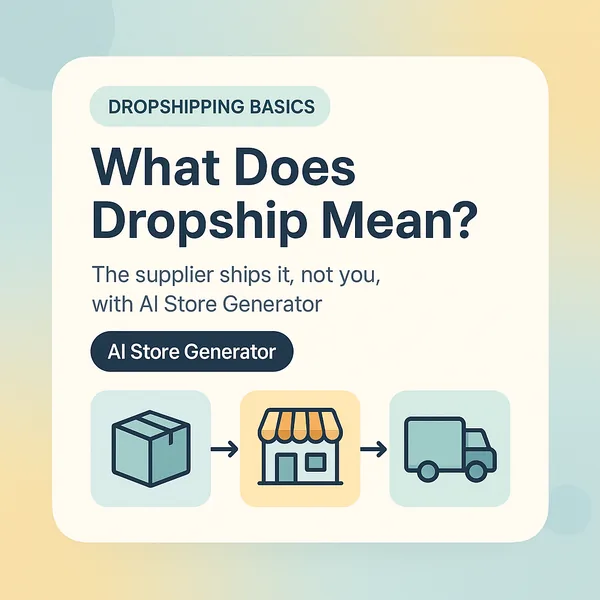
To dropship something means to sell it without ever touching it. The order goes to a supplier, and the supplier ships the item straight to the customer.
That is the whole meaning. One party sells, another party ships, and the box never passes through the seller’s hands.
Everything else on this page is about where you found the word and what it should tell you.
Three Places You Will See the Word
The definition never changes. What changes is who is speaking and what they want you to know.
On a guide or a how-to article
Here “dropship” describes a way of filling orders. The writer means: you run a store, you do not buy stock in advance, and your supplier ships each order as it comes in. That is the sense almost every article on the internet uses, and if you want the full version of it, what is dropshipping walks through the model end to end.
On a product page you are buying from
This one catches people out. Big retailers, furniture stores, tool suppliers and appliance sellers often label an item “drop shipped” or “ships direct from the manufacturer.” They are not telling you about their business model. They are telling you about your delivery.
It usually means the item is not in the store’s own warehouse, so the timeline, the carrier and sometimes the return route are different from the rest of your order. More on what to expect below.
On a supplier site or a purchase order
In wholesale, “drop ship” is the oldest use of the term and it works as an instruction. A buyer places an order and marks it drop ship, which tells the supplier: do not send this to my warehouse, send it to my customer, and put my name on the packing slip.
This is where phrases like “drop ship purchase order” and “drop ship address” come from. The retailer is buying the goods; the customer is receiving them. Ordering software and wholesale portals treat it as a flag on the order rather than a business philosophy.
Dropship, Dropshipping, Dropshipper, Dropshipped
The word bends into several forms, and they are not interchangeable.
| Form | What it is | How it is used |
|---|---|---|
| dropship | verb | “We dropship all oversized items.” |
| dropshipping | the activity, or a describing word | “She started dropshipping in March.” / “a dropshipping store” |
| dropshipped | past tense, or a label on an item | “That order was dropshipped.” / “a dropshipped product” |
| dropshipper | a person or a company | Confusing, because it means the store owner in some sentences and the supplier in others. Ask which one is meant. |
| drop shipment | the single order itself | Common in shipping, accounting and wholesale paperwork. |
The one worth flagging is dropshipper. A store owner will say “I am a dropshipper” and a supplier will say “we are a dropshipper,” and both are using the word correctly. When you see it in a listing or an email, work out from context whether it means the one selling or the one shipping. Getting this backwards is how people end up signing up to the wrong kind of account.
One Word, Two Words, or a Hyphen?
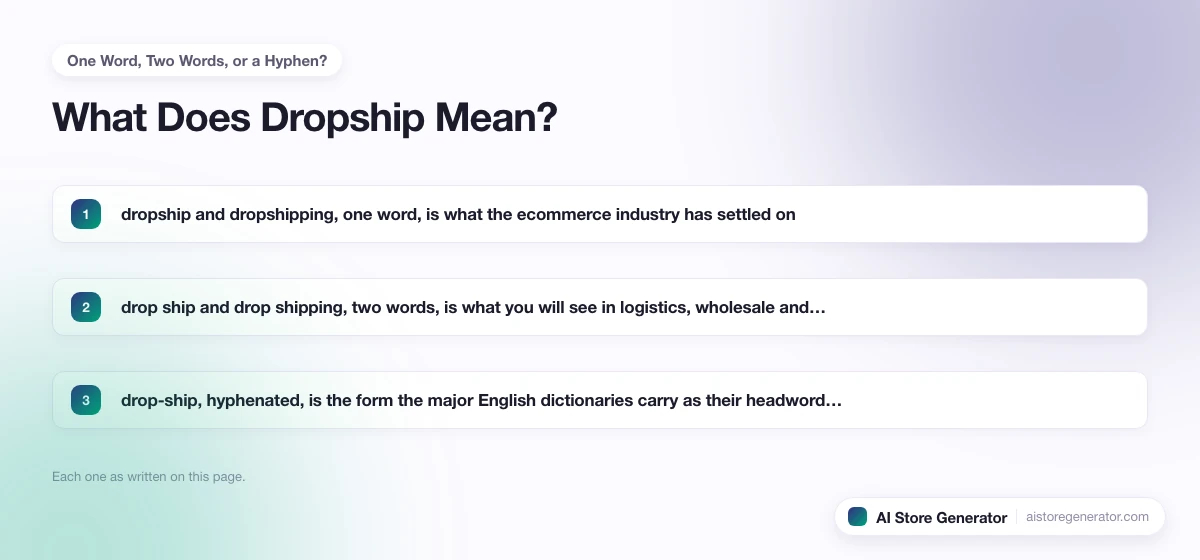
All three spellings are in use and they all mean the same thing:
- dropship and dropshipping, one word, is what the ecommerce industry has settled on. Platforms, apps, supplier directories and almost every article use it.
- drop ship and drop shipping, two words, is what you will see in logistics, wholesale and accounting writing.
- drop-ship, hyphenated, is the form the major English dictionaries carry as their headword, and it shows up in more formal or older trade writing.
None of them are wrong. Pick one word for your own store and be consistent, because mixing spellings inside the same site looks careless to a reader and gives search engines slightly muddier signals to work with. Most stores use the one-word version.
What “Drop Shipped” Means When You Are the Buyer
If you are shopping rather than selling, that label is useful information. Here is what it usually changes, and what to check before you order.
- The delivery estimate is the supplier’s, not the store’s. The item leaves a warehouse the store does not control, so “ships in 2 days” may be counted from when the supplier receives the order rather than from when you paid.
- Your order may arrive in separate shipments. If one item is drop shipped and the rest are in the store’s own stock, expect two deliveries, two tracking numbers, and two arrival dates.
- Tracking can appear late. The number is generated when the supplier creates the label, which can be a day or two after your confirmation email.
- Large items may come by freight, not parcel. Furniture and appliances often arrive on a truck with a delivery appointment, a curbside drop, and no help getting it inside unless you paid for that.
- Returns may go back to the manufacturer. Some stores accept the return themselves, others route it back to the supplier with its own window and restocking terms. This is the one worth reading before you buy, because it is the detail that varies most between stores.
- Questions about the item may take longer to answer. The seller does not have the product in front of them, so anything about the exact model, colour or condition has to go back to the supplier first.
None of this makes a drop-shipped item a bad buy. Plenty of legitimate retailers sell this way for anything bulky or slow-moving, because holding it themselves would be pointless. It simply means you should read the delivery and returns wording rather than assuming it matches the rest of the store.
Supplier Phrases That Sit Next to the Word
When a supplier says they dropship, these are the terms that usually show up in the same paragraph. They decide whether the arrangement is actually worth taking.
- Dropship price. What you pay the supplier per unit when they ship for you. It is often higher than the bulk wholesale price, because you are buying one at a time.
- Dropship fee. A flat per-order charge on top of the item price, covering the pick and pack. Small enough to ignore on a big item, big enough to erase your margin on a cheap one.
- Blind shipping. The parcel carries no trace of the supplier: your name on the packing slip, no invoice inside, sometimes your logo on the label. Worth asking about directly, because a supplier’s own branding turning up in your customer’s box is a bad surprise.
- MOQ, or minimum order quantity. Usually waived for dropship accounts, since the point is single units. If a supplier still insists on an MOQ, they are not really set up for this.
- MAP, or minimum advertised price. The floor the brand will let you advertise at. It caps how aggressively you can discount, so it matters before you plan promotions.
- Dropship agreement or application. Many suppliers gate dropship pricing behind an application, a business name and sometimes a resale document. A supplier who hands out dropship pricing with no questions at all is often a reseller in the middle rather than the source.
The mechanics of how these fit into a live order are covered in how does dropshipping work.
Terms People Mix Up With Dropshipping
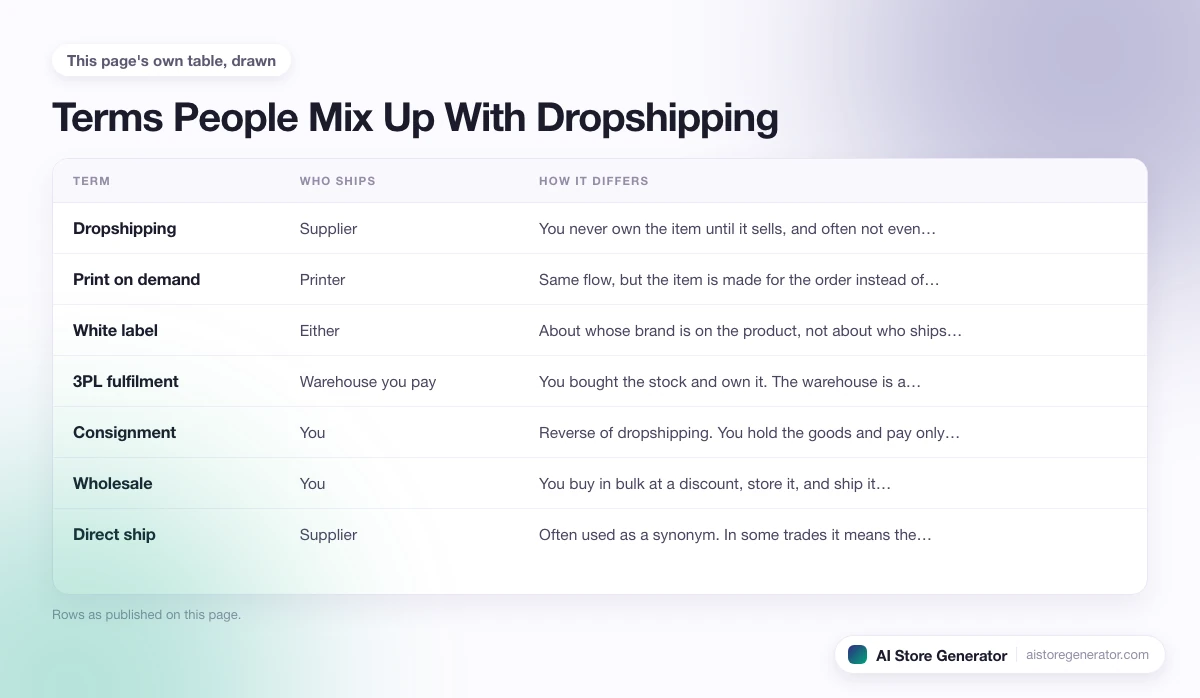
Several arrangements look similar from the outside. The difference is always who owns the stock and who ships it.
| Term | Who holds the stock | Who ships | How it differs |
|---|---|---|---|
| Dropshipping | Supplier | Supplier | You never own the item until it sells, and often not even then. |
| Print on demand | Printer | Printer | Same flow, but the item is made for the order instead of pulled off a shelf. |
| White label | You or the supplier | Either | About whose brand is on the product, not about who ships it. The two often go together. |
| 3PL fulfilment | You | Warehouse you pay | You bought the stock and own it. The warehouse is a service, not a source. |
| Consignment | Supplier | You | Reverse of dropshipping. You hold the goods and pay only once they sell. |
| Wholesale | You | You | You buy in bulk at a discount, store it, and ship it yourself. |
| Direct ship | Supplier | Supplier | Often used as a synonym. In some trades it means the manufacturer ships to a business buyer with no retailer in the middle at all. |
If the comparison you actually want is dropshipping against holding your own stock, ecommerce vs dropshipping puts real numbers on both sides.
What Dropship Does Not Mean
Four things the word gets stretched to cover, when it should not.
It is not a type of business. It is a way of filling orders. A dropshipping store is an ecommerce store, taxed like one, judged by customers like one, and ranked by Google like one. Nothing about the fulfilment method gives it a separate category.
It is not a promise about profit. A supplier saying “we dropship” tells you about logistics. It says nothing about whether the numbers work once you add the item cost, the per-order fee, shipping, payment fees and advertising.
It is not the same as reselling from a retail marketplace. Buying from a consumer marketplace and having it posted to your customer is sometimes described as dropshipping, but it is not a supplier arrangement, and most selling platforms treat it differently in their policies. If that is the route you are considering, read is dropshipping legal first.
It is not a claim about quality. Drop-shipped items run from cheap unbranded goods to serious appliances from named manufacturers. The label tells you where the box comes from, not how good what is inside it is.
One Other Meaning, In Case You Landed Here Sideways
If you searched “dropship” and expected a spacecraft, that meaning is real too. In science fiction and video games a dropship is a vessel that carries troops or vehicles down to a planet’s surface. It has nothing to do with selling anything.
Using the Word in Your Own Store
If you are writing your own product and shipping pages, two practical rules.
First, say what the customer needs to know instead of using the label. “Ships directly from the manufacturer, arrives in 5 to 9 days” is clearer than “this item is dropshipped,” and it removes a question your support inbox would otherwise have to answer.
Second, do not put the word in your store’s marketing copy at all. No shopper is looking for a dropshipping store. They are looking for the product. The word belongs in your supplier emails and your own notes, not on your homepage.
That is also the point where most people stop researching and start building, because the term stops being the hard part. Getting a store that actually looks trustworthy is. AI Store Generator builds the Shopify store around your product idea, with product pages, collections and the SEO structure already in place, so you have something real to edit instead of an empty admin panel. You can see the whole picture on the AI Dropshipping Store Builder page.
FAQ
What does dropship mean in simple terms?
It means selling something you do not have. The customer orders from you, you pass the order to a supplier, and the supplier posts the item straight to the customer. You never handle or store it.
Is dropship the same as dropshipping?
Effectively yes, but they work differently in a sentence. “Dropship” is the verb, as in “we dropship every order.” “Dropshipping” is the activity or the describing word, as in “a dropshipping store.”
What does it mean when a product says it is drop shipped?
That the store does not hold it. The item ships from the manufacturer or a distributor, so the delivery timing, the carrier and sometimes the return route differ from the rest of the store’s catalogue. Check the delivery estimate and the returns wording before ordering.
Is it dropship, drop ship, or drop-ship?
All three are accepted. One word is standard in ecommerce, two words is common in logistics and accounting writing, and the hyphenated form is what the major dictionaries list. Pick one and use it consistently.
What is a dropshipper?
Either the store owner who sells without stock, or the supplier who ships on their behalf. Both uses are correct, which is why it pays to check from context which one somebody means.
What does drop ship mean on a purchase order?
It is an instruction to the supplier: ship this order to the address given rather than to the buyer’s own warehouse. The buyer pays for the goods, the customer receives them, and the paperwork usually shows the buyer as the sender.
Does dropship mean cheap or low quality?
No. It describes where the parcel is posted from, nothing else. Furniture retailers, tool suppliers and appliance sellers all drop ship items from named manufacturers because storing them would make no sense.
What can you actually dropship?
Almost any physical item a supplier is willing to stock and post for you, with a short list of restricted categories that are not worth the risk. What can you dropship covers where the line sits.