
You have a product idea, or maybe a whole category in mind, and you want to know one thing: can you actually dropship it? The short version is that dropshipping works for a huge range of products, but not for everything. If a supplier already stocks an item and it is legal to sell where your buyers live, you can almost certainly dropship it. That covers most physical goods people shop for online, from phone cases to pet beds to kitchen gadgets. Where it breaks down is a specific list of items that are restricted, banned by shipping carriers, or simply too expensive to ship for the margin left over. This guide answers both halves: first, what you can sell, with real categories and examples. Then the part most articles skip, what you cannot or should not dropship, plus a quick test to check any product idea before you build a store around it.
The short answer
You can dropship almost any physical product a supplier is willing to store and ship on your behalf. That is the whole mechanic. You list the product, the customer buys, and the supplier ships it straight to their door. Because you never hold stock yourself, the range of things you can sell is limited mainly by what suppliers carry and what is legal to sell. Many of those suppliers are overseas factories, which is why stores that scale often end up using Alibaba for dropshipping.
Physical products are the core of dropshipping. Print-on-demand items like custom shirts and mugs also work, since a supplier prints and ships each order as it comes in. Digital products and services are a different story, covered further down. If you want a refresher on the mechanics before picking products, what dropshipping is and how dropshipping works lay out the order flow in plain terms. A tool like AI Store Generator builds the Shopify store around whatever you choose to sell, so the product decision becomes the real work instead of the store setup.
The dropshippability test: six checks for any product
Before you commit to a product, run it through six quick checks. Pass all six and it is a strong candidate. Fail two or more and you should think twice or plan for owned inventory instead.
- A supplier already stocks it. Someone has to hold the inventory and ship it for you. If no supplier carries the item, there is nothing to dropship. Checking how to find dropshipping suppliers tells you fast whether a real source exists.
- It ships cheaply and safely. Small, light, and hard to break is the sweet spot. Heavy, bulky, or fragile items rack up freight costs and arrive damaged, which eats your margin and your reviews.
- There is margin room. After the supplier price, shipping, and ad cost, some profit has to be left over. Products with thin spreads are hard to make money on, so it helps to sanity-check the numbers against profitable dropshipping niches before you build a page for it.
- It is legal and unrestricted where your customers live. Some products are banned outright, and others need licenses or paperwork most beginners do not have. The next-to-last section lists the common ones.
- It does not live or die on branding. If the sale depends on premium packaging, an unboxing moment, or a specific brand name, a generic supplier will disappoint buyers. Products judged on function travel better through dropshipping than products judged on presentation.
- Returns will not sink you. Return shipping on a cheap item often costs more than the item is worth. Products with low defect rates and simple use keep refund headaches down.
A product that clears all six is worth testing. One that stumbles on shipping or legality usually is not, no matter how well it sells for someone else.
Product categories that dropship well
Most consumer categories work. The winners tend to be affordable, easy to ship, and useful enough that people buy on impulse. Here are the categories that consistently perform, with examples:
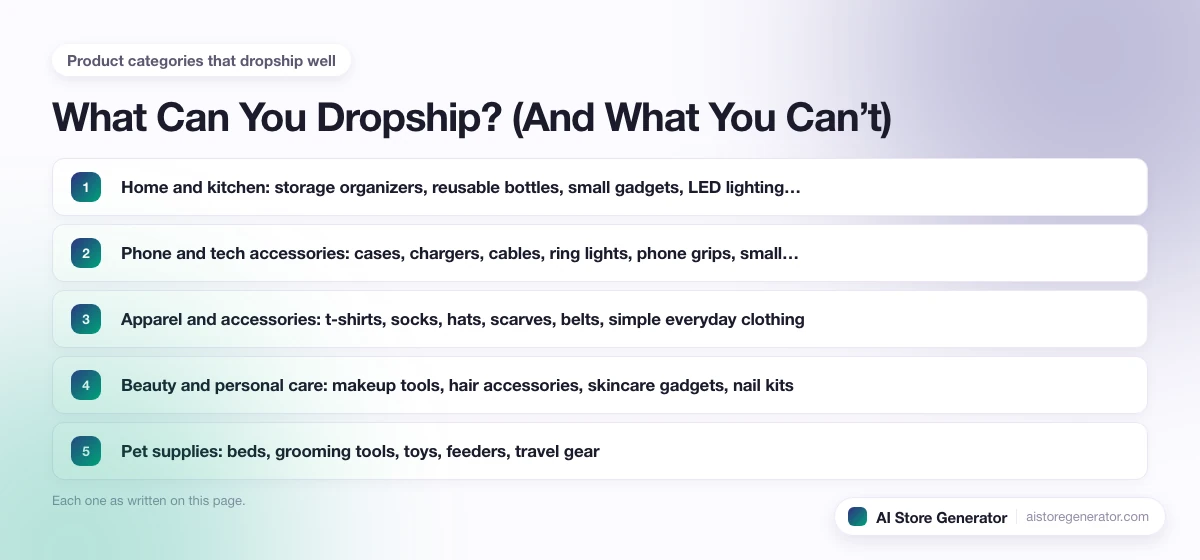
- Home and kitchen: storage organizers, reusable bottles, small gadgets, LED lighting, cleaning tools.
- Phone and tech accessories: cases, chargers, cables, ring lights, phone grips, small speakers.
- Apparel and accessories: t-shirts, socks, hats, scarves, belts, simple everyday clothing.
- Beauty and personal care: makeup tools, hair accessories, skincare gadgets, nail kits.
- Pet supplies: beds, grooming tools, toys, feeders, travel gear.
- Fitness and outdoor: resistance bands, yoga mats, water bottles, small camping gear.
- Baby and kids: teethers, feeding tools, simple toys, nursery accessories.
- Car accessories: phone mounts, organizers, seat covers, cleaning kits.
- Hobby and craft: small tools, kits, supplies for a specific interest.
- Office and desk: organizers, stands, lighting, small stationery items.
If you are still deciding on a direction, the dropshipping niches guide walks through how to pick one, and the best dropshipping niches shows which categories have room to grow. Picking a lane beats listing random products across ten unrelated categories.
Can you dropship digital products, print-on-demand, or services?
This is where the word “dropship” gets stretched, so it helps to be precise. If the term itself is new to you, what does dropship mean covers the forms it takes and where each one shows up.
Print-on-demand: yes
Print-on-demand is a form of dropshipping. A supplier prints your design onto a shirt, mug, poster, or phone case only after a customer orders, then ships it directly. You hold no stock and pay nothing until a sale happens. It suits designs, slogans, and niche art, and it works cleanly on Shopify.
Digital products: not really dropshipping
Ebooks, templates, presets, and printables sell with zero inventory, but no supplier ships a box, so this is not dropshipping in the usual sense. It is its own model with instant delivery and near-total margin. If a digital product is what you want to sell, you can, it is just filed under a different label.
Services: no
You cannot dropship a service. Consulting, coaching, and done-for-you work all require a person to deliver them. There is no supplier to route the order to, so the dropshipping model does not apply.
What you can’t (or shouldn’t) dropship
Here is the part the “best products” lists leave out. Some items are restricted, banned by carriers, or blocked by payment processors and ad platforms. Others are legal but a poor fit for the model. Treat this as a checklist of trouble before you fall in love with a product.
- Counterfeit or unauthorized branded goods. Generic “Nike” shoes or “Apple” chargers from an overseas marketplace are usually fakes, and selling them invites takedowns and legal action. Selling genuine branded products often needs authorization you will not have. Whether dropshipping is legal has a longer answer than most people expect, and trademarks are a big part of it.
- Prescription drugs, medical devices, supplements, and CBD. These are tightly regulated, and suppliers rarely provide the compliance paperwork you would need. High risk for a beginner.
- Hazardous materials and certain batteries. Flammables, aerosols, and some lithium batteries face carrier shipping bans and special handling rules. Many will not ship by air at all.
- Perishable food and fresh goods. Long shipping times and no cold chain mean spoilage. Shelf-stable packaged items are a different, safer story.
- Weapons, ammunition, and realistic replicas. Banned on most selling platforms and subject to licensing and local law.
- Alcohol, tobacco, and vaping products. Licensing, age verification, and payment processor restrictions make these off-limits for a standard store.
- Adult products. Many payment processors and ad platforms restrict or block them, which cuts off your ability to charge customers and advertise.
- Live animals and plants. Shipping welfare and agricultural rules make these impractical and often illegal to send.
- High-value, heavy, fragile, or oversized items. Not illegal, but international dropship shipping costs, damage rates, and return logistics usually break the math. Furniture and appliances are better handled with owned inventory or a domestic warehouse.
- Recalled or unsafe products. Selling these exposes you to liability, and platforms remove them quickly.
Before listing anything in a gray area, check the rules that actually apply to you: your selling platform’s policy, your payment processor’s terms, and the laws in the countries you ship to. The dropshipping business setup guide covers the paperwork and compliance side so you do not learn these limits the hard way.
Where AI Store Generator fits
Once you know what you can sell, the next hurdle is building a store that turns visitors into buyers. That means product pages with real specs and buying-decision content, collection pages both shoppers and Google can read, category structure, SEO markup, fast mobile pages, and trust signals that make cold traffic convert. Building all of that by hand takes weeks, and the SEO side is where most first-time store owners stall.
AI Store Generator builds that store in under five minutes: a full Shopify store with products, SEO-optimized product pages, collection pages, and ready-to-sell pages. You still choose the products, run the ads, and handle customer service. What gets removed is the slow, technical part, so the product decision you made above is the thing you spend your time on, not wrestling with store setup.
How to decide what to actually sell
“What can I dropship” is the easy question. “What should I dropship” is the one that makes money. Almost everything on the allowed list is available to you, which means the real skill is narrowing down, not opening up.
A simple order of operations helps:
- Pick a category you can build a small collection around, not one-off random products.
- Run each product idea through the six-check test above.
- Confirm a real supplier stocks it at a price that leaves margin.
- Validate demand before you bulk up, using research from how to find products to dropship.
If any of the fundamentals here are still fuzzy, dropshipping basics for Shopify covers the groundwork before you commit. When you are ready to turn a product list into a real store, build your Shopify store with AI Store Generator and start selling what you picked.
FAQ
What is the easiest thing to dropship?
Small, light, affordable products with broad appeal are easiest, since they ship cheaply and rarely arrive damaged. Phone accessories, kitchen gadgets, and simple pet supplies are common starting points. The goal is low shipping risk and enough margin to cover ads.
Can you dropship anything you want?
Almost, but not quite. You can dropship most legal physical products a supplier will ship, but counterfeit goods, regulated items, hazardous materials, and a handful of restricted categories are off the table. Passing the six-check test is a faster way to decide than guessing.
What products are not allowed for dropshipping?
Counterfeit and unauthorized branded goods, prescription drugs, supplements and CBD, weapons, alcohol, tobacco and vapes, adult products, hazardous materials, perishable food, and live animals are the common ones. Platform policies and payment processor terms add their own limits, so check both before listing anything borderline.
Can you dropship brand-name products?
Only with authorization from the brand or an approved distributor. The cheap “branded” items on overseas marketplaces are usually counterfeit, and selling them risks takedowns and legal trouble. Most beginners are safer with generic or unbranded products.
Can you dropship food or supplements?
Shelf-stable packaged snacks are possible with the right supplier, but fresh or perishable food is impractical because of shipping time and spoilage. Supplements and CBD are heavily regulated and best avoided unless you have the compliance side handled.
Can you dropship digital products?
You can sell digital products like ebooks and templates with zero inventory, but that is not technically dropshipping since no supplier ships anything. It is a separate zero-inventory model with instant delivery and very high margins.
What sells best for dropshipping beginners?
Impulse-friendly products under about $40 in home, kitchen, tech accessories, and pet categories tend to work well for newcomers. They are cheap to test, easy to ship, and simple to advertise. Start narrow, prove the sales, then expand the range.